"Solar battery" supplies hydrogen from solar energy at the touch of a button
Copolymer enables flexible use of energy over time
Advertisement


Storing energy from sunlight and converting it into hydrogen days later is what a new material jointly developed by researchers from Ulm and Jena can do - even in the dark. The process is reversible and can be reactivated several times using a pH switch. The results were published in the journal Nature Communications.
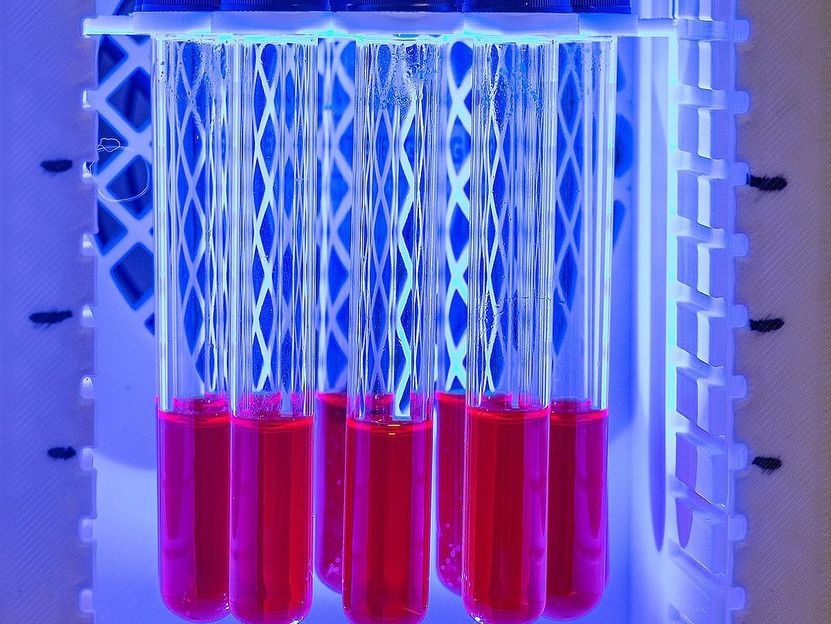
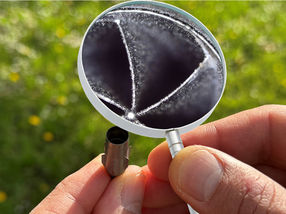
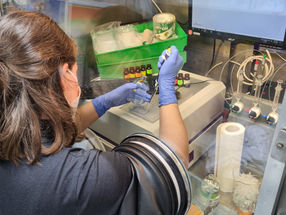
Catalyst solutions with luminescent ruthenium dye, which are irradiated with visible light in the reactor
Elvira Eberhardt / Ulm University)
Green hydrogen is one of the most important pillars of the energy transition. It is produced from sunlight using photocatalytic processes. There are now a variety of technologies for converting and storing solar energy into chemical energy. But now, for the first time, a material has been successfully developed that can store the energy from sunlight for several days and then release it in the form of hydrogen "at the push of a button". "You can think of it as a combination of a solar cell and a battery at the molecular level," explains Professor Sven Rau, who heads the Institute of Inorganic Chemistry I at Ulm University.
A water-soluble, redox-active copolymer is used as a material for temporary energy or electron storage. Copolymers are macromolecules that consist of different organic building blocks. They form a stable framework and have been equipped with functional units that have certain chemical-physical properties - in this case a reinforced redox activity. The system developed by the researchers from Ulm and Jena achieves a charging efficiency of over 80 per cent and maintains this state for several days. "When required, we can retrieve the chemical energy in the form of hydrogen. The stored electrons are used efficiently for this purpose," says Professor Ulrich S. Schubert, Head of the Institute of Organic Chemistry and Macromolecular Chemistry at Friedrich Schiller University Jena, who coordinated the study together with Rau. By adding an acid and a hydrogen evolution catalyst, the electrons stored in the polymer are combined with protons - this process produces hydrogen "on demand". The efficiency is astonishingly high at 72 per cent. Another great advantage is that this process also takes place in the dark, i.e. regardless of whether the sun is shining.
Restarting the system with a pH switch
If the solution is subsequently neutralised, the system can be exposed to light again and recharged. "This is because the polymer-based redox reactions are reversible and enable multiple charging, storage and catalysis cycles. The benefit of the process is that the polymer does not have to be isolated first. To reset the system, the pH value of the system simply has to be changed," explain the two lead authors of the study, Marco Hartkorn (Ulm University) and Dr Robin Kampes (FSU Jena). The pH switch not only has a practical side, but also a beautiful one: when the battery is discharged in the presence of acid, the colour changes from violet to yellow; if it is then recharged with light, the yellow turns to violet and the battery is "armed" again.
New paths with an industrial perspective
"The project is also of scientific significance because it combines very different concepts from the field of chemistry that otherwise have few points of contact: namely macromolecular polymer chemistry and photocatalysis," says Professor Sven Rau. The researchers are firmly convinced that such methods for so-called "on-demand" hydrogen development could also be used for energy-intensive industrial processes - for example for climate-neutral steel production, which relies on a reliable supply of green hydrogen. "The results open up new perspectives for cost-effective, scalable solar storage technologies - and provide an important building block on the way to a sustainable, chemical-based energy economy," emphasises Professor Ulrich Schubert. The project, in which researchers from the Leibniz Institute of Photonic Technology in Jena were also involved, was carried out as part of the joint Collaborative Research Centre TRR/SFB 234 "CataLight" of the Ulm University and the University of Jena.
Original publication
Marco Hartkorn, Robin Kampes, Felix Müller, Linda Zedler, Akuila Edwards, Philip Rohland, Alexander K. Mengele, Stefan Zechel, Martin D. Hager, Benjamin Dietzek-Ivanšić, Michael Schmitt, Jürgen Popp, Ulrich S. Schubert, Sven Rau; "A water-soluble copolymer for storage and electron conversion in photocatalytic on-demand hydrogen evolution"; Nature Communications, Volume 17, 2026-1-28


Other news from the department science