Inkjet printing fabrication paves way for practical perovskite solar cell production
New approach could offer scalable production of high-efficiency solar cells
Advertisement


Researchers from Karlsruhe Institute of Technology have developed a new fabrication technique based on inkjet printing that could enable fast, efficient and scalable production of perovskite solar cells.

pruzi/ Pixabay
Perovskite semiconductors are a very promising material for solar cells because they absorb light and convert it to energy with better efficiency and potentially lower production costs than the silicon used now. However, more work is needed to achieve practical industrial-scale manufacturing of perovskite solar cells.
Helge Eggers, doctoral student in the research group of Dr. Ulrich W. Paetzold from Karlsruhe Institute of Technology, will present the new ink-jet printing approach at The Optical Society (OSA) 2020 Advanced Photonics Congress, an all-virtual meeting held 13-16 July.
Inkjet printing is a scalable and material efficient deposition method for solution-based materials that allows to easily adjust the printing patterns.
"Developing a well-working inkjet printing process for the fabrication of perovskite solar cells could not only enable low-cost mass production, but would also offer to easily modify the printed design based on digital image files opening up the market for individually customized solar cells," said Eggers.
The research group shows that the new technique can produce solar cells that convert light to power with efficiencies that come close to those achieved with less-scalable fabrication methods. Because their approach could be used to print arbitrary patterns, it could also be useful for printing solar cells onto materials used to turn skylights and building facades into sources of power.
Optimized inkjet printing
The researchers began by using their new approach to create solar cells with an inkjet-printed perovskite absorber layer. Their key achievements were the development of an optimized ink and fabrication process based on vacuum drying. This process allows for a preferable crystallization pattern of the perovskite material with micrometer-large columnar grains. The solar cells exhibited a power conversion efficiency of more than 20 percent, which the authors say is the highest conversion efficiency reported for partially ink-jet printed perovskite solar cells. This result helps close the performance gap with state-of the-art spin-coated perovskite solar cells, which have an efficiency around 25 percent.
They then went one step further by creating perovskite solar cells with inkjet-printed absorber and extraction layers. These solar cells exhibited a power conversion efficiency of more than 17 percent. They also showed that their optimized ink formulation could create millimeter-scale structures by printing detailed portraits of some of the authors.
Although these results are an important step towards the development of scalable perovskite solar cells, there are still key challenges to overcome.
"At the moment we are still processing solar cells on lab scale. Upscaling inkjet-printed perovskite photovoltaics to large areas is an ongoing effort," said Ulrich W. Paetzold, group leader of the Perovskite Taskforce at Karlsruhe Institute of Technology. "For this, we team up with our industrial partners in the field."
Inkjet-printed electrodes are under investigation by the group. In addition, the group is still optimizing the quality and reproducibility of the developed inkjet-printing process, since even small changes in homogeneity of the printed film can have a huge influence on the performance of the solar cell.


Other news from the department science





















Most read news












More news from our other portals

























Last viewed contents
Chromium replaces rare and expensive noble metals

From CO2 to acetaldehyde: Towards greener industrial chemistry - This breakthrough tackles two environmental issues at once
BASF Coatings starts operations at production site for paints in Russia
TU Graz develops mobile device for the high-precision measurement of air pollutants - A device the size of a moving box can detect traces of toxic gases from miles away
Search for new semiconductors heats up with gallium oxide
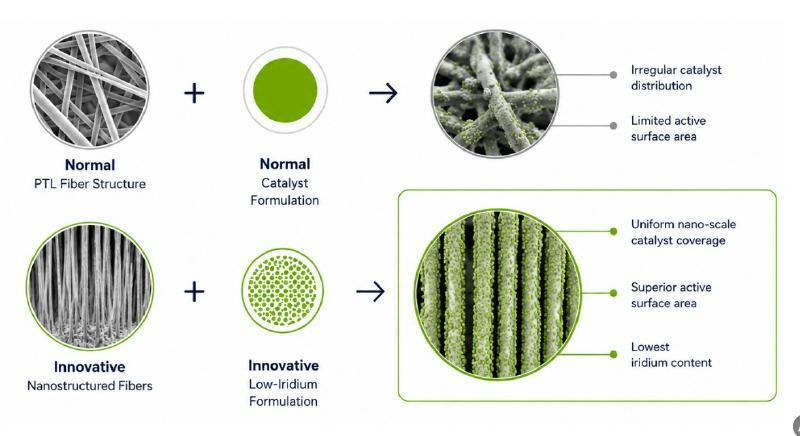
Smoltek Hydrogen and Heraeus Precious Metals advance next-generation ultra-low iridium electrolysis technology

Chemistry without detours: Researchers introduce a two-step process for producing phosphorus-containing chemicals - This promising innovation not only contributes to environmental protection but also saves significant time and costs

Evidence stacks up for poisonous books containing toxic dyes

Adhesives from waste wood, biofuel from straw - EU research project on the potential of agroforestry waste as environmentally friendly raw materials completed

Computational trick enables better understanding of exotic state of matter - New process relevant for fusion and materials research

Pushing boundaries: Detecting the anomalous Hall effect without magnetization in a new class of materials - The first experimental evidence for the anomalous Hall effect emerging in a collinear antiferromagnet with non-Fermi liquid behavior