Biodiesel made from discarded cardboard boxes
Development of a microorganism that doubles the yield of biodiesel precursor production using genetic scissors and based on the principles of evolution
Advertisement


Automobile exhaust emitted by fossil-fuel-based vehicles, especially those operating on diesel, is known to be a major source of fine dust and greenhouse gases. Using biodiesel instead of diesel is an effective way of coping with climate change caused by greenhouse gases while reducing fine dust emission. However, the current method of producing biodiesel by chemically processing vegetable oil or waste cooking oil-such as palm or soybean oil-is limited because of the unreliable availability of raw materials.
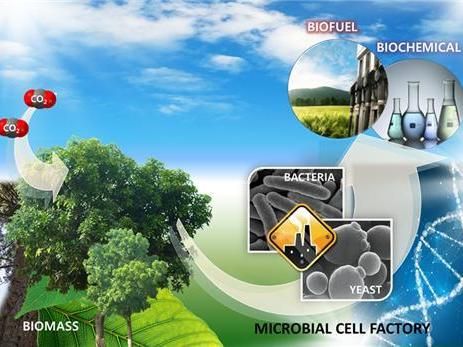
Conceptual diagram for producing biofuels using microorganisms as raw materials for wood-based biomass
Korea Institue of Science and Technology (KIST)
Therefore, there is an active effort to develop biofuels by converting lignocellulosic biomass generated as a by-product of farming or logging, instead of consuming raw materials derived from food crops. Lignocellulosic biomass is an economical and sustainable raw material that can be converted to eco-friendly motor fuel through microbial metabolism.
Dr. Sun-Mi Lee and her team at the Clean Energy Research Center of the Korea Institute of Science and Technology (KIST) have announced that they have developed a novel microorganism capable of producing biodiesel precursors from lignocellulosic biomass such as discarded agricultural by-products, waste paper, and cardboard boxes. This microorganism has achieved the product yield twice of what was obtainable from its predecessors.
This novel microorganism can produce biodiesel precursors during the process of metabolizing sugars contained in the lignocellulosic biomass that it feeds on. The sugar contained in lignocellulosic biomass is generally composed of 65-70% glucose and 30-35% xylose. While microorganisms that exist in nature are effective in producing diesel precursors by metabolizing glucose, they do not feed on xylose, thus limiting the yield of the raw materials.
To solve this problem, the KIST research team developed a new microorganism that can produce diesel precursors by effectively metabolizing xylose as well as glucose. In particular, the metabolic pathway of the microorganism was redesigned using genetic scissors to prevent interference with the supply of coenzymes essential for producing diesel precursors. The ability to metabolize xylose was improved by effectively controlling the process of evolution in a laboratory, for instance, by selecting and cultivating only those microorganisms that delivered excellent performance.
This confirmed the possibility of producing diesel precursors using all sugar components including xylose from lignocellulosic biomass, and the product yield was almost doubled, compared to that obtained in previous studies which employed metabolic pathways having unresolved coenzyme issues.
"Biodiesel is an effective alternative fuel that can reduce greenhouse gas and fine dust emissions without restricting the operation of existing diesel-fueled vehicles, and we developed a core technology that can improve the economic efficiency of biodiesel production," said Dr. Sun-Mi Lee of KIST. "At a time like this, when we feel climate change in our bones due to frequent typhoons and severe weather phenomena, expanded supply of biofuels that help us cope with climate change most quickly and effectively will facilitate the expansion of related industries and the development of technology."
Original publication



Other news from the department science




















These products might interest you

Most read news












More news from our other portals

























Last viewed contents

Breakthrough for efficient and high-speed spintronic devices - New soft X-ray source could be used for many applications in physics, chemistry, and biology

Keep safe and cool in the pool - Novel chip sensor quickly and continuously does all the work of a chemistry laboratory

“Dictionaries” make fluorescence-based data for integrative structure models and their dynamics accessible - 3D structures of biomolecules

PSL - Powder Systems Limited - Liverpool, United Kingdom
Significant progress achieved in chemical liquid analysis - ISFET-based pH sensor-control successfully miniaturized and optimized for easy use

From research to spinoff - PSI Founder Fellowship supports two spin-off projects: AI platform and solid-state batteries
Waste Becomes Recyclable Material - New Process Turns Urine and Ash into Sustainable Raw Materials
Stora Enso announces startups selected for its second Accelerator Programme

Scientists develop new thermofluidic process for lab-on-a-chip applications - This will unlock groundbreaking solutions for nanotechnology, the manipulation of liquids in systems in tiny spaces, or in the field of diagnostics

Breakthrough process for directly converting methane to methanol

Discovering new field affecting metals solidification