Scientists have developed fluorophores that are 2.4 to 20 times more intense than analogues
The new material will help improve displays on smartphones, computers, and televisions
Advertisement


Scientists have developed, synthesized, and studied a series of new fluorophores, a luminous chemical compound. These are the new cyanopyrazine-based bullet systems. Studies have shown that the presence of cyanogroup substance in the composition of fluorophores significantly increases the efficiency of organic light-emitting diodes (OLED). This means that they can be used for create new materials to enhance the brightness of displays on smartphones, computers, and televisions. An article describing the research and its results was published in the journal Dyes and Pigments.

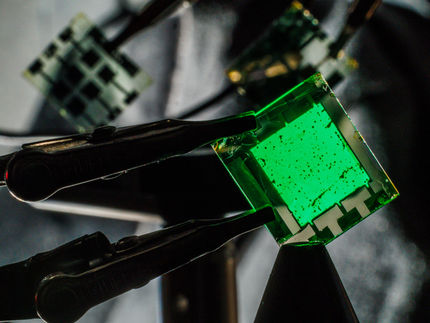
One of the assembled organic LEDs based on push-pull systems containing cyanopyrazine fragment.
Ruslan Gadirov
According to the head of the research team, director of the Postovsky Institute of Organic Synthesis Ural Branch of RAS, member of the Laboratory of Medical Chemistry and Advanced Organic Materials at the Ural Federal University Egor Verbitskiy, physicists knew beforehand that the introduction of cyanogroups in fluorophores can lead to improved properties and overall efficiency of OLEDs.
“Therefore, we modified the pyrazine-based push-pull system with cyanogroup and studied how this affected the photophysical properties of the fluorophores and the performance of OLEDs based on it. The phenomenon of TADF, due to the peculiarities of the structure of the initial substance, did not arise, although there are prerequisites for it. However, it turned out that the introduction of a cyanogroup intensifies intermolecular interactions, as a result of which not individual molecules but complexes of molecules begin to fluoresce. As a consequence, the increase in luminescence intensity was from 2.4 to 20 times, and the brightness of the emitted light was up to 75 times. Such results were shown by several prototype devices made by our colleagues and co-authors from Tomsk State University. It is also important that we used inexpensive and accessible compounds in our research,” says Egor Verbitskiy.
In previous research work, chemists demonstrated that one of the most promising compounds as an acceptor (attracting electrons) part in push-pull systems is the pyrazine ring (another name is 1,4-diazine), a compound of nitrogen, hydrogen and carbon that has a significant electron-accepting effect.
A study of the properties of a wide range of 1,4-diazine-based push-pull systems revealed that the addition of a benzene ring to the pyrazine cycle can improve the efficiency and brightness of the OLEDs produced. At the same time, some of the OLEDs tend to exhibit thermally activated delayed fluorescence (TADF). This is evidenced by the increase in fluorescence lifetime.
It should be noted that scientists of the Postovsky Institute of Organic Synthesis of the Ural Branch of the Russian Academy of Sciences, the Ural Federal University (UrFU, Yekaterinburg), and Tomsk State University are working on the creation of new fluorophores.
Original publication


Other news from the department science





















Most read news












More news from our other portals

























Last viewed contents
Enerkem adds two new executive roles to growing North American presence
Measuring Planck's constant, watt balance brings world closer to new kilogram
WACKER strengthens silicone business in China with new technology center for specialty silanes - 2,300-square-meter center consolidates Group expertise in the field of organofunctional silanes
Inspired by the chemistry of the eye: Research team develops innovative catalytic chemistry process
Pitt researchers harness carbon nanomaterials for drug delivery systems, oxygen sensors - Researchers describe carbon nanocapsules for drug and energy storage in Advanced Materials, creation of highly sensitive oxygen sensors in Nature Chemistry
How to produce fluorescent nanoparticles for medical applications in a nuclear reactor
Water, Clay and Carbon: A New Route to Sustainable Energy Storage - Researchers demonstrate an all-water supercapacitor stable over 60,000 charging cycles
Don't Give the Slightest Chance to Toxic Elements in Medicinal Products - New high-accuracy reference solutions for the SI-traceable measurement

Bodo Möller Chemie Group enters exclusive acquisition talks with Rocktin - Strengthen adhesives distribution in Asia
Researchers develop procedure to interpret x-ray emission spectra of liquid water - Study helping to advance the understanding of the structure of water

How can life emerge in a world of minerals? - The European Research Council (ERC) has awarded an ERC Synergy Grant to the project “The role of silica at the dawn of life on our planet” (PROTOS)