Distinguish sugars with eye-catching and stretchy rainbow film
Advertisement


Rainbows and sugar may conjure up images of a certain leprechaun-branded breakfast cereal. But now, researchers in ACS Nano report a kaleidoscope-like film for telling different sweeteners apart that displayed multiple colors when stretched by hand. When evenly stretched with a simple apparatus, the material enhanced the unique shifts in fluorescence intensity of 14 sugars tagged with a dye, distinguishing between them in beverages and sweat samples.

symbolic picture
Computer generated picture
Sweet tastes in drinks can come from many types of sugar, including sucrose, fructose and glucose, as well as less common ones, such as maltose. There are also sugars in people’s sweat, which could be tracked to noninvasively monitor blood sugar. It’s hard to tell which molecules are present based on taste or look alone; instead, they’re usually identified with complex methods and sophisticated instruments. To simplify the detection process, Fengyu Li and colleagues previously used photonic crystals — polystyrene nanospheres whose color shifts when sugary compounds are nearby — in a color-changing chip sensor that distinguished 12 different sugars from one another. But these sensors weren’t wearable, so, Li, Chunbao Li and a new team wanted to incorporate photonic crystals into a stretchable easy-to-carry film and see whether the rainbow-colored platform could also detect and differentiate sugars.
The researchers embedded closely packed, ordered rows of polystyrene nanospheres into a film of polyethyl acrylate. Initially, the gummy material looked red, but when it was stretched with a uniform force, its color shifted through the rainbow — red to pink to orange to yellow-green to light green and, finally, dark green at a 40% stretch. And when pulled by hand, the material produced a kaleidoscope of colors, as different parts of the material had different forces on them.
In initial experiments, the researchers showed that stretching the film enhanced the fluorescent signals from 14 sugars that had been attached to dyes. These signals could then be sorted from one another. To see if the sensor could do the same with real-world samples, they mixed six commercially available drinks with the dye alizarin red S-2-diphenylboronic acid 2-aminoethyl ester, creating fluorescent complexes. Solutions with these complexes were dotted onto the film, which was then stretched, and the fluorescence intensities were measured at two different wavelengths of light. And because each samples’ sugar-dye complexes produced unique signals, they could be distinguished from each other. The sensor also differentiated sweat samples from six people. Based on these results, the researchers say that the stretchable, multicolored material could be incorporated into wearable devices for environmental, clinical or health monitoring of sugar, or modified to detect other substances.
The authors acknowledge funding from the National Natural Science Foundation of China.
Original publication


Other news from the department science





















Most read news












More news from our other portals

























Last viewed contents
TU Graz develops mobile device for the high-precision measurement of air pollutants - A device the size of a moving box can detect traces of toxic gases from miles away
Search for new semiconductors heats up with gallium oxide
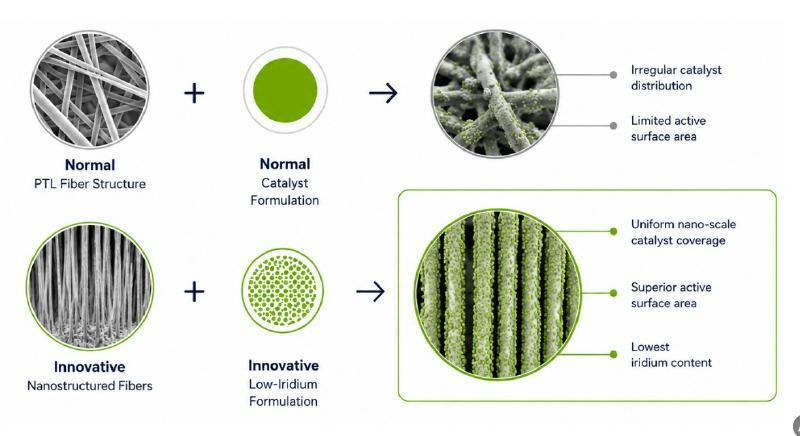
Smoltek Hydrogen and Heraeus Precious Metals advance next-generation ultra-low iridium electrolysis technology

Chemistry without detours: Researchers introduce a two-step process for producing phosphorus-containing chemicals - This promising innovation not only contributes to environmental protection but also saves significant time and costs

Evidence stacks up for poisonous books containing toxic dyes

Adhesives from waste wood, biofuel from straw - EU research project on the potential of agroforestry waste as environmentally friendly raw materials completed

Computational trick enables better understanding of exotic state of matter - New process relevant for fusion and materials research

Pushing boundaries: Detecting the anomalous Hall effect without magnetization in a new class of materials - The first experimental evidence for the anomalous Hall effect emerging in a collinear antiferromagnet with non-Fermi liquid behavior
Unveiling how water and ions impact chemical reactivities at solid-aqueous interfaces
Chemistry meets biology: controlling artificial cell membranes through catalysis - Researchers develop an artificial metalloenzyme-based platform that enables programmable control of artificial membrane behavior
'Hot' oxygen atoms on titanium dioxide motivated by more than just temperature - PNNL scientists find unexpected chemical behavior on catalyst surface
