Scientists thread rows of metal atoms into nanofiber bundles
Intercalation of indium into nanostructures promises applications to nanocircuitry
Advertisement


Researchers from Tokyo Metropolitan University have successfully threaded atoms of indium metal in between individual fibers in bundles of transition metal chalcogenide nanofibers. By steeping the bundles in indium gas, rows of atoms were able to make their way in between the fibers to create a unique nanostructure via intercalation. Through simulations and resistivity measurements, individual bundles were shown to have metallic properties, paving the way for application as flexible nanowires in nanocircuitry.
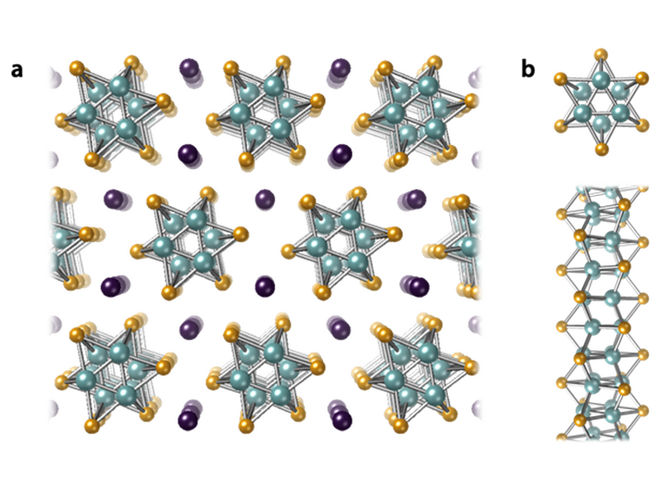
(a) 3D TMC crystalline structure consisting of TMC nanofibers surrounded by single-atom rows of an intercalating element. (b) End on and side view of a single TMC nanofiber. Chalcogens are golden, transition metals are green, and the intercalating element is dark purple.
Tokyo Metropolitan University
Atomic wires of transition metal chalcogenides (TMCs) are nanostructures consisting of a transition metal and a group 16 element like sulfur, selenium, and tellurium. They are able to self-assemble into a wide range of structures with different dimensionality, putting them at the heart of a revolution in nanomaterials that has been the focus of intense research in recent years. In particular, a class of 3D TMC structures have garnered particular interest, consisting of bundles of TMC nanofibers held together by metallic atoms in between the fibers, all forming a well-ordered lattice in its cross section (see Figure 1). Depending on the choice of metal, the structure could even be made to become a superconductor. Furthermore, by making the bundles thin, they could be made into flexible structures that conduct electricity: this makes TMC nanostructures a prime candidate for use as wiring in nanocircuitry. However, it has been difficult to make these structures into the long, thin fibers that are required to study them in depth, as well as for nanotechnology applications.
A team led by Assistant Professor Yusuke Nakanishi and Associate Professor Yasumitsu Miyata has been studying synthesis techniques for TMC nanostructures. In recent work, they showed that they could produce long, thin bundles of TMCs (with no metal) over unprecedentedly large length scales. Now, they have used a vapor phase reaction to thread atomically-thin rows of indium into thin bundles of tungsten telluride. By exposing their long nanofiber bundles to indium vapor under vacuum at 500 degrees Celsius, the indium metal atoms made their way into the space between the individual nanofibers that make up the bundles, forming an intercalating (or bridging) row of indium that binds the fibers together.
Having successfully produced large amounts of these threaded TMC bundles, they proceeded to study the properties of their new nanowires. By looking at the resistivity as a function of temperature, they showed conclusively that individual bundles behave like a metal and thus conduct electricity. This agreed with computer simulations, and also demonstrated how well-ordered the structures were. Interestingly, they found that this structure was slightly different to bulk batches of bundled nanofibers, in that the intercalated rows caused each nanofiber to rotate slightly about its axis.
The team’s technique is not only limited to indium and tungsten telluride, nor to this particular structure. They hope their work might inspire a new chapter for nanomaterial development and the study of their unique properties.
Original publication


Other news from the department science





















Most read news












More news from our other portals

























Last viewed contents
Computational trick enables better understanding of exotic state of matter - New process relevant for fusion and materials research
Pushing boundaries: Detecting the anomalous Hall effect without magnetization in a new class of materials - The first experimental evidence for the anomalous Hall effect emerging in a collinear antiferromagnet with non-Fermi liquid behavior
Unveiling how water and ions impact chemical reactivities at solid-aqueous interfaces
Chemistry meets biology: controlling artificial cell membranes through catalysis - Researchers develop an artificial metalloenzyme-based platform that enables programmable control of artificial membrane behavior
'Hot' oxygen atoms on titanium dioxide motivated by more than just temperature - PNNL scientists find unexpected chemical behavior on catalyst surface

New method measures the 3D position of individual atoms - The method developed at the Universities of Bonn and Bristol uses an ingenious physical principle

Grand opening of new laboratory world - Training and testing facilities on over 1,500 m2

Fine particles from aircraft exhaust become more harmful over time

A sustainable path for energy-demanding photochemistry - Novel strategy for the generation of highly energetic UV light

DHL improves shipping of chemical freight

Co-reactive secures €6.5 million in seed funding for CO₂-negative construction materials technology - Climate-tech start-up converts emissions into supplementary cementitious materials