International Research Team Develops Method to Characterize Nanomaterials
Advertisement


Researchers from Paderborn University, the Istituto Nazionale di Ricerca Metrologica (INRiM),Italy’s national metrology institute, the Politecnico di Torino, Italy, and the Physikalisch-Technische Bundesanstalt (PTB), National Metrology Institute of Germany, have studied sequential infiltration synthesis in nanostructured polymers. They hope to improve the possibilities for characterizing material properties at the smallest length scale. Materials with structures in the range of just a few nanometers will be essential, for instance, in future computer chips, energy conversion and energy storage processes, and molecular sieves. The researchers have now published their findings as a cover article in “ACS Applied Polymer Materials.”

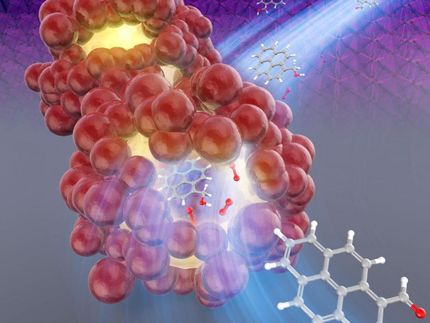
Symbolic image
Computer-generated image
At Paderborn, the team led by physicist Prof. Jörg Lindner works with nanostructured block copolymers, interlinked polymer chains that “self-organize” into regular patterns, allowing for a wide range of applications. “Our ability to control the self-organization of block copolymers has made rapid progress in recent years,” says Lindner. In order to continue this development, though, nondestructive methods for characterizing material properties must be expanded, as the goal of a larger endeavour involving the co-authors of partner institutions, INRiM, Politecnico di Torino and PTB.
Block copolymers allow extremely small structures to be created on semiconductor surfaces, which facilitates future-oriented processes for further miniaturizing next-generation microelectronic components. “The structure sizes that can be achieved here are limited only by the length of the polymer chains, so they can be even smaller than the structures that are laboriously produced through conventional techniques. The advances in miniaturization also create a need for new measurement methods and size standards so that smaller structures can be analyzed. Block copolymers can help here, too – but only after the chemical differences between the involved polymer types are increased by selectively modifying one of the polymers. Selectively integrating aluminum oxide using sequential infiltration synthesis makes it possible to create nanostructures that can be used to test these new measurement processes,” explains Lindner.
Original publication


Other news from the department science





















Most read news












More news from our other portals

























Last viewed contents

How Molecules Break and Form Bonds - A crucial step toward truly understanding chemical processes
A catalytic flying carpet - Chemical engineering researchers develop self-powered microfluidic sheet that wraps, flaps and creeps

“Dictionaries” make fluorescence-based data for integrative structure models and their dynamics accessible - 3D structures of biomolecules

PSL - Powder Systems Limited - Liverpool, United Kingdom
Significant progress achieved in chemical liquid analysis - ISFET-based pH sensor-control successfully miniaturized and optimized for easy use

From research to spinoff - PSI Founder Fellowship supports two spin-off projects: AI platform and solid-state batteries

Waste Becomes Recyclable Material - New Process Turns Urine and Ash into Sustainable Raw Materials
Stora Enso announces startups selected for its second Accelerator Programme

Scientists develop new thermofluidic process for lab-on-a-chip applications - This will unlock groundbreaking solutions for nanotechnology, the manipulation of liquids in systems in tiny spaces, or in the field of diagnostics

Breakthrough process for directly converting methane to methanol

Discovering new field affecting metals solidification