An end to the battle between touchscreens and long fingernails is on the horizon
New nail polish could make long fingernails touchscreen-compatible
Advertisement


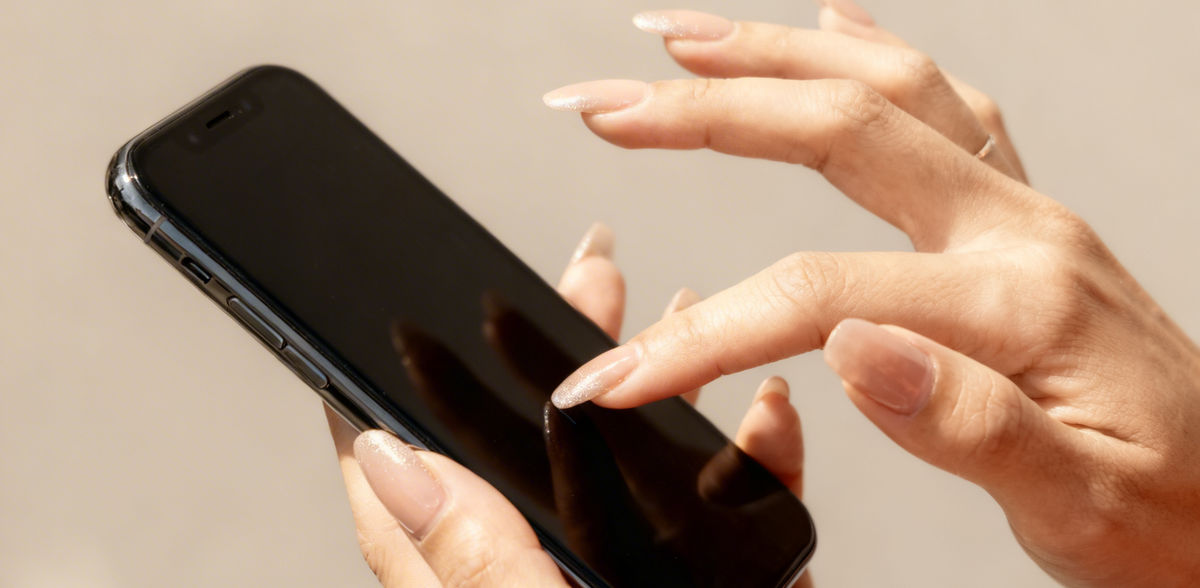
Anybody who tried to use a smartphone or tablet with long nails knows that there’s a learning curve. Rather than effortlessly tapping with a fingertip, you must awkwardly lay the pads of your fingers onto the screen. Wouldn’t it be easier if you could just type with your fingernails instead? To try and make this idea a reality, a group of researchers are formulating a clear nail polish that could turn long fingernails into touchscreen-compatible styluses. The team from Centenary College of Louisiana presented their results at the spring meeting of the American Chemical Society (ACS).
Manasi Desai, an undergraduate at Centenary, had an interest in cosmetic chemistry and went to her research supervisor, Joshua Lawrence, looking for a suitable project. Lawrence, an organometallic chemist, explains that “chemists are here to solve problems and to try to make your world better.” So, they looked around to see what problem might need solving. When they noticed the difficulty many people had when operating smartphones with long nails — including a phlebotomist at a bloodwork appointment — they asked if a touchscreen-compatible nail would be useful. The answer was a resounding “yes, please!” And thus, Desai’s project came to be.
Most modern touchscreens, such as those in smartphones and tablets, are known as capacitive touchscreens. They work by creating a small electric field across the screen. When a conductive material — something that allows electricity to flow through itself — disrupts that field, like your finger or a droplet of water, the surface changes its capacitance. Then, the device interprets that capacitance change as a touch.
But, tapping a screen with a nonconductive material, like a long fingernail or pencil eraser, does not change the capacitance and, as a result, the device doesn’t register the touch. So, to make long fingernails touchscreen compatible, they need to carry a small electric charge.
Previously, other researchers have attempted this by incorporating electrically conductive carbon nanotubes or metallic particles into nail polish, but these substances can introduce hazards to the manufacturers, as they’re dangerous if inhaled. Additionally, the additives result in a deep black or metallic shimmer, limiting the shade range of the polishes. Lawrence and Desai wanted to instead create a polish that was, ideally, both clear and nontoxic to both the wearer and the manufacturer.
To find the perfect combination of clarity and conductivity, Desai turned to good, old-fashioned trial and error. Using 13 commercially available clear-coat polishes and more than 50 different additives, she slowly worked her way through the combinations to find which ones resulted in a conductive topcoat for nails. The molecules that performed the best were forms of taurine, an organic compound commonly sold as a dietary supplement, and ethanolamine, another simple, organic molecule.
Ethanolamine provided the conductivity and polish compatibility they were looking for but has some toxicity. And while modified taurine formula is nontoxic, it took on a slightly opaque hue. But when combined, these additives created a formula that was able to register as a touch on a smartphone, so it’s a promising first step. “Our final, clear polish could be put over any manicure or even bare nails, which could help people with calluses on their fingertips, too. So, it has both a cosmetic and lifestyle benefit,” explains Desai.
Unlike the previous attempts, Lawrence and Desai believe that their polish works through a slightly different pathway: acid-base chemistry instead of inherently conductive metal or carbon nanotubes. They arrived at this hypothesis because the best initial results came from ethanolamine-based formulas, which can release protons to move charge around. Therefore, they think that when the nail polish contacts a touchscreen’s electric field, it causes the protons to jump between the molecules, changing the polish’s capacitance ever so slightly — but just enough for the smartphone to recognize it as a touch.
These initial results are promising, but the team still has a long way to go before the polish will be available on store shelves. Even the best-performing ethanolamine-taurine formula is finicky and doesn’t yet work consistently when painted on a nail. Plus, ethanolamine evaporates quickly, so the polish only works on a touchscreen for a few hours once outside of the bottle, and researchers would prefer a truly nontoxic compound. Despite these setbacks, the researchers now have an idea of how the successful formula works, and they are continuing to screen compounds and test new formulas to find the best-performing combination.
“We’re doing the hard work of finding things that don’t work, and eventually, if you do that long enough, you find something that does,” concludes Lawrence.
The research was funded by the Centenary College of Louisiana, the Albert Sklar Family and the Sklar Chair in Chemistry. The researchers have submitted a provisional patent on this research.


Other news from the department science





















Most read news












More news from our other portals

























Last viewed contents
International consortium to advance decarbonisation of the aviation sector - CARE-O-SENE research project will develop advanced catalysts for sustainable aviation fuels
EU project SMHYLES develops novel salt- and water-based hybrid energy storage systems (HESS) on an industrial scale - The consortium includes 16 partners from seven countries
Consortium develops evolutionary concept for recycling of end-of-life polyurethane mattress foams - Ecomaison, Covestro, Secondly and Federal Eco Foam launch research project
Controversial Mass Products: Ceresana Analyzes the Global Market for Plasticizers
New metal-free, recyclable polypeptide battery that degrades on demand - Breakthrough could lead to battery production moving away from cobalt
Shedding light on mechanisms of electrochemical energy storage - UV-visible spectroscopy gives researchers a tool to study battery materials - a breakthrough that could speed the design of higher performing energy storage devices

Researchers discover new ultra strong material for microchip sensors - A material that doesn't just rival the strength of diamonds and graphene, but boasts a yield strength 10 times greater than Kevlar

Brown chemists report promising advance in fuel-cell technology

Climate pioneers cooperate to produce solar fuels - INERATEC joins forces with Synhelion
Micro- and nanoplastics in the body are passed on during cell division - That plastic may increase metastasis of tumors
Search for new semiconductors heats up with gallium oxide