From lab to industry: 3D printing accelerates the future of lithium batteries
A major review highlights the potential, the pitfalls, and different perspectives of 3D printing's role in manufacturing lithium batteries
Advertisement


Recent progress in advanced energy manufacturing has opened a new path for lithium battery design. A joint research team led by Associate Professor Eric Jianfeng Cheng of Tohoku University has published a major review in Materials Science and Engineering: R: Reports on March 30, 2026, that highlights the potential, the pitfalls, and different perspectives of 3D printing's role in manufacturing lithium batteries. The article provides a systematic roadmap for how 3D printing may redefine next-generation lithium batteries.
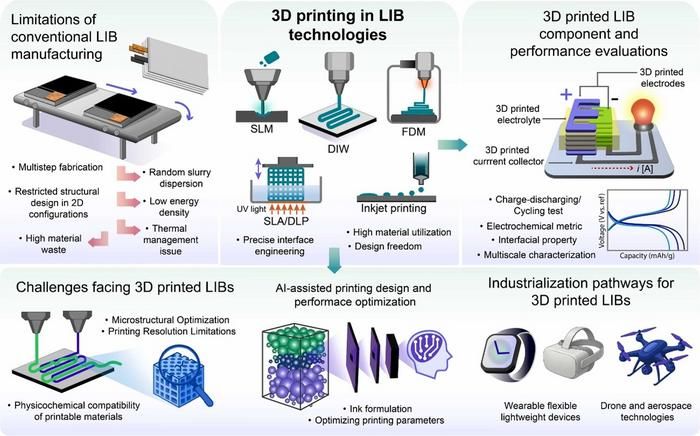
Schematic overview of the design, technologies, challenges, and industrial pathways of 3D-printed lithium batteries.
©Eric Jianfeng Cheng et al.
The review shows that 3D printing can move battery manufacturing beyond the geometric limits of conventional coating-based production. Instead of relying on flat, stacked shapes, 3D printing enables precise control over three-dimensional structures. This topology-driven design can shorten ion-transport pathways, improve electron conduction, reduce local stress concentration during cycling, and enhance mechanical robustness. In this sense, 3D printing is not simply a new processing method, but a way to redesign how electrochemical performance is built into battery structure itself.
The paper places particular emphasis on all-solid-state lithium batteries, where both energy density and interface quality are critical. For these systems, the challenge is not merely to print battery components, but to fabricate thin, structurally precise solid-electrolyte architectures while maintaining low interfacial resistance and reliable ionic transport. The review critically analyzes the key scientific bottlenecks involved, especially the trade-off between high ceramic filler content, ink rheology, sub-100-micrometer structural fidelity, and interfacial integrity in composite solid electrolytes.
"We believe the next stage of progress will depend on integrating artificial intelligence (AI) with 3D printing," says Siraprapha Deebansok (Tohoku University). "The guidance of data-driven AI can help us move away from trial-and-error, and towards intelligent manufacturability."
This research provides one of the most comprehensive roadmaps to date for applying 3D printing technologies to lithium battery manufacturing. The research team thoroughly examines how the precise control of 3D printing could improve a battery's energy density, safety, and stability. This framework may accelerate the design of advanced batteries for electric vehicles, flexible electronics, and grid-scale energy storage.
Original publication
Jing Wei, Siraprapha Deebansok, Xin He, Qian Wang, Tanant Waritanant, Zijian Geng, Ying Li, Manoj Gautam, Guoqiang Luo, Yizhou Zhang, Hongze Wang, Xuning Feng, Hirotoshi Yamada, Hyoung Seop Kim, Hidemi Kato, Shin-ichi Orimo, Kiyoshi Kanamura, Venkataraman Thangadurai, Eric Jianfeng Cheng; 3D printing in lithium battery manufacturing: Opportunities, challenges, and perspectives; Materials Science and Engineering: R: Reports, Volume 170, 2026


Other news from the department science





















Most read news











More news from our other portals



























See the theme worlds for related content
Topic World Battery Technology
The topic world Battery Technology combines relevant knowledge in a unique way. Here you will find everything about suppliers and their products, webinars, white papers, catalogs and brochures.

Topic World Battery Technology
The topic world Battery Technology combines relevant knowledge in a unique way. Here you will find everything about suppliers and their products, webinars, white papers, catalogs and brochures.
Last viewed contents

Pyrolysis oil instead of crude oil: Faster fluorine analysis reduces the risk for refineries - New method solves a key analytical challenge

Research guides future of plastic waste chemical recycling

The competitiveness of low-carbon fuels depends on location - New infrastructure could boost European production

Deep tech startup Reduciner introduces novel technology to turn captured carbon into sustainable fuels - Raising 3.6 million euros in its initial funding round, the Finnish startup plans to build its first industrial-scale pilot
Bruker announces strategic collaboration with Atinary Technologies to advance self-driving laboratories

FUST Lab Receives Investment from Asia2G Capital - The Korean deep-tech company plans to use the capital to expand into the U.S., European, and Japanese markets

ACHEMA Middle East: Debut in Saudi Arabia not until 2027 - Messe Frankfurt Saudi Arabia and DECHEMA are responding to regional uncertainties and are also changing the venue

New core-shell design for anodes significantly increases performance of sodium-ion batteries - Researchers coat porous carbon with a filter-like layer that allows sodium ions to pass through while keeping disruptive electrolyte molecules out

New "chemical armor" could unlock the holy grail of solid-state battery technology - A simple one-step coating builds a silicon-indium hybrid shield on lithium metal, quadrupling current density and extending battery cycle life
Scientists unveil mechanism behind greener ammonia production
Siemens to digitalize one of Europe's largest renewable hydrogen projects - Physics-based digital twin and real-time optimization