Short circuits in solid-state batteries: the mechanism finally proven
Using cryo-electron microscopy under vacuum, a Max Planck team has resolved a decade-long debate on dendrite-induced cracking
Advertisement


Smartphones, electric vehicles and many portable devices rely on batteries. Their energy storage capacity, lifetime and safety will strongly shape the future of electrification. Among the most promising next-generation technologies are solid-state batteries. These batteries would allow smartphones to run for several days instead of requiring daily charging and electric vehicles with third as high driving range as today’s options.
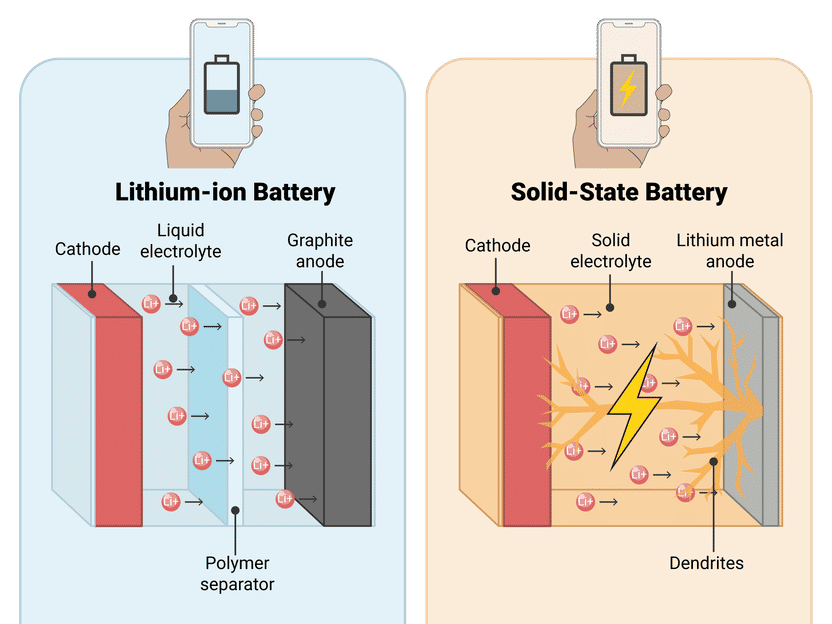
Inside of a lithium-ion battery compared to a solid-state battery. The widely use of solid-state batteries is till now prevented due to the formation of dendrites while charging.
P. Mehta: Max-Planck-Institut für Nachhaltige Materialien GmbH
Unlike today’s widely used lithium-ion batteries, which use a liquid electrolyte between two solid electrodes, solid-state batteries employ a solid electrolyte. This design can increase energy density, improve safety and extend battery lifetime. However, one major challenge still limits their commercial use. During charging, microscopic intrusions known as dendrites, form. These tiny tree-like structures grow from the anode, penetrate the solid electrolyte and cause short circuits inside the battery.
An interdisciplinary team at the Max Planck Institute for Sustainable Materials has now uncovered how dendrites induce fracture, leading to short circuits. They published their results in the journal Nature.
What causes dendrite-induced cracking in solid-state batteries?
Dendrite formation in solid-state batteries is a counterintuitive phenomenon. “Although the electrodes and the forming dendrites consist of lithium metal, which is soft like a gummy bear, the dendrites are able to penetrate the ceramic electrolyte and lead to a short circuit,” says Dr. Yuwei Zhang, first author of the new publication and head of the group “Chemo-Mechanics of Battery Materials” at the Max Planck Institute for Sustainable Materials. “How can soft dendrites fracture the stiff solid ceramic? There are two hypotheses: either internal stress is built up inside the dendrites and induces mechanical fracture of the solid electrolyte. Or, electrons leak along the grain boundaries of the solid electrolyte promoting the formation of lithium nuclei that interconnect later.”
To prove either hypothesis, the researchers used a complex setup of sample preparation and material’s characterization techniques, characterized entirely under vacuum and cryogenic temperatures to exclude any influence from oxygen, water or from the electron beam of the microscopes.
The Max Planck team analysed the stress state and plastic activity of lithium dendrites confined within the cracks and was able to show that no lithium was enriched ahead of the dendrite tip. “The soft lithium metal is able to penetrate the stiff ceramic electrolyte, like a continuous waterjet that penetrates a rock. We calculated that hydrostatic stress in the dendrite leads to brittle fracture of the solid electrolyte in the end”, says Zhang. Additional phase field simulations and electron backscatter diffraction measurements backed up their findings.
Possible ways to prevent or delay dendrite-induced cracking
After uncovering how dendrite-induced cracking occurs, the researchers are now exploring strategies to prevent it. Possible approaches include increasing the toughness of the solid electrolyte to delay crack formation, introducing microscopic voids that redirect dendrite growth and deflect cracks, or applying protective coatings to the lithium electrodes to suppress dendrite formation.
These findings highlight how crucial a fundamental understanding of materials behaviour is for turning promising technologies into practical, real-world applications.
Original publication


Other news from the department science





















Most read news












More news from our other portals

























See the theme worlds for related content
Topic World Battery Technology
The topic world Battery Technology combines relevant knowledge in a unique way. Here you will find everything about suppliers and their products, webinars, white papers, catalogs and brochures.

Topic World Battery Technology
The topic world Battery Technology combines relevant knowledge in a unique way. Here you will find everything about suppliers and their products, webinars, white papers, catalogs and brochures.
Last viewed contents
Insects as mini molecule-making factories, marking a breakthrough in chemical engineering - Caterpillar factories produce fluorescent nanocarbons
Metal powder: zero-carbon fuel for the future? - How iron can be used to store and transport energy
A touch of gold and silver - For the first time, it is possible to produce crystalline layers of precious metals that consist of a single atomic layer and which are semiconducting

Nanoparticle supersoap creates 'bijel' with potential as sculptable fluid

Inspired by nature: Scientists have developed a nanopore-microchip

Reinforcement of structures with Memory Steel
Ultra-thin lenses that make infrared light visible - Researchers have achieved this using a special metal-oxide lens material called lithium niobate and through nanoscale pattern, stamped into the material

Team develops bioprocess for converting plant materials into valuable chemicals

Wonder material graphene claims yet another superlative
Magnets trump metallics - Magnetic fields can block conductivity of carbon nanotubes

Cellphone converts into powerful chemical detector - With only $50 worth of components, an ordinary cellphone transforms into a sophisticated scientific instrument, capable of identifying chemicals, drugs, and pathogens