New "chemical armor" could unlock the holy grail of solid-state battery technology
A simple one-step coating builds a silicon-indium hybrid shield on lithium metal, quadrupling current density and extending battery cycle life
Advertisement


What if recharging your electric car took no longer than filling up a tank of gas, and the battery lasted for decades? Scientists have long pinned their hopes on lithium metal batteries to make this a reality. Dubbed the "holy grail" of energy storage, lithium metal offers a theoretical capacity nearly ten times that of the graphite used in today's smartphones and electric vehicles. Yet every time researchers get close, the metal sprouts microscopic, tree-like filaments called dendrites that pierce the battery, cause short circuits, and can even trigger fires.
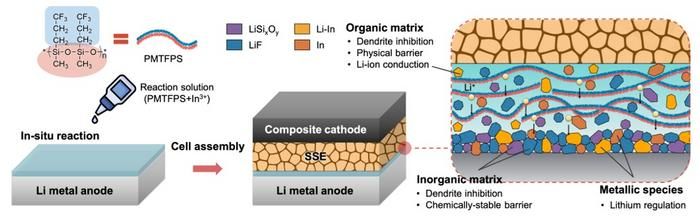
This illustration depicts the in-situ formation of the PFSIn-Li interlayer on a lithium metal anode. A liquid precursor containing a fluorinated siloxane polymer and indium salt reacts on the lithium surface to generate a multifunctional hybrid film. The organic polymer network interpenetrates with inorganic lithium fluoride, lithium-indium alloy, and lithium silicon oxide nanodomains, simultaneously suppressing dendrite growth and stabilizing the interface with the sulfide solid electrolyte.
©Science China Press
Now, a team at Xidian University in China may have found a way to tame this unruly metal with a surprisingly simple chemical trick: painting its surface with a liquid that turns into a durable, multi-functional armor in situ.
In a study published in SCIENCE CHINA Chemistry, researchers led by Professors Siwu Li, Weiwei Wu, and Chuang Yu describe a one-step solution-cast coating that transforms a standard lithium metal surface into a hybrid shield. The coating combines a silicon-based polymer with indium chloride. When applied to lithium, the metal's natural chemical drive triggers an in-situ reduction reaction. The polymer's fluorine groups convert into lithium fluoride, a rock-solid electrical insulator, while indium ions reduce and alloy with lithium to form tiny nanoparticles. All of this happens within a flexible, 12-micrometer-thick film that clings tightly to the lithium surface.
"This hybrid layer acts like a smart fortress," explains corresponding author Siwu Li. "The polymer backbone provides flexibility to absorb the mechanical stress of lithium expanding and contracting. The lithium fluoride phase blocks electrons to prevent dendrite nucleation. And the lithium-indium alloy nanoparticles act as traffic conductors, guiding lithium ions to deposit evenly rather than piling up in dangerous spikes."
The numbers tell a striking story. In symmetric cell tests, the protected lithium anode sustained a critical current density of 3.5 mA cm⁻², more than four times the 0.8 mA cm⁻² that unprotected lithium can handle before failing. In full cells paired with a nickel-cobalt-manganese oxide cathode and a sulfide solid electrolyte, the new design delivered an initial capacity of 129.8 mA h g⁻¹ and retained 82.3% of that capacity after 300 cycles at 0.5C. Bare lithium cells retained only 43.0%.
The researchers used advanced spectroscopy and microscopy to confirm the hybrid architecture. X-ray diffraction and photoelectron spectroscopy revealed organic siloxane networks alongside crystalline lithium fluoride, metallic indium, and lithium-indium alloy. Cross-sectional electron microscopy showed a dense, uniform film with no cracks or gaps.
Importantly, the chemistry is compatible with industrial roll-to-roll manufacturing. Because the coating is applied as a simple liquid solution, it could be integrated into existing battery production lines using slot-die or gravure coating techniques, with no expensive vacuum chambers required.
Solid-state batteries are widely viewed as the next frontier for electric vehicles and grid-scale energy storage because they replace flammable liquid electrolytes with safer solid materials. Sulfide electrolytes are particularly attractive due to their exceptionally high ionic conductivity, but their instability against lithium metal has been a major roadblock. This new interface engineering strategy effectively removes that roadblock without sacrificing performance.
The team believes their approach opens the door to designing other hybrid interfaces by swapping indium for alternative metals such as tin or zinc. For now, the polysiloxane-indium chemistry offers a scalable, low-cost path toward the high-energy, long-life batteries that could one day power everything from electric aviation to renewable energy grids.
Original publication


Other news from the department science





















Most read news











More news from our other portals



























See the theme worlds for related content
Topic World Battery Technology
The topic world Battery Technology combines relevant knowledge in a unique way. Here you will find everything about suppliers and their products, webinars, white papers, catalogs and brochures.

Topic World Battery Technology
The topic world Battery Technology combines relevant knowledge in a unique way. Here you will find everything about suppliers and their products, webinars, white papers, catalogs and brochures.
Last viewed contents
Scientists unveil mechanism behind greener ammonia production
Siemens to digitalize one of Europe's largest renewable hydrogen projects - Physics-based digital twin and real-time optimization
Collaboration between University of Bristol and Malvern Panalytical - Bringing academia and business together to solve global challenges

Digital lab day 2025 celebrates international success - virtual battery day 2025 follows in November

RE:VOLTAGE and CometHire Win the HTW Startup Challenge 2026 in Berlin - The competition awarded 10,000 euros in prize money in the GreenTech and Impact Entrepreneurship categories
Atomic reshuffle paves way for record-breaking catalysts for hydrogen production - "This opens a new strategy for designing adaptive catalysts for a wide range of applications"

Global underground CO₂ storage hits record 43.6 million tonnes - London Register expands reach
Research Breakthrough on the Path to a New Reserve Antibiotic - For the first time, chemists have succeeded in synthesizing the highly potent natural compound neosorangicin A

Endress+Hauser expands its presence in the U.S. - 44 million euros are being invested in the new facility in Greenwood, Indiana
Plastic bottles could find new life in batteries as graphite - Penn State researchers converting PET waste into synthetic graphite that outperforms natural graphite
Turning food waste into carbon captors - Expected to be cheaper than other capture methods