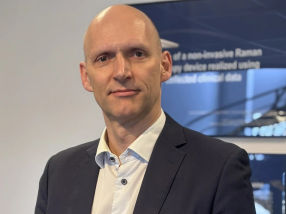
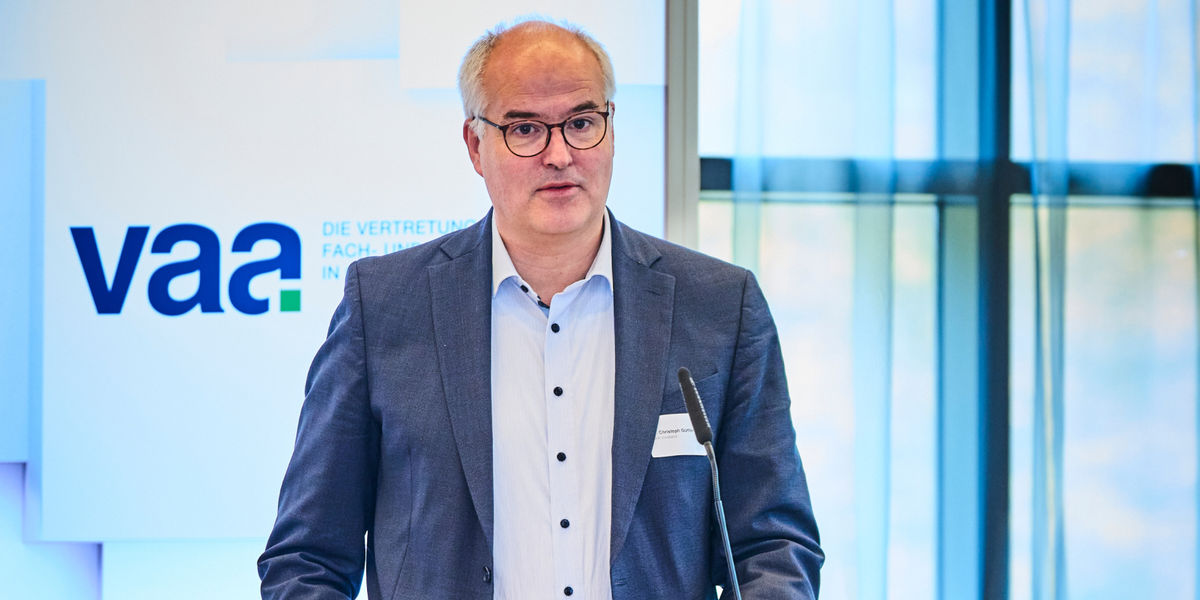
Dr. Christoph Gürtler (VAA): Germany's greatest competitive advantage is its skilled workforce
"Germany as a business location is much better than it is often portrayed in public discourse."
Advertisement


The chemical and pharmaceutical industry is the third-largest sector of our economy. It supplies the raw materials for countless products and applications in our daily lives—from medicines and plastics to specialty chemicals for the electronics industry. However, the future of the chemical industry in Germany and Europe faces major challenges: high energy prices, complex permitting procedures, and increasing international competitive pressure are weighing on our companies. Since other regions often benefit from opaque and substantial government subsidies, a level playing field on the global market is essential.
To secure Germany’s industrial base in the long term, the industry needs reliable framework conditions, a sufficient supply of skilled workers, and effective trade defense instruments in cases of proven distortions of competition. Nothing less than the future viability of our industry is at stake—an industry that employs over 500,000 people.
Dr. Christoph Gürtler is the 2nd Chairman of the Association of Chemical and Pharmaceutical Professionals and Executives (VAA). Germany remains a strong location for the chemical industry—yet opaque and distorted competition is taking a heavy toll on the domestic chemical industry.
Dr. Gürtler, we are currently experiencing a geopolitical realignment amid rapidly changing climate conditions. Why do we need to respond to these two crises?
The new buzzword is resilience on multiple levels. The geopolitical changes vividly demonstrate the massive impact that disruptions to key trade routes have on Europe’s security of supply. The consequences of climate adaptation and the megatrend of artificial intelligence are not even included in this assessment.
We should therefore ensure that critical chemicals can also be produced in Europe. To do this, we need well-trained and well-prepared specialists and leaders who can remain capable of taking action under difficult conditions. Resilience therefore means not only secure supply chains, but also people who can cope with change.
In addition, some major powers are massively distorting global competition to the detriment of local industry. What steps do you call for to restore a level playing field?
The costs of Asian imports must be transparent and traceable. We must ensure that products do not gain an unfair competitive advantage over European companies through hidden government subsidies. We need a true level playing field. To achieve this, all stakeholders must speak out forcefully: the European Commission and Parliament, business associations, labor unions, social partners, and the German federal government.
Because only when policymakers, the business community, and employee representatives act together can we ensure fair competitive conditions and preserve high-quality jobs in Germany and Europe.
The chemical industry cannot be decarbonized; it must be defossilized. What does that mean in concrete terms?
The chemical industry must transform its production in a sustainable manner and gradually replace fossil fuels and raw materials with climate-friendly alternatives—in other words, defossilize. To achieve this, Scope 1 and 2 emissions must be reduced as quickly as possible, primarily through renewable energy. In the long term, this also applies to Scope 3 emissions. Here, alternative raw materials and a functioning circular economy play a particularly important role.
Waste management, regulation, agriculture, and biotech are European strengths. Where does the greatest untapped potential lie?
There is potential everywhere, but I’d also like to draw attention to the regulation of AI at the European level! Many leading AI experts are currently wondering where artificial intelligence might be headed and how dangerous this development could be. Europe is the only continent so far that, with wise foresight, has launched the uniformly applicable EU AI Act—that’s truly excellent. But now we need specialists and executives who can use AI in a sensible and ethically sound way. That’s a huge asset!
How do you assess Germany as a business location?
Germany is a much better business location than is often portrayed in public discourse! Even though there’s room to eliminate unnecessary regulation, lower energy prices, speed up approvals, improve the framework conditions for startups, and accelerate the transformation—let’s look ahead with optimism! Germany’s greatest strength is its people. Education and training continue to be rated very highly in international comparisons. This ensures a supply of well-trained specialists and executives.
Note: This article has been translated using a computer system without human intervention. LUMITOS offers these automatic translations to present a wider range of current news. Since this article has been translated with automatic translation, it is possible that it contains errors in vocabulary, syntax or grammar. The original article in German can be found here.


Other news from the department business & finance