How Is Haze Formed?
Soot as a surprising source of haze-building hydroxyl radicals: new perspectives for air purification and the energy industry
Advertisement


Haze is formed when a cocktail of various gaseous pollutants is oxidized and forms particulate matter diffusing sunlight. This process is mainly mediated by hydroxyl radicals (OH), and researchers have now discovered a new route to their formation. This newly discovered radical-building mechanism could also offer new perspectives for air purification and the energy industry, as the study published in Angewandte Chemie shows.
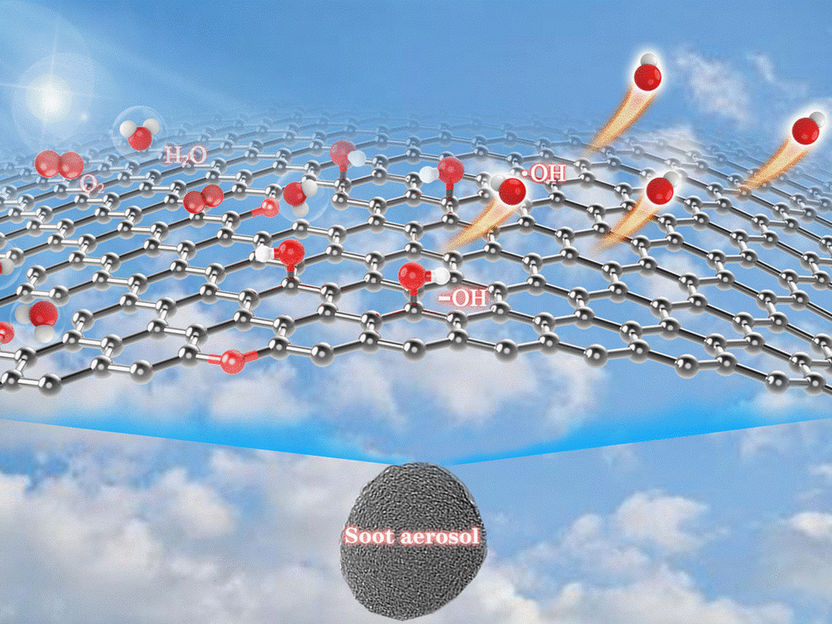
© Wiley-VCH
Haze consists of fine particulate matter containing soot. It is formed when gaseous pollutants, which are from industrial emissions, vehicle exhausts, and other sources, are converted to condensable matter. “This condensation is remarkably accelerated under the action of OH radicals,” says Joseph S. Francisco from the University of Pennsylvania in Philadelphia, USA, who is co-author of the study.
The commonly known sources for OH radicals, such as nitrogen oxide and ozone, only partly account for the vast haze events which keep occurring in haze-afflicted regions such as the megacities of East and South Asia.
In a cooperation, the teams of Hong He at the Chinese Academy of Sciences, Xiao Cheng Zeng at the University of Nebraska-Lincoln, USA, and Francisco have now taken a closer look at the chemical activity of soot particles. Soot originates from diesel engine exhaust fumes or is spread by slash-and-burn practices or forest fires. However, to date, soot particles consisting of uncombusted carbon have been considered more as a sink of hydroxyl radicals, rather than a source.
Despite this, Francisco and the team’s new experiments showed that soot particles can produce OH radicals if air and water vapor are blown over the particles while being irradiated with light.
It was expected, though, that hydroxyl species formed in this process would not leave the surface of the soot and would quickly react again. However, energy calculations showed that the hydroxyl exhibited “roaming-like features”, as the authors stated it: they migrated over the surface, ultimately leaving it.
The results of their study led the team to the conclusion that soot particles play an active role in smog formation. But the researchers aren’t stopping there: since it seems that light radiation is sufficient to decompose water molecules into radicals, this material could potentially be used to develop metal-free carbocatalysts. Such soot-based catalysts could either help purify the air from pollutants such as nitrogen oxide and volatile organic compounds (VOCs), or they could be used to generate chemical energy from light energy. This could pave the way for an environmentally friendly form of artificial photosynthesis.
Original publication


Other news from the department science





















Most read news












More news from our other portals

























Last viewed contents

Breakthrough for efficient and high-speed spintronic devices - New soft X-ray source could be used for many applications in physics, chemistry, and biology

Keep safe and cool in the pool - Novel chip sensor quickly and continuously does all the work of a chemistry laboratory

“Dictionaries” make fluorescence-based data for integrative structure models and their dynamics accessible - 3D structures of biomolecules

PSL - Powder Systems Limited - Liverpool, United Kingdom
Significant progress achieved in chemical liquid analysis - ISFET-based pH sensor-control successfully miniaturized and optimized for easy use

From research to spinoff - PSI Founder Fellowship supports two spin-off projects: AI platform and solid-state batteries
Waste Becomes Recyclable Material - New Process Turns Urine and Ash into Sustainable Raw Materials
Stora Enso announces startups selected for its second Accelerator Programme

Scientists develop new thermofluidic process for lab-on-a-chip applications - This will unlock groundbreaking solutions for nanotechnology, the manipulation of liquids in systems in tiny spaces, or in the field of diagnostics

Breakthrough process for directly converting methane to methanol

Discovering new field affecting metals solidification