Gas Drying with up to 90 Percent Less Energy
Advertisement


Natural gas, biomethane, hydrogen: Each of these must have their water content removed before they can enter the supply network. This process previously involved the use of chemicals and high temperatures. A new technology developed by Fraunhofer researchers can now deliver this result using nanoporous membranes—rapidly, cleanly, and with minimal energy consumption. This allows renewable energy suppliers to cut costs and reduce climate-damaging emissions.
Water present in hydrogen, natural gas or biomethane can cause corrosion in pipelines and jeopardize the functionality of valves or sensors. Until now, the practice has been to expose these gases to triethylene glycol (TEG) so that water is absorbed from them before they are fed into the network. The absorbed water is then removed by distillation at approximately 200 degrees Celsius before the chemical is reused. However, the high temperatures induce cracking in the TEG, generating undesirable gases, which must be burned off—an extremely energy-intensive process that also generates carbon emissions.
Researchers at the Hermsdorf location of the Fraunhofer Institute for Ceramic Technologies and Systems IKTS have now developed an innovative method that uses membrane technology to extract the water from the gas. The gas passes through a ceramic tube, the inner surface of which is coated with an ultra-thin, nanoporous layer that acts as a membrane. Since the water molecules are smaller than the gas molecules, they pass through the pores and are conducted through the porous ceramic carrier to the outside.
Hannes Richter, Head of Nanoporous Membranes, lists the advantages: “This process dispenses with TEG and therefore eliminates the need for distillation and residue incineration. We save up to 90 percent of the energy used by conventional gas-drying technology, and there are no carbon emissions whatsoever.”
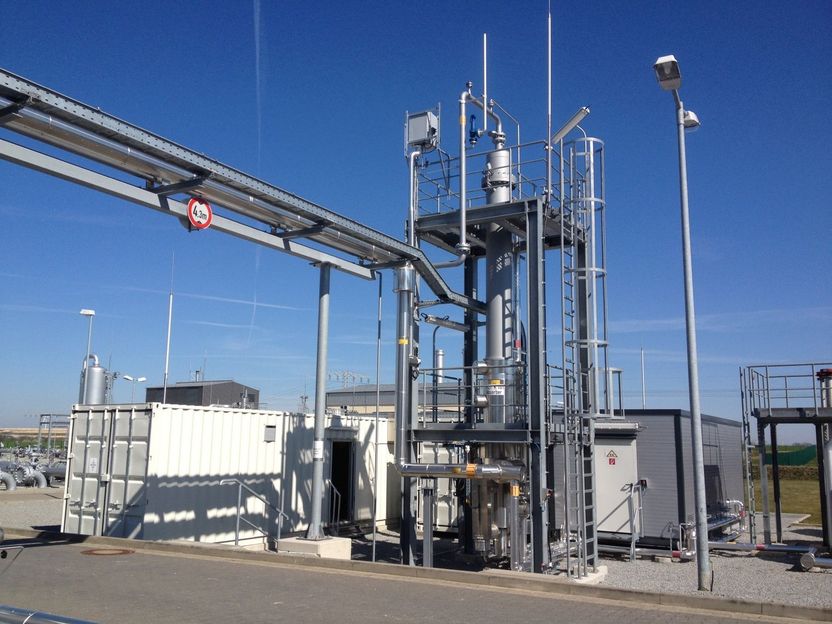
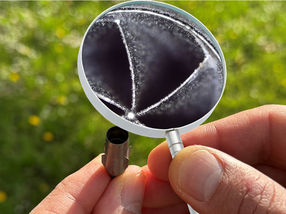
Pilot plant in Stassfurt, where gas is dried using ceramic membranes.
© Fraunhofer IKTS
Nanopores for water molecules
The Fraunhofer researchers had to develop a nanoporous membrane that would allow the water to separate from the gases. The layer thickness is measured in micrometers, while the pores are 0.4 nanometers in size. This membrane is applied to a ceramic carrier. Water molecules are 0.28 nanometers in size and can therefore pass through the pores. Adrian Simon, Group Manager for Zeolite and Carbon Membranes, describes the challenge: “The nanoporous material covering the ceramic carrier must form a perfectly sealed layer, otherwise it cannot function as a membrane for water molecules and would also allow larger molecules to pass through.”
The research team has developed two types of membrane: one a carbon-based membrane for drying biomethane, the other a zeolite-based membrane for natural gas and hydrogen. Zeolite is a crystalline material consisting of silicon, aluminum and oxygen. The membrane is created by pouring a zeolite suspension into the ceramic tube, where it adheres to the inner surface. After heating the tube in a synthesis solution, the zeolite crystals grow and merge into a closed layer.
The carbon-based version is produced from an organic precursor, which is likewise poured into the tube. This results in the formation of a thin polymer layer with defined properties, which is then heated in the absence of oxygen. At temperatures above 700 degrees Celsius, the polymer converts into a non-porous carbon layer.
The research team succeeded in optimizing the production process after numerous tests and development steps, during which the Fraunhofer institute in Hermsdorf was able to draw on years of expertise in high-end membrane technology and the handling of ceramic materials.
Cutting the cost of renewable energy
Fraunhofer researcher Richter describes the next step: “We are currently scaling up the technology from pilot plant dimensions to industrial implementation.”
The Fraunhofer technology offers pipeline operators the opportunity to dry biomethane, natural gas or hydrogen quickly and cleanly while minimizing energy consumption, thus protecting their systems and cutting costs. The experts at Fraunhofer IKTS can advise energy suppliers, grid operators and plant manufacturers on pilot plant construction or work with them to develop corresponding concepts.


Other news from the department research and development










Most read news










More news from our other portals



























Last viewed contents
From trash to treasure: new method efficiently regenerates spent lithium cobalt oxide batteries - A significant step toward sustainable battery reuse
New AI Method Revolutionises the Design of Enzymes - New Riff-Diff technology designs enzymes for chemical reactions efficiently and precisely in a one-shot process

Not just faster, but smarter: AI that explains its discoveries - Using a grey-box approach, a catalyst was identified in fewer than 50 experiments that outperforms the industry standard for propane dehydrogenation
Green hydrogen from sunlight and water - without electrolyzers and without electricity - Photreon, a spin-off from KIT, is developing a photoreactor panel that enables direct solar hydrogen production

Digital lab day 2025 celebrates international success - virtual battery day 2025 follows in November

RE:VOLTAGE and CometHire Win the HTW Startup Challenge 2026 in Berlin - The competition awarded 10,000 euros in prize money in the GreenTech and Impact Entrepreneurship categories
Atomic reshuffle paves way for record-breaking catalysts for hydrogen production - "This opens a new strategy for designing adaptive catalysts for a wide range of applications"

Global underground CO₂ storage hits record 43.6 million tonnes - London Register expands reach
Research Breakthrough on the Path to a New Reserve Antibiotic - For the first time, chemists have succeeded in synthesizing the highly potent natural compound neosorangicin A

Endress+Hauser expands its presence in the U.S. - 44 million euros are being invested in the new facility in Greenwood, Indiana
Plastic bottles could find new life in batteries as graphite - Penn State researchers converting PET waste into synthetic graphite that outperforms natural graphite