Humanoid robots, AI & co.: the digital transformation of industry enters the next round
More than half of German industrial companies fear they will miss out on the AI revolution
Advertisement


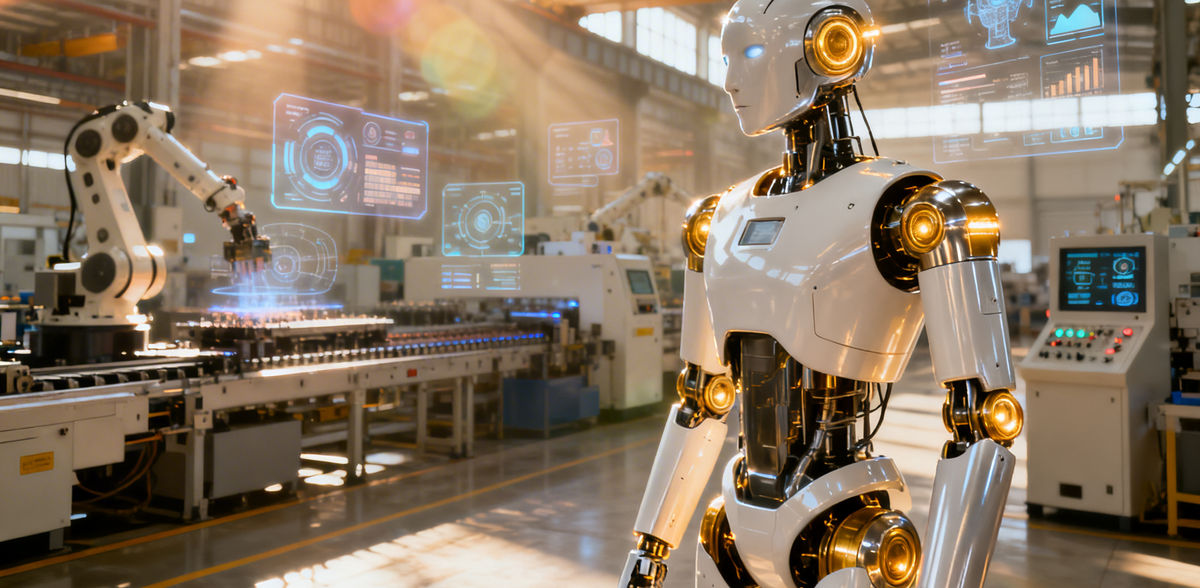
Automated production processes with artificial intelligence, faster production through 3D printing or humanoid robots that take over dangerous welding work - Germany's factories are becoming more digital. German industry is largely positive about the use of digital technologies in production: 81% of German industrial companies see Industry 4.0 as an opportunity, while only 16% see it as a risk. At the same time, Industry 4.0 is a competitive factor. For almost all German industrial companies (94%), Industry 4.0 is very important or even indispensable in order to survive in international competition (indispensable: 30%; very important: 64%). Only just under 4 percent, on the other hand, consider Industry 4.0 to be unimportant. These are the results of a representative survey conducted on behalf of the digital association Bitkom among 555 industrial companies in the manufacturing sector with 100 or more employees in Germany on the occasion of the Hannover Messe. "Industry 4.0 is not a technology trend, but the basis for industrial competitiveness," says Bitkom Vice President Dr. Tanja Rückert. "With AI and future humanoid robots, Industry 4.0 is getting a massive upgrade; the digital transformation of German industry is entering the next round with AI."
The Bitkom study shows just how important these technologies are for the competitiveness of German industrial companies. 9 out of 10 industrial companies (89%) generally consider Industry 4.0 to be very important or somewhat important for the competitiveness of industry, and almost 8 out of 10 (78%) do so for artificial intelligence. Humanoid robots, i.e. AI-based human-like robots, are also considered by the majority to be important for competitiveness: more than 6 in 10 industrial companies (63%) consider this technology to be very important or somewhat important.
Industry 4.0 has arrived in production
In production, Industry 4.0 is not a vision of the future, but a reality. 97% of industrial companies use at least one Industry 4.0 application. Artificial intelligence is most widespread in the area of intelligent control and planning. AI is already being used by 40 percent of industrial companies, and almost as many (38 percent) are planning to do so. Digital twins are now also widespread: 45% of industrial companies are using them and 26% are planning to do so. Physical AI, i.e. AI that enables machines or robots to perform physical tasks independently, is used by 6% of German industrial companies. Although the technology is still in its infancy, more than a quarter of companies (28%) are already planning to introduce it. When it comes to digital infrastructures and networking, IoT platforms are at the top of the list of relevant technologies: they are used by 45% of industrial companies and planned by a third (33%). However, data rooms, edge computing, lifecycle management and 5G campus networks are also used in production and contribute to networked production. "A good ten years after the term was introduced, Industry 4.0 is part of everyday life in factories," says Rückert. "Now it's important to open a new chapter in Industry 4.0 with digital twins, AI and, in future, humanoid robots." 27% of German industrial companies want to invest more in Industry 4.0 technologies in 2026 compared to 2025, while 50% want to maintain their investments at the current level. 20 percent are planning to invest less.

Humanoid robots as an opportunity for greater productivity
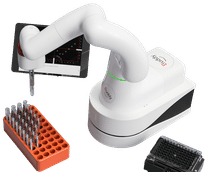
In addition to widely used applications such as AI, IoT platforms and digital twins, new technologies are increasingly coming to the fore - including humanoid robots. They belong to the field of physical AI and can perform tasks that were previously carried out by humans. Industrial companies see this as a productivity factor: more than 6 out of 10 industrial companies (64%) believe that humanoid robots will make industry more productive. Almost 7 out of 10 (68 percent) are in favor of Germany quickly developing humanoid robots itself and bringing them to the global market. At the same time, almost one in three industrial companies (31%) believe that humanoid robots are a hype that will soon pass, while 41% believe that the technology costs more than it brings. Rückert: "Opinions are currently divided on humanoid robots."
Humanoid robots are already being used in isolated cases in German industry. 6 percent of industrial companies are working with them, one in ten companies (10 percent) are planning to do so and 8 percent are discussing it. However, for 3 out of 4 industrial companies (72%), the use of humanoid robots is not yet an issue. Looking to the future, the situation looks different. Overall, almost the entire German industry (97%) can imagine the widespread use of humanoid robots in production, at least in the long term. One in five companies surveyed (20 percent) expects humanoid robots to be used in the majority of industrial companies in the next ten years. 3% assume that this will already be the case in five years' time, while 17% expect this to be the case in the next six to ten years. At 54%, the majority of industrial companies believe that such a scenario is only realistic in the long term in the period from 11 to 20 years, 14% expect it to happen in 21 to 30 years and 9% expect it to happen in the very distant future after more than 30 years. However, hardly anyone thinks that humanoid robots will never become widespread in industry. Only 2 percent of industrial companies share this fundamental skepticism towards this new technology.
"Humanoid robots were science fiction the day before yesterday, yesterday they were considered visionary and now they are becoming a real, business-relevant industrial topic," says Tanja Rückert. "It is crucial that Germany invests equally in the development and use of humanoid robots."
Industry sees AI as a competitive factor
The example of humanoid robotics shows how strongly industrial development is now being shaped by artificial intelligence. Rückert: "AI is no longer just a single application, it is currently becoming the most important basic technology in industrial development, production and operation." Almost 8 out of 10 industrial companies (79%) believe that artificial intelligence will be decisive for the competitiveness of German industry in the future. 76% are of the opinion that German industry should play a pioneering role in the use of AI. Only 19 percent consider AI in industry to be a temporary hype. At the same time, more than half (55%) agree with the statement that German industry is in danger of missing out on the AI revolution, nine percentage points more than last year. Nevertheless, every second German industrial company (51%) sees itself at the forefront of AI. In contrast, 46 percent see themselves as lagging behind (36 percent) or even say they have missed the boat (10 percent).
"Artificial intelligence is probably the most important future issue for German industry," says Rückert. "Companies see enormous potential in AI for greater efficiency, quality and competitiveness."
Difficult economy slows down digitalization
The difficult overall economic situation is having a negative impact on the digitalization of German industry. More than half (58%) of industrial companies believe that the current economic situation will slow down the digitalization of their company. 45% anticipate job cuts in their own company, while 48% expect to be able to recruit skilled workers as a result of job cuts in other industrial companies.
In addition to the economic situation, competition from China is also increasing the pressure on German industry. More than one in eight industrial companies (13%) feel very strong competitive pressure due to increased exports from China, while almost half (49%) feel somewhat strong competitive pressure. Conversely, only one in five industrial companies (22%) feel only slight additional pressure, while 13% feel no additional pressure at all.
Germany has some catching up to do when it comes to Industry 4.0
The economic pressure is hitting industry at a time when international competition is intensifying. According to companies' self-assessment, Germany is only in third place internationally when it comes to Industry 4.0. One tenth (10 percent) of industrial companies see Germany as an international leader in Industry 4.0. China is currently most frequently named as the leading nation in Industry 4.0 (34%), and the USA is also perceived as leading in this area by 21%.
Respondents were somewhat more positive about the situation of their own company. 9 percent of German industrial companies see themselves as leaders, 38 percent as pioneers in Industry 4.0. Conversely, just under half (50 percent) see themselves as laggards, with only 1 percent saying that their own company has missed the boat. "China is setting the pace in Industry 4.0," says Rückert. "Germany must keep up, with more speed and investment in innovation and digital infrastructure."
Companies and politicians now have a responsibility
How can industrial companies be better supported in the introduction of Industry 4.0 applications? The right course needs to be set both in industry itself and in politics:
"Many central applications of Industry 4.0 are now based on AI or are becoming significantly more powerful thanks to it. This makes it all the more important to not just test AI selectively, but to systematically transfer it into production and engineering processes - with efficient infrastructure, uniform data standards and qualified employees along the value chain," says Rückert. "Germany needs better location conditions for industrial AI: More computing capacities, better data infrastructures, implementable rules, targeted specialist training and simple funding programs for SMEs. Now it's no longer about the next pilot project, but about the widespread use of AI in business and industry."
Note: This article has been translated using a computer system without human intervention. LUMITOS offers these automatic translations to present a wider range of current news. Since this article has been translated with automatic translation, it is possible that it contains errors in vocabulary, syntax or grammar. The original article in German can be found here.


Other news from the department business & finance







These products might interest you