For a Knowledge-Based Democracy
The Klaus Tschira Foundation Supports Research Collaboration on Decisions Between Natural and Artificial Intelligence
Advertisement


How can we make good decisions in an increasingly complex world? A research collaboration funded by the Klaus Tschira Foundation is addressing this question. Participants include the Max Planck Institute for Geoanthropology in Jena, Arizona State University, and the Alexander von Humboldt Foundation.
The focus is on societal challenges such as urban planning, water supply, and the energy transition. Many interests converge in these areas. At the same time, the volume of data and information is growing. Finding common ground often seems nearly impossible.
The project therefore aims to develop digital tools and platforms for dialogue that help people navigate the complex issues of the Anthropocene. Researchers use the term “Anthropocene” to describe the geological epoch in which humans are having a decisive impact on the planet.

Shaping the Future Together
The researchers aim to bring together people with diverse interests. Those directly affected should participate alongside experts and artificial intelligence. AI can, for example, adopt the perspective of a group that is not represented at the table. It can also quickly calculate various future scenarios and demonstrate the potential consequences of specific decisions.
The focus is on the challenges of the energy transition at the regional and global levels. The researchers want to find out how data-driven models, clear visualizations, and the use of artificial intelligence can facilitate societal debates. Their goal is a knowledge-based democracy.
The Max Planck Institute for Geoanthropology offers ideal conditions for this project. The institute was founded in 2022 and investigates the causes and interconnections of the multiple crises of the Anthropocene.
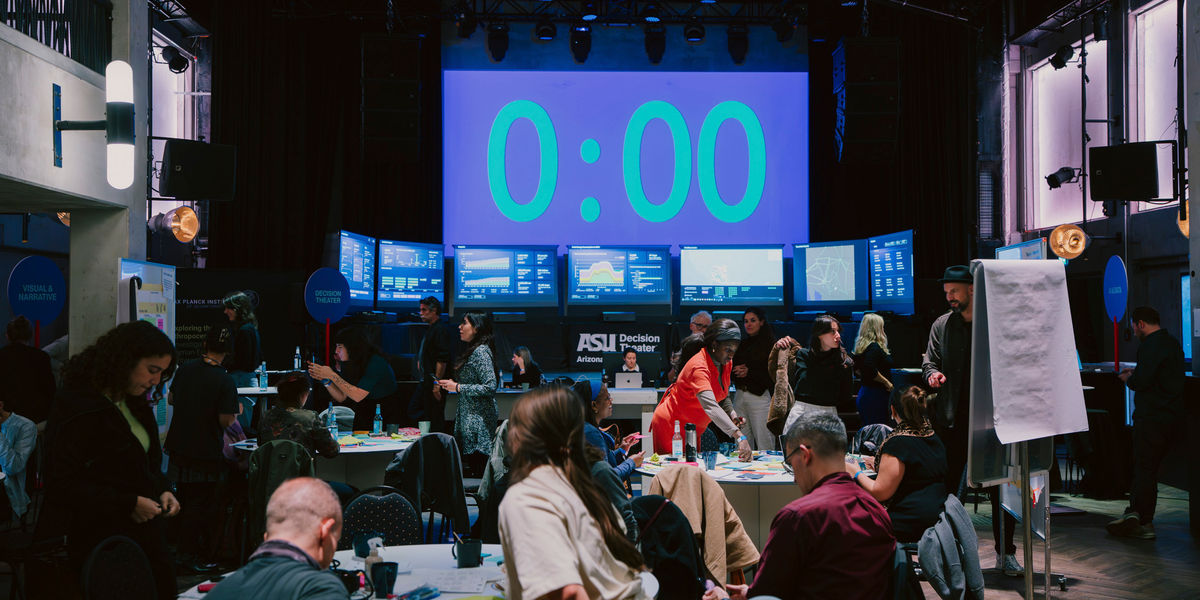
The project takes its cue from Arizona State University’s Decision Theater. There, a participatory format was developed that helps people develop shared visions of the future and negotiate concrete solutions.
New Tools for the Future
“It’s about constructive solutions,” explains Professor Jürgen Renn, one of the lead researchers. “To address the conflicts of our time, we need new tools.”
He is particularly drawn to the project’s practical approach. It’s not about abstract models, but about concrete initiatives. One example is a municipality in Baden-Württemberg that aims to become climate-neutral. There, the goal is to bring different interests to light and facilitate dialogue among people.
“We want neither radical oversimplification nor fatalism,” says Renn. Science must translate complex concepts and make connections understandable. Only when people regain the sense that they can make a difference themselves will sustainable decisions be possible.
A parallel scientific research study is examining how these methods can be applied to other regions. At the same time, it aims to demonstrate how transparency and credibility can be ensured, particularly where artificial intelligence is involved. Disclosing assumptions and data sources makes the results open to scrutiny in the best sense of the word: they become the subject of discussion, not the end of it. If this succeeds, it could also strengthen trust in political action.
Note: This article has been translated using a computer system without human intervention. LUMITOS offers these automatic translations to present a wider range of current news. Since this article has been translated with automatic translation, it is possible that it contains errors in vocabulary, syntax or grammar. The original article in German can be found here.


Other news from the department science