Molecular chains with bite: breakthrough achieved in polymer research
Halogen-free process produces cleanest PPP synthesis ever
Advertisement


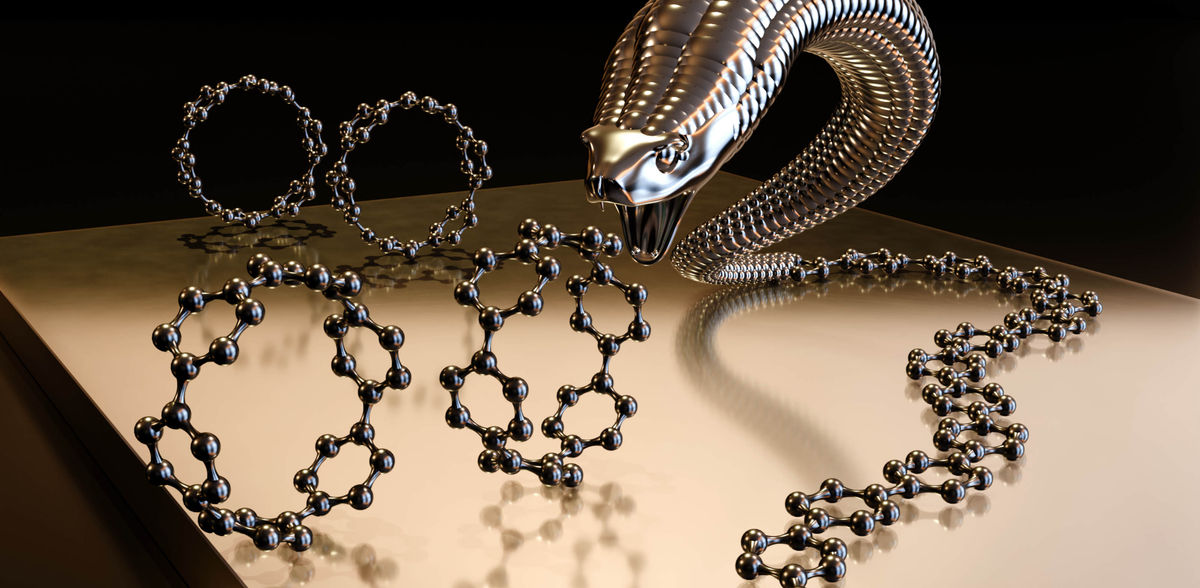
The longest chains of the conductive polymer poly(p-phenylene) (PPP) produced to date are almost one micrometre (thousandth of a millimetre) long - almost an order of magnitude longer than previously possible. A research team from chemistry and physics led by Prof. Dr. Michael Gottfried from the Philipps University of Marburg has thus shown for the first time that PPP can be synthesized on surfaces via a specific ring-opening polymerization as true chain-growth.
The statistically most frequently measured length value is around 170 nanometers - with one outlier up to almost 1,000 nanometers. Record. The new, halogen-free process does not require any disruptive by-products and thus opens up particularly clean access to ultra-long, conjugated polymer chains. The interdisciplinary team from the University of Marburg, Giessen, Leipzig and Chinese researchers published the results in the journal "Nature Chemistry".
Targeted chain growth
In contrast to previous surface-based coupling reactions, in which many short pieces of molecule come together by chance, here a chain continues to grow at one end in a controlled manner: pre-stressed ring molecules are opened and attached to a copper surface in an ultra-high vacuum by the reactive end of the chain. "This mechanism prevents by-products that would otherwise block the surface for further reactions," reports chemist Michael Gottfried. Using high-resolution scanning tunnelling microscopy (STM) and non-contact atomic force microscopy (nc-AFM) with a functionalized tip, the researchers were able to make individual bonds directly visible. X-ray photoelectron spectroscopy (XPS) and NEXAFS measurements provided additional evidence of the chemical changes during the reaction. Density functional theory simulations from the University of Leipzig underpinned the proposed reaction pathway and explained the energetic advantages of chain growth. The ultra-long PPP chains can be heated via specific intermediate stages to produce novel nanoribbons with lengths of up to around 40 nanometers. "We later turn two chains into a new ribbon of carbon, just like a zipper," explains Gottfried.
Potential applications for molecular semiconductor components
The work is basic research in the best sense of the word: it expands the chemical toolset for producing atomically precise carbon structures - potential building blocks for future molecular electronics, organic transistors or novel semiconductor nanoribbons. "PPP is one of the conjugated polymers whose electronic properties are strongly dependent on chain length and structural perfection," comments Gottfried. At the same time, the ultra-long chains that are now accessible serve as a starting point for defined carbon nanoribbons with tailored properties.
Collaboration of short paths
The breakthrough was made possible by the close interaction between chemical design, surface physics, high-resolution microscopy and theory in the LOEWE focus area "Principles of On-Surface Synthesis (PriOSS)", a joint project of the Universities of Marburg and Giessen. Short paths, interdisciplinary expertise and the consistent combination of ideas, experiments and atomic imaging - this "Marburg-Gießen spirit" makes it possible to construct molecules as if according to a blueprint and to visualize their formation step by step. "The work of Michael Gottfried and his team impressively demonstrates the potential that lies in the close cooperation between the universities of Marburg and Giessen at the Central Hesse Research Campus," says Vice President for Research Prof. Dr. Gert Bange. "By pooling complementary expertise, scientific breakthroughs and new perspectives for atomically precise materials and future semiconductor technologies are emerging here."
Note: This article has been translated using a computer system without human intervention. LUMITOS offers these automatic translations to present a wider range of current news. Since this article has been translated with automatic translation, it is possible that it contains errors in vocabulary, syntax or grammar. The original article in German can be found here.
Original publication
Qitang Fan, J. Michael Gottfried et al., On-Surface Radical Ring-Opening Polymerization Produces Ultra-Long Poly(p-phenylene) for Access to Nonbenzenoid Carbon Nanoribbons, Nature Chemistry (2026)


Other news from the department science











Most read news








More news from our other portals




















See the theme worlds for related content
Topic World Spectroscopy
Investigation with spectroscopy gives us unique insights into the composition and structure of materials. From UV-Vis spectroscopy to infrared and Raman spectroscopy to fluorescence and atomic absorption spectroscopy, spectroscopy offers us a wide range of analytical techniques to precisely characterize substances. Immerse yourself in the fascinating world of spectroscopy!

Topic World Spectroscopy
Investigation with spectroscopy gives us unique insights into the composition and structure of materials. From UV-Vis spectroscopy to infrared and Raman spectroscopy to fluorescence and atomic absorption spectroscopy, spectroscopy offers us a wide range of analytical techniques to precisely characterize substances. Immerse yourself in the fascinating world of spectroscopy!