Ironing out materials for gas storage and separations
Advertisement


An iron-based porous solid that can store hydrogen and capture carbon dioxide, potentially leading to greener energy and cleaner air, has been made by US scientists.
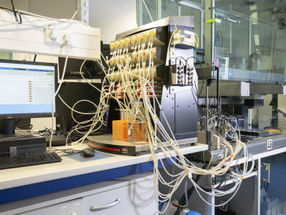
Jeffrey Long, at the University of California, Berkeley, and colleagues made a metal-organic framework (MOF) with accessible Fe2+ sites on its surface. Although similar structures using manganese and copper cations were made by the team, they found that the iron ions were better at binding hydrogen. At room temperature, the iron-based MOF bound hydrogen more strongly than most other reported MOFs, moving hydrogen storage research a step closer to US Department of Energy targets for hydrogen fuel cell-powered cars. The MOF is also good at binding carbon dioxide, reports Long, making it of interest for capturing the greenhouse gas from power station waste. Long developed a high-throughput method for making the MOF, which made it easy to investigate a variety of reaction conditions.
Porous solids known as MOFs can have extremely high internal surface areas, making them of interest for use in mobile hydrogen storage systems. However, at room temperature, MOFs are not good at storing hydrogen because the interactions between the gas and the MOF surface are weak. One way to improve their performance is to generate exposed metal cation sites on the framework surface, which provide strong adsorption sites for hydrogen.
“Our research lays out a strategy for using automated instrumentation for the rapid, parallel synthesis of new materials for hydrogen storage and carbon dioxide capture,” says Long. “We are now working to couple this technology with high-throughput screening instrumentation that will enable us to further speed the pace of discovery of these desperately needed materials.”
Original publication: Kenji Sumida, Satoshi Horike, Steven S. Kaye, Zoey R. Herm, Wendy L. Queen, Craig M. Brown, Fernande Grandjean, Gary J. Long, Anne Dailly and Jeffrey R. Long; Chem. Sci. 2010.


Other news from the department science















Most read news









More news from our other portals























See the theme worlds for related content
Topic world Synthesis
Chemical synthesis is at the heart of modern chemistry and enables the targeted production of molecules with specific properties. By combining starting materials in defined reaction conditions, chemists can create a wide range of compounds, from simple molecules to complex active ingredients.

Topic world Synthesis
Chemical synthesis is at the heart of modern chemistry and enables the targeted production of molecules with specific properties. By combining starting materials in defined reaction conditions, chemists can create a wide range of compounds, from simple molecules to complex active ingredients.