Antiferromagnetic network with direction of rotation
Tiny magnetic structures in an ultra-thin manganese layer show an unusual direction of rotation - now researchers from Kiel and Hamburg explain why
Advertisement


A standard refrigerator magnet is ferromagnetic: the tiny magnetic moments of the atoms all point in the same direction. The magnetic forces of such magnets can therefore be easily utilized, for example in compasses, sensors or data storage devices.
However, there are also materials in which the magnetic moments of neighboring atoms are aligned in opposite directions. These are called antiferromagnets. They do not form a measurable magnetic field on the outside and were long considered difficult to use. The French physicist Louis Néel was awarded the Nobel Prize in Physics in 1970 for this discovery.
Today, this class of materials is considered very promising. Antiferromagnets could play a central role in magnetoelectronics, a field of research that uses electrical currents to manipulate and read magnetic states. At the same time, complex magnetic networks offer completely new possibilities for novel, unconventional computers. They react particularly strongly to electrical currents and can form three-dimensional magnetic structures in which the atomic moments point in different spatial directions.
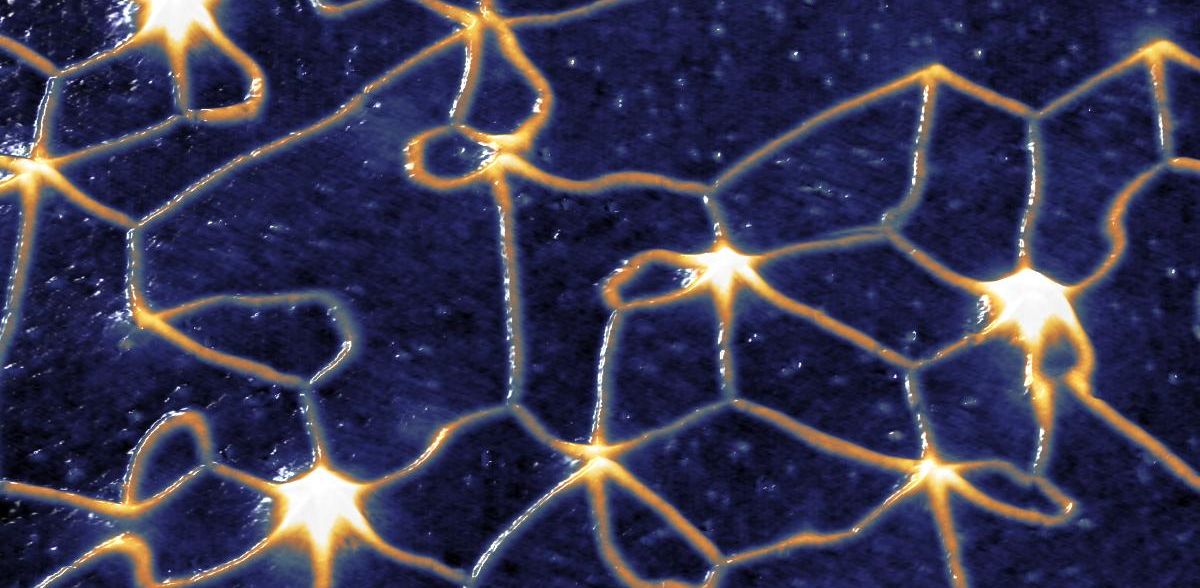
Researchers from Kiel University (CAU) and the University of Hamburg have now shown in Nature Communications how a complex antiferromagnetic network is formed in an ultra-thin manganese layer. At the intersection points of the domain walls, the atomic magnetic moments are directed in a defined spatial direction of rotation. The study thus provides direct insights into the inner structures of antiferromagnets and opens up perspectives for new magnetic components.
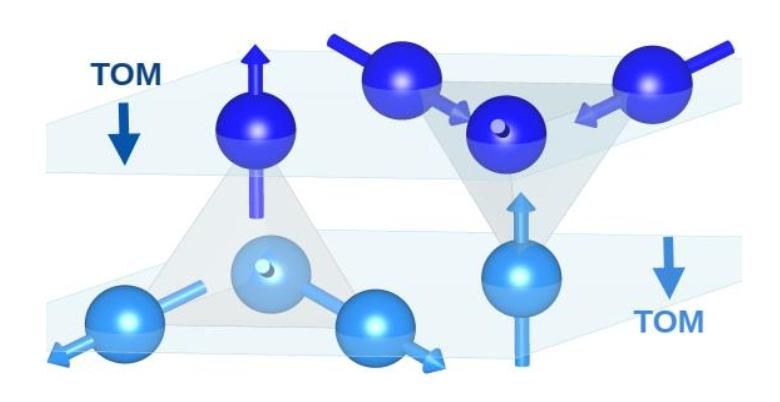
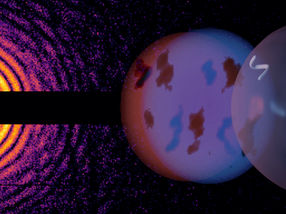
The dark blue (light blue) spheres represent the manganese atoms of the upper (lower) layer of the film. The arrows show the orientation of the "atomic bar magnets" of the manganese atoms. The plane of the atoms in the upper and lower layers are represented by transparent gray areas. The orientation of the "atomic bar magnets" along the axes of a tetrahedron is shown by the gray tetrahedra. The topological orbital magnetization (TOM) in the upper and lower layers is aligned parallel to each other (see small arrows)
© Mara Gutzeit, Uni Kiel
A look inside the nanomagnet network
The research team investigated a model system consisting of just two layers of manganese atoms deposited on an iridium crystal. Using spin-polarized scanning tunnelling microscopy, they were able to visualize the magnetic alignment of the atoms down to the atomic scale.
Project leader Dr. Kirsten von Bergmann from the University of Hamburg explains: "A complex magnetic network of domain walls between antiferromagnetically ordered areas appeared in the scanning tunneling microscopy images. We could see that it was generated by the implanted argon bubbles. At the crossing points of three domain walls, we found a handedness of the structure on the one hand, and on the other hand we discovered that the "atomic bar magnets" here point in the directions of the corners of a tetrahedron, i.e. they have an angle of approx. 109.47° to each other."
Using complex quantum mechanical calculations, for which supercomputers from the National Supercomputing Alliance (NHR) were used, the Kiel team showed that the top layer of the manganese layers shifts slightly sideways due to magnetic exchange forces. "Tension builds up at the points where areas with different magnetic alignments meet. This can explain the observed preferred structural direction of rotation (handedness) at the crossing points," says Professor Stefan Heinze from Kiel University. The Kiel researchers also clarified how a three-dimensional magnetic structure is formed at these points and how the two manganese layers are coupled together.
The branching of the domain walls does not occur randomly at the argon bubbles. The local tension in the material favors a certain type of magnetically induced shear motion of the film. The calculations also show that the three-dimensional magnetic order at these intersections has special, so-called topological properties. The study thus provides fundamental evidence that the close connection between structure and magnetism can be used in a targeted manner to create complex antiferromagnetic networks.
Note: This article has been translated using a computer system without human intervention. LUMITOS offers these automatic translations to present a wider range of current news. Since this article has been translated with automatic translation, it is possible that it contains errors in vocabulary, syntax or grammar. The original article in German can be found here.
Original publication


Other news from the department science