A New Source of Raw Materials for the Chemical Industry
Study Analyzes Research Needs on the Path to a Defossilized Basic Chemicals Industry
Advertisement


The organic chemical basic materials industry is still largely based on fossil carbon today—primarily natural gas and naphtha. The study “Transformation of chemical process engineering – Efficient Production Pathways with a Changed Raw Material Base,” conducted by DECHEMA Society for Chemical Engineering and Biotechnology e.V. on behalf of IREES GmbH – Institute for Resource Efficiency and Energy Strategies.
Pathways to Raw Material Transformation in the Chemical Industry
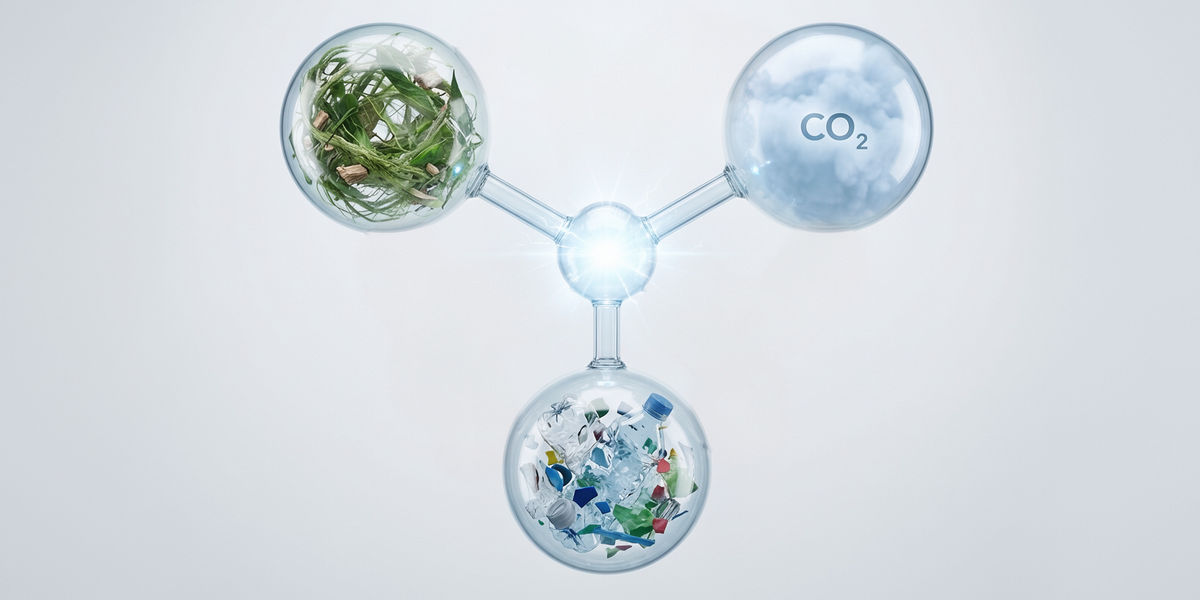
The study identifies three carbon sources intended to replace fossil naphtha and natural gas in the future: CO₂ from unavoidable point sources such as cement and lime plants, and biogenic sources such as biogas plants, biogenic residues and waste materials, as well as plastic waste. Process chains are described for these sources—from the processing of raw materials to the production of high-volume petrochemical platform chemicals. There are several technical pathways for producing the same basic chemical feedstocks in a climate-neutral manner in the future—provided that alternative carbon sources and renewable energy are combined. A comparative assessment of the various process chains—from raw materials to basic chemicals—is used to identify so-called “high-efficiency processes,” which, in addition to technical maturity, demonstrate significant potential for savings in costs and energy consumption, as well as low raw material requirements.
Three key areas are considered for the chemical conversion of alternative carbon sources:
- Power-to-X processes: The conversion of CO₂ and green hydrogen into methanol, and via “methanol-to-X” into basic chemicals, as well as via the Fischer-Tropsch route into synthetic feedstocks for the steam cracker.
- Biomass gasification and the conversion of synthesis gas into basic materials
- Thermochemical plastics recycling, particularly pyrolysis processes that yield cracker-compatible feedstocks
Some processes complement one another, such as the joint gasification of plastics and biomass or the parallel use of plastic pyrolysis and Fischer-Tropsch synthesis to produce cracker feedstocks.
Recommendations for Research Policy
Research and development on individual process steps, as well as experience gained from pilot and demonstration plants, are necessary before industrial implementation can occur. The study provides concrete recommendations for action regarding research needs in feedstock pretreatment, catalyst development, reaction engineering, and product processing. To achieve the best possible energy and feedstock efficiency, these must work together and be considered in conjunction with one another. In addition to feedstock-flexible gasification processes, Power-to-X processes, and the chemical recycling of plastics, priority research areas also include technically immature but particularly efficient processes such as homogeneously catalyzed methanol synthesis or the direct synthesis of olefins from synthesis gas.
Infrastructure and framework conditions must be in place
The study identifies three urgent infrastructural and political prerequisites:
1. Internationally competitive industrial electricity prices for electrified facilities
2. the accelerated development of supraregional CO₂ and hydrogen transport networks
3. a clear political prioritization of the material use of biomass and plastic waste over their use for energy.
It is also clear that while the transformation makes the chemical industry less dependent on imported fossil raw materials, it does not make it self-sufficient—the dependency simply shifts toward imported hydrogen and its derivatives from regions of the world with favorable conditions for renewable energy. The transformation is not feasible without investment: to ensure that value creation remains in Germany and Europe, the retrofitting of existing facilities (brownfield) plays a key role compared to expensive new investments (greenfield).
Note: This article has been translated using a computer system without human intervention. LUMITOS offers these automatic translations to present a wider range of current news. Since this article has been translated with automatic translation, it is possible that it contains errors in vocabulary, syntax or grammar. The original article in German can be found here.



Other news from the department science









Most read news







More news from our other portals






















See the theme worlds for related content
Topic world Synthesis
Chemical synthesis is at the heart of modern chemistry and enables the targeted production of molecules with specific properties. By combining starting materials in defined reaction conditions, chemists can create a wide range of compounds, from simple molecules to complex active ingredients.
Topic world Synthesis
Chemical synthesis is at the heart of modern chemistry and enables the targeted production of molecules with specific properties. By combining starting materials in defined reaction conditions, chemists can create a wide range of compounds, from simple molecules to complex active ingredients.