Reliable detection of highly toxic gases directly in the field
Biohybrid materials made from silica particles and selective peptides are intended to enable on-site detection using a handheld device

Advertisement


Whether in chemical accidents, contaminated sites, or the deployment of chemical warfare agents, hazardous gases must be detected quickly and reliably. What has so far been possible only through complex or inaccurate methods is set to become simple and reliable on-site in the future thanks to specifically designed materials. As part of the ProtecKD research project, the Fraunhofer Institute for Silicate Research ISC and its partners are developing a novel sensor system based on biohybrid materials designed to detect highly toxic substances with extreme sensitivity in the future. This will enable emergency responders to assess hazardous situations more quickly and precisely in the future. The project is funded by the Federal Ministry of Research, Technology, and Space (BMFTR).
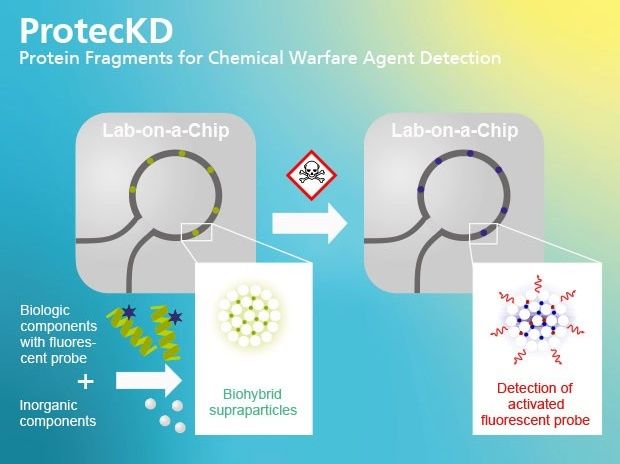
ProtecKD – the concept: Biohybrid sensor materials as a lab-on-a-chip system in a portable fluorescence handheld device for the early detection of chemical warfare agents and haz-ardous substances.
© Projekt ProtecKD
In operation against hazardous gases and chemical warfare agents such as sarin, sulfur mustard, or chloropicrin, emergency responders must be able to identify threats quickly and safely. Even the smallest concentrations can cause serious health damage or be fatal. Therefore, their rapid, simple, and reliable detection is crucial for the safety of emergency responders and the general public.
Methods currently available for on-site analysis during operations are often inaccurate or impractical. More precise and reliable methods are complex and can only be performed in specialized laboratories. Consequently, it is difficult to reliably assess the danger during an operation.
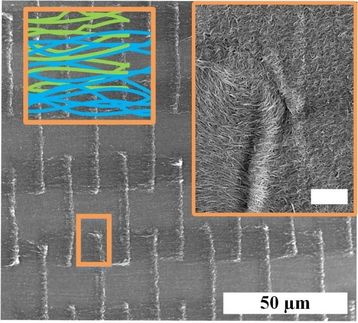
Biohybrid Sensor Materials for Rapid On-Site Detection
In the ProtecKD research project, the partners are working on a portable device that can directly and rapidly detect highly toxic gases using novel biohybrid materials. A novel aspect of the ProtecKD concept is the combination of biological detection units with inorganic nanoparticles that form stable, highly functional microparticles. They combine the properties of nanoscale materials with significantly easier handling. Fraunhofer ISC is contributing its many years of expertise in the field of functionalized particles.
Teamwork for Enhanced Safety
Four research institutions and companies are working closely together in the project team: project coordinator Fraunhofer ISC, JPT Peptide Technologies, the Bundeswehr Institute for Protective Technologies and CBRN Protection (WIS), and Noxoon GmbH.
At Fraunhofer ISC, carrier particles are synthesized from silicon dioxide—a mineral that occurs frequently in nature, e. g. in sand—and combined with special protein molecules known as peptides. These proteins are fixed on the specially functionalized particle surface and react specifically to certain gases by emitting fluorescence—that is, they emit light. This creates a biohybrid material. Project partner JPT is responsible for synthesizing these selective peptides. By employing various peptides that react specifically to different gases, multiple sensor fields can be integrated into a miniaturized, chip-based analysis system (lab-on-a-chip). Project partner Noxoon is responsible for building the detection device, which integrates all components. The characterization of the synthesized components and testing with various chemical warfare agents and hazardous substances under realistic conditions are carried out by project partner WIS.
ProtecKD Targets Easy Handling
The biohybrid sensor chip is inserted into the detection device. Both the optical measurement and automatic analysis are performed directly within the device, delivering reliable results to emergency responders in a short timeframe. Sensitive detectors capture changes in fluorescence; the signals are evaluated using self-learning algorithms and immediately display the detected gas type and its associated warning information to the user. In this way, the portable detection device is intended to provide quick and reliable support for mobile operations.
A key advantage of the concept is that the chemically engineered peptides react highly selectively and precisely to specific gases and chemical warfare agents. Thanks to the optimized sensor geometry of the lab-on-a-chip system, these substances can be detected with exceptional sensitivity. This will allow even minute quantities to be reliably detected and evaluated.
Another advantage is end-to-end digitization. All material and measurement data are recorded and stored in machine-readable form. ProtecKD is linked to the BMFTR’s “Material digital” initiative. The Fraunhofer ISC ensures the seamless digitization of material data with its “Material digital” expertise.
Better Protection for Emergency Responders and the Public
The rapid and reliable detection of highly toxic chemicals can significantly reduce response times. Emergency responders can initiate protective measures in a more targeted manner, assess hazardous situations more accurately, and avoid unnecessary lock-downs or evacuations. This allows for more efficient use of personnel and material resources.
Transferable to Other Application Areas
What works for the extreme demands of operations against hazardous gases and chemical warfare agents can also be further developed for other areas of application. For the project consortium, conceivable applications include, for example, environmental monitoring and industrial safety in the use and storage of industrial chemicals, active pharmaceutical ingredients, or explosives. ProtecKD could thus contribute to strengthening Germany’s international competitiveness in the field of safety and security technologies.


Other news from the department science












Most read news







More news from our other portals


















See the theme worlds for related content
Topic world Sensor technology
Sensor technology has revolutionized the chemical industry by providing accurate, timely and reliable data across a wide range of processes. From monitoring critical parameters in production lines to early detection of potential malfunctions or hazards, sensors are the silent sentinels that ensure quality, efficiency and safety.
Topic world Sensor technology
Sensor technology has revolutionized the chemical industry by providing accurate, timely and reliable data across a wide range of processes. From monitoring critical parameters in production lines to early detection of potential malfunctions or hazards, sensors are the silent sentinels that ensure quality, efficiency and safety.