Driving Reactions with Light – and without Solvents
Photochemistry: The correct movement facilitates light-driven reactions without the use of environmentally harmful solvents
Advertisement


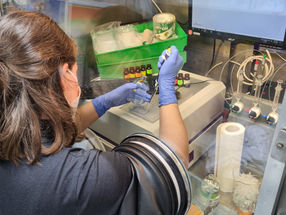
Light is an environmentally friendly energy source for chemical reactions. However, large quantities of harmful solvents have been required to ensure that light, due to its poor penetration depth, reaches the areas where it is needed. Carolina Spula omits the use of solvents. As a doctoral student working with Professor Lars Borchardt at the Chair of Inorganic Chemistry I at Ruhr University Bochum, her focus is on movement and dry photochemical reactions on solids.
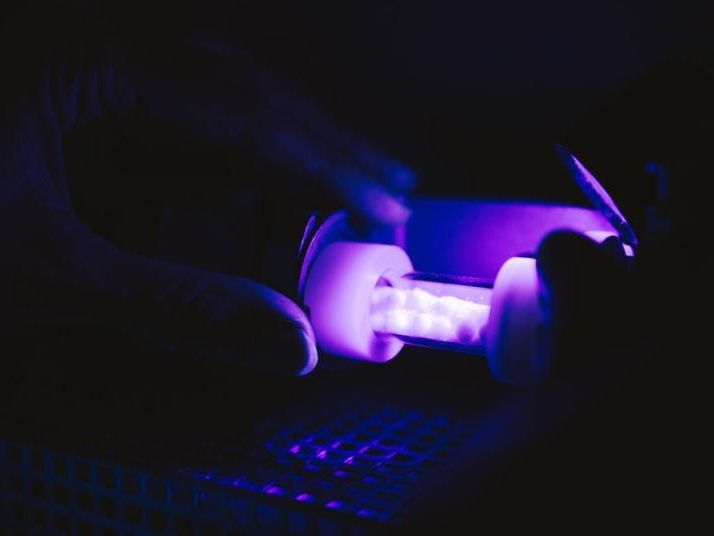
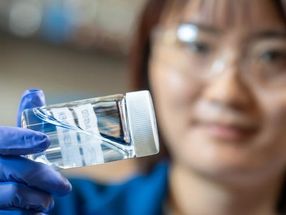
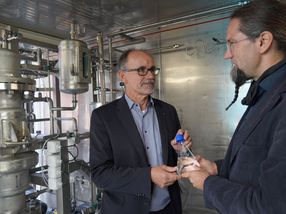
The researchers developed the transparent cylinders and small Teflon balls themselves for the experiments.
© RUB, Kramer
“Conventional solid-state photochemistry is limited to very small quantities,” explains Spula. Because light cannot deeply penetrate into solid powders, the conventional method used very thin powder layers spread onto a glass plate and illuminated it from below. This raised the question: How can larger quantities of powder be uniformly exposed to enable reactions throughout the whole mixture?
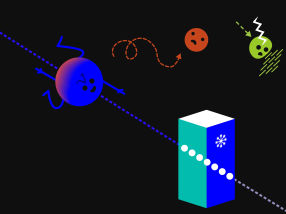
In her doctoral research, Carolina Spula developed specialized photoreactors for ball mills to allow irradiation of the reaction vessels, while shaking. These consist of a transparent quartz glass cylinder containing several small Teflon balls. The powdery starting material for the desired light-driven reaction is poured into the vessel.
Shaking or mixing
To realize photochemical reactions for larger powder quantities, Spula tested an alternative instrument with a different motion pattern: the resonant acoustic mixer. In this approach, the vessel is mounted upright and set into vertical vibration. “In some ways, it can be compared to the paint mixers you find in hardware stores,” she explains. No milling balls are required, allowing for greater powder loading.
Spula is working on organic reactions. This has allowed her to create small graphene nanoribbons and transfer her insights to C-X functionalizations. “The evaluation has shown that our UV-driven mechanochemical method has the best evaluation in terms of green chemistry metrics with the lowest energy consumption compared to solvent-based or metal-catalyzed methods,” the researcher explains.


Other news from the department science