Toxic metals in wheat grain: do they come from the soil or the fertilizer?
Advertisement


Plants not only absorb nutrients through their roots, but also toxic metals. It was previously unclear whether they came from the soil or the fertilizers applied. Under the leadership of the UFZ and Duke University (USA), a research team has examined wheat grains to clarify the question and, using a special isotope signature, found that the majority of the toxic metals come from the mineral fertilizer. A combination of mineral and organic fertilization would not only reduce the content of toxic metals, but also increase the content of metals that are important for human nutrition.
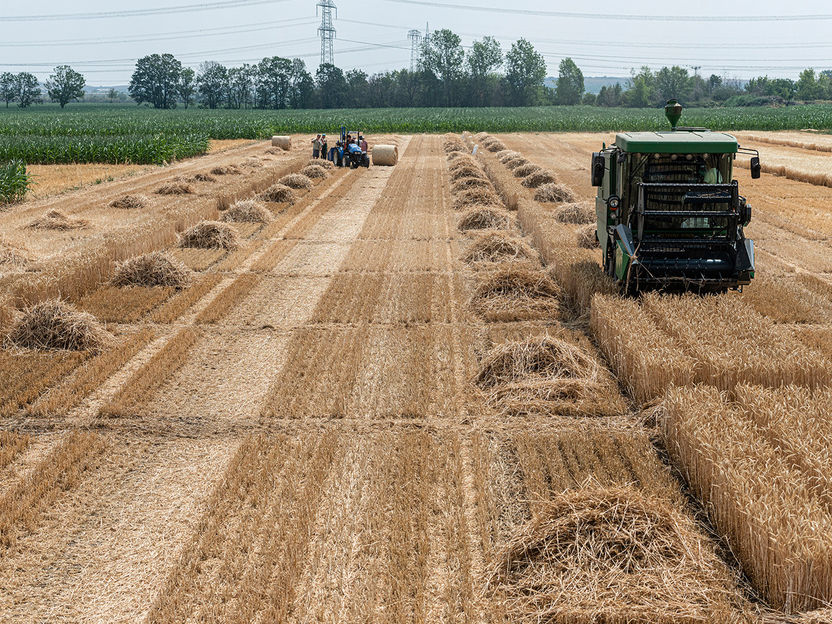
Cereal harvest in the static fertilization trial at the UFZ experimental station Bad Lauchstädt (Saxony-Anhalt).
André Künzelmann
"It is known from field and greenhouse studies that the type of fertilization, i.e. mineral or organic, has an influence on the metal content in food crops," says Prof. Dr. Marie Muehe, head of the Plant Biogeochemistry working group at the UFZ and co-study leader of the publication. "However, it was not previously known whether the metals absorbed by the plants originated from the soil or directly from the fertilizers applied." This is what the German-American research team wanted to find out with their current study.
The scientists used soil samples and wheat grains from the static fertilization trial at the UFZ research station in Bad Lauchstädt. The static fertilization trial was set up back in 1902 and is one of the most valuable long-term trials in the world, particularly due to its long duration. "Some trial fields have not been fertilized for over 120 years, others only with mineral fertilizer or with organic fertilizer such as manure from neighbouring farms or with a mixture of both," explains Marie Muehe. Over the long duration of the trial, the soil properties have developed very differently, for example the pH value or the organic matter content. The sample material from this long-term trial was therefore the perfect basis for the investigations. In addition, there is an excellent database, as soil samples and harvested wheat grains are archived every year from all the trial areas.
For their study, the researchers took a closer look at the samples from the past 20 years. "We first determined the respective metal contents in the soil, in the harvested wheat grains and in the fertilizers used," explains Aleksandra Pieńkowska, UFZ doctoral student and co-first author of the study. To find out whether the metals contained in the wheat grains originate from the soil or the fertilizer, the researchers used a special method: the so-called strontium isotope signature method. It is based on the fact that the chemical element strontium (Sr) occurs in two different forms - so-called isotopes - namely 87Sr and 86Sr. "Since the ratio of these two isotopes is different in every soil, it's basically like a fingerprint," explains Robert Hill, PhD student at Duke University (Durham, USA) and co-first author of the study. "If the ratio in the wheat grain is the same as in the soil on which the plant grew, you can conclude that it has absorbed the strontium from the soil. However, if the isotope ratio in the grain corresponds to that of the fertilizer, this is a clear indication that the strontium entered the grain via the fertilizer." And since it is known that plants absorb strontium and cadmium via similar pathways, conclusions can also be drawn for cadmium.
On the one hand, the results show that the toxic metals in the wheat grains examined originate from the fertilizer applied and not from the soil. Secondly, the metal content is particularly high in mineral fertilizers compared to organic fertilizers. "To classify these results, it is important to know that our investigations were carried out in a region with very fertile black earth soils. These effects could be even more pronounced in sandy or acidic soils," says Alexandra Pieńkowska. In view of the fact that permanent mineral fertilization also causes soil acidification, measures to stabilize the pH value, such as liming the soil, become even more important.
However, not all metals contained in mineral fertilizers are undesirable. Zinc, for example, is an important metallic trace element for nutrition. But can the uptake of zinc in wheat grain be promoted while at the same time preventing the uptake of toxic metals? "Our studies have also shown this: By combining fertilizers, it was actually possible to increase the zinc content in the wheat grain without increasing the cadmium content," says Marie Muehe. "We therefore recommend combined fertilization or alternating the application of mineral and organic fertilizers. On the one hand, this saves on fertilizer costs, and on the other, the grain is of a higher quality."
In further studies, the researchers want to investigate how the metal content in crops behaves when environmental conditions change, for example due to climate change.
Note: This article has been translated using a computer system without human intervention. LUMITOS offers these automatic translations to present a wider range of current news. Since this article has been translated with automatic translation, it is possible that it contains errors in vocabulary, syntax or grammar. The original article in German can be found here.
Original publication


Other news from the department science