Higher, faster, further with solid-state batteries
New findings on space charge effects could improve efficiency

Advertisement


In the future, solid-state batteries could store electricity more efficiently and safely than today's batteries with liquid electrolytes. Space charges that form in solid-state batteries have so far impaired their performance. * Space charges form primarily at the positive terminal of the batteries. This provides a starting point for preventing their formation by modifying the structure or material of the electrode.
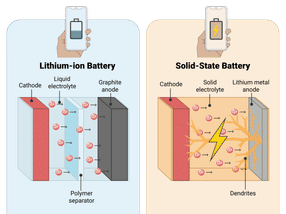
Whether in e-mobility or in stationary storage systems: Solid-state batteries promise more storage capacity and greater safety. This is because they no longer use a liquid electrolyte, but a solid one. This means they cannot leak, and the risk of fire, which is very rare with today's batteries but a recurring topic of discussion, is virtually non-existent.
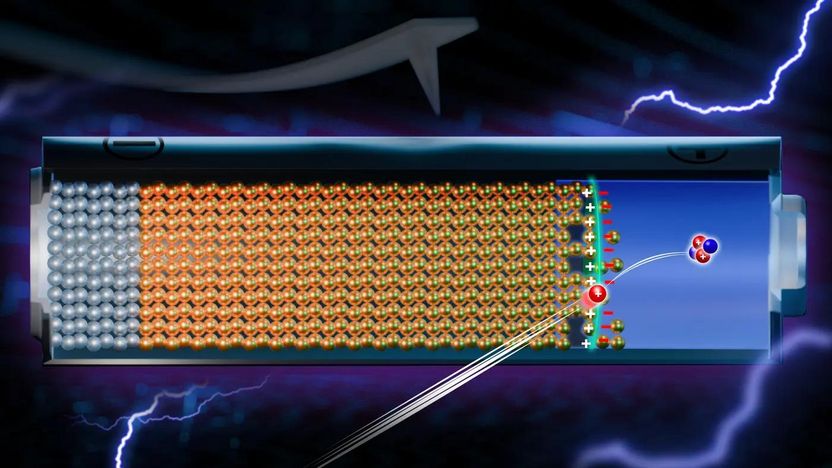
Researchers have taken a closer look at the space charge zone created within a lithium battery. With their investigations, they hope that such batteries could become even more powerful in the future.
© MPI-P
Resistance in the charge pump
Researchers from the Max Planck Institute for Polymer Research and Japanese universities have now opened up the possibility of making solid-state batteries more efficient in a study published in the journal ACS Nano. "A battery is a kind of pump," explains Rüdiger Berger, group leader at the Max Planck Institute for Polymer Research. "Ions, i.e. charged atoms, move around inside, which has to be balanced on the outside by a flow of electrons and thus a flow of current." When the ions migrate in the battery, a so-called space charge layer can form on the inner boundary surfaces of the battery. These repel the other migrating ions. This charge layer creates additional resistance and therefore losses within the battery - it hinders both the charging and discharging process.
As the Mainz team has now discovered, the effect occurs primarily at the positive electrode, where a charge layer less than 50 nanometers thick forms - as thin as the thinnest part of a soap bubble. In addition, they have quantitatively determined that the space charge layer is dynamic, i.e. it depends on the state of charge of the battery. This space charge layer accounts for around 7 percent of the total resistance of the battery, but can also be much greater depending on the materials used for the electrolyte.
Investigation during operation
Until now, little was known about the size of this charge layer and its influence on the current flow. Various research teams around the world have already investigated this effect in earlier studies, but have come to completely different conclusions about the thickness of the charge layer depending on the method used.
The international team led by Rüdiger Berger therefore used two microscopic methods for the first time to investigate where and how the charge layer forms. The challenge was to use microscopic methods to investigate the boundary layer of a model battery virtually during operation and at different states of charge.
A close look at space charges
For the current study, the researchers examined a thin-film model battery, which they had built specifically for this purpose, using Kelvin probe force microscopy on the one hand and nuclear reaction analysis on the other. Using Kelvin probe force microscopy, they were able to scan the cross-section of the battery - a cut-open battery, so to speak - with a fine needle, thus learning more about the local influence of the voltage and observing electrical potentials in real time. Using nuclear reaction analysis, they detected the accumulation of lithium at the interface to the positive terminal of the battery.
"Both techniques are new in battery research and can also be used for other issues in the future," explains Taro Hitosugi from the University of Tokyo. The researchers now hope to find a way to reduce the resistance and further increase the performance of solid-state batteries by modifying the material or the structure of the electrode.
Note: This article has been translated using a computer system without human intervention. LUMITOS offers these automatic translations to present a wider range of current news. Since this article has been translated with automatic translation, it is possible that it contains errors in vocabulary, syntax or grammar. The original article in German can be found here.


Other news from the department science












Most read news





More news from our other portals























See the theme worlds for related content
Topic World Battery Technology
The topic world Battery Technology combines relevant knowledge in a unique way. Here you will find everything about suppliers and their products, webinars, white papers, catalogs and brochures.

Topic World Battery Technology
The topic world Battery Technology combines relevant knowledge in a unique way. Here you will find everything about suppliers and their products, webinars, white papers, catalogs and brochures.