AI instead of rare earths: Munich start-up searches for magnets made from abundant elements
Interview with the founder: alqem
Advertisement


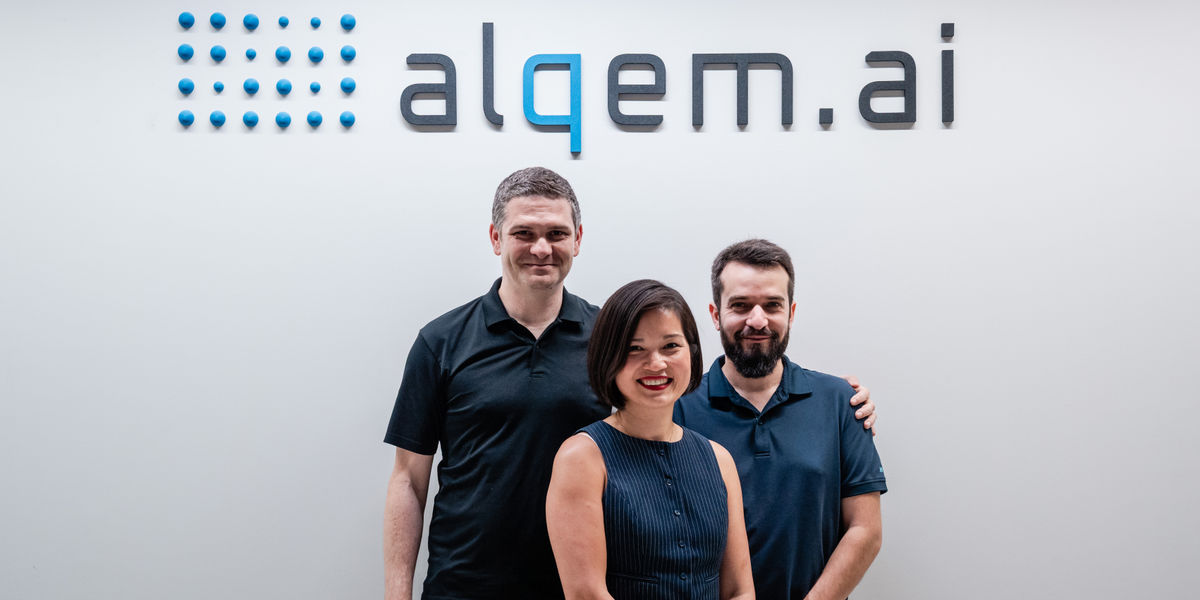
Who is alqem and what does the start-up do? In an interview, Hanh Nguyen, Co-Founder & CEO of alqem, answers all questions from the chemeurope.com editorial team. Thank you very much for that!
Who are you and where do you come from?
alqem is a materials-discovery company that uses AI to find and bring to market high-performance magnets that don't rely on rare-earth elements. We're headquartered in Munich, with a research operation in Portugal.
Our founding team has complimentary expertise. I'm a co-founder and CEO; before alqem I spent fifteen years across McKinsey, Unilever and OCI Global, and earlier led the World Economic Forum's first circular-economy initiative, so I come at materials from the supply-chain and strategy side. My co-founder Dr. Tiago Cerqueira, our CTO, comes from computational materials science, he is the co-author of Alexandria, the leading open database for inorganic materials and has been working on ML/AI high throughput workflow for materials discovery over the last 10+ years. And Prof. Milan Allan, our CSO, holds the Chair of Experimental Physics at LMU Munich, which anchors us on the lab side. Around that core we've built a team of roughly ten PhD scientists, and we're advised by people like Prof. Claudia Felser of the Max Planck Institute in Dresden and Prof. Miguel Marques in Bochum and Michael Viertler, former Senior Managing Partner of McKinsey Munich and leader of automotive and high tech practice.
What challenge does alqem solve? What is your big vision?
Almost everything that moves in the energy transition depends on a permanent magnet, e.g., the motor in an electric car, the generator in a wind turbine, robotics, industrial drives. The strongest magnets we know how to make require rare-earth elements, and the highest-performing ones need heavy rare earths like dysprosium and terbium to hold up at the temperatures a motor actually runs at.
The problem is that this supply chain is extraordinarily concentrated. A single region dominates the mining and almost all of the processing. That makes a material European industry can't function without into a geopolitical and economic chokepoint, which is something we saw sharpen considerably with the export restrictions of the last two years.
What we do is use AI to search for magnetic compounds built from abundant, accessible elements that can exceed or match rare-earth performance and, just as importantly, to predict how to actually synthesize them. Permanent magnet is just the start. We apply the same approach to thermoelectric materials, which turn waste heat back into useful energy.
The big vision is straightforward: a materials base for the energy transition that Europe can actually control, discovered and commercialized in years rather than decades.
How did you come up with the idea?
The origin is genuinely academic. Milan and Tiago met through SuperC, an international research consortium working toward one of the hardest goals in physics: a room-temperature superconductor. What made SuperC unusual is that, for the first time, it brought
theory, computation, synthesis and characterization together into a single coordinated effort to discover new materials.
Out of that, the two of them developed a shared conviction with three parts. First, that physics-informed AI is a genuinely powerful tool for finding materials in territory no one has explored before. Second, that the SuperC way of working didn't have to be confined to superconductors, the same approach could be turned on entirely different classes of materials. And third, that outside academia, with focus and the right resources, all of it could move dramatically faster.
My own background is where the choice of which materials came from. Fifteen years in energy and chemicals taught me that we constantly design around the materials we happen to have and we treat their constraints as fixed and engineer our way around them. Once you've seen that often enough, you start to see the inverse: how much technological progress is quietly held back by materials limits, and how much could be unlocked if those limits weren't there. Rare-earth-free magnets with better performance than today standards are amongst the materials where that potential lies.
What did your development process look like? What were the biggest challenges and setbacks? What were the biggest successes?
We built our platform in three stages. The first maps out the space of candidate structures to search. The second predicts the properties that matter, for magnets, things like magnetization and anisotropy, so we can rank candidates. The third is to predicts synthesis: how you'd actually make a promising candidate in the lab.
One of the hardest challenges is the lack of real world data on magnets to train the model. Therefore, our approach has been the combination of building ab-initio training dataset and using our synthesis capabilities to validate the training data across a wide range of chemical systems. We are particularly proud of the level of accuracy we achieved from prediction to experiments: our predicted values are within 15% from experimental results, which is completely within expectation.
The other challenge is the ability to synthesize predicted materials in the lab. The challenges are 2 fold: 1) lack of published failed experimental data (one that many of our peers also acknowledge); and 2) we are working on new systems that have not been done before. To that end, we are building an LLM scientist that help overcome this challenge, especially on 2) where it helps with coming up with the most educated hypotheses as a synthetic chemist would, devising ways to test them and learning from (failed) results.
On the success side: assembling advisors of the caliber we have, building real validation capability rather than staying purely in silico (as mentioned above), actually seeing candidates in our pipeline that have potentials to outperform NdFeB and SmCo magnets in all aspects including costs, and having serious engagement from industrial partners who feel this problem acutely.
How did the market and the industry respond?
We see strong engagement from industry. Supply-chain de-risking moved from a slide in a strategy deck to a board-level priority across automotive and industrial manufacturing, and it happened almost in real time as export controls tightened. That meant the people we spoke to didn't need convincing that the problem was real or urgent.
There are strong interests from end users to test new candidates as they are proven in our lab. We would like to work with selected partners per use case to co-develop the products toward commercialization.
On the investor side, the interest came from deep-tech specialists who understand that hard-science companies take a different shape than software, which is exactly the kind of capital this needs.
Would you take this path again – or is there anything you would do differently?
I'd take it again without much hesitation, partly because the problem is real and important, and partly because we are assembling such a great team who can tackle any problem coming our way.
What I'd do differently is mostly about going even faster than we are already doing today.
What can others learn from your startup story?
I have three things in mind.
First: AI is most powerful as an amplifier of deep domain expertise, not as a replacement for it. The teams that win in hard science will be the ones who pair good models with people who genuinely understand the physics and the chemistry. We built alqem around that conviction.
Second: Pick problems where your (combination of) backgrounds is an advantage. In our case, our backgrounds as computational scientist, experimental physicist and industry executive help us carve out a path to solve a relevant problem and create value.
Third: Be honest in telling your story, most investors are smart and can see through the jargons and bluffs.



Other news from the department business & finance








Most read news







More news from our other portals























Something is happening in the chemical industry ...
This is what true pioneering spirit looks like: Plenty of innovative start-ups are bringing fresh ideas, lifeblood and entrepreneurial spirit to change tomorrow's world for the better. Immerse yourself in the world of these young companies and take the opportunity to get in touch with the founders.
See the theme worlds for related content
Topic world Synthesis
Chemical synthesis is at the heart of modern chemistry and enables the targeted production of molecules with specific properties. By combining starting materials in defined reaction conditions, chemists can create a wide range of compounds, from simple molecules to complex active ingredients.

Topic world Synthesis
Chemical synthesis is at the heart of modern chemistry and enables the targeted production of molecules with specific properties. By combining starting materials in defined reaction conditions, chemists can create a wide range of compounds, from simple molecules to complex active ingredients.