Automated Lab Speeds Up Material Development
New research platform independently investigates materials for thin-film photovoltaics and other optoelectronic applications
Advertisement


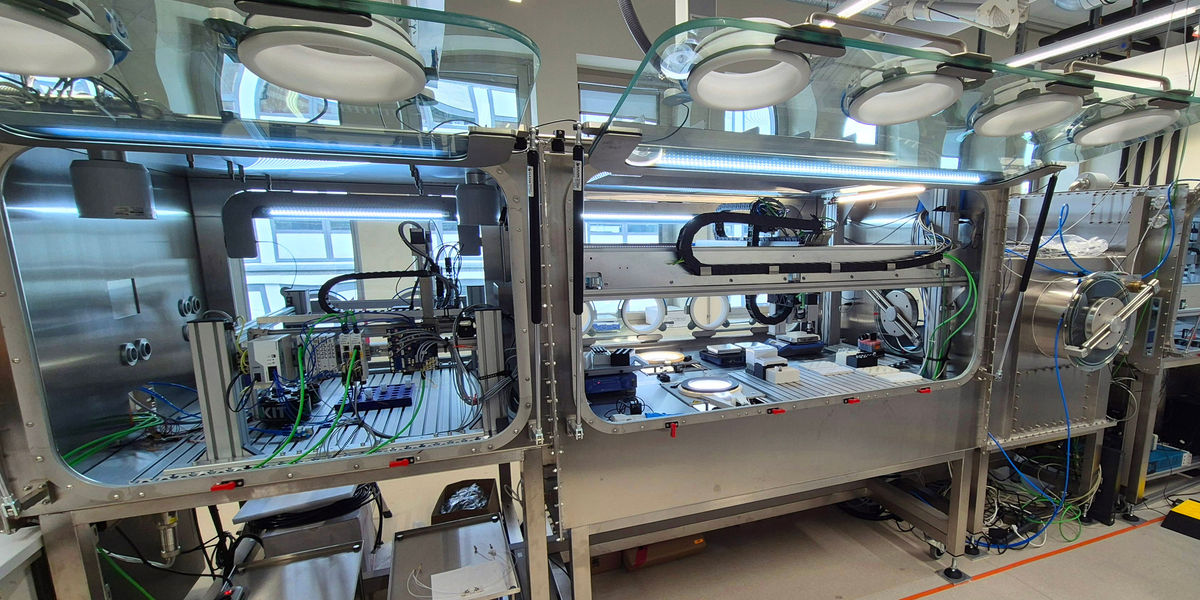
Systematically investigating, evaluating, and specifically developing thousands of material variants—that’s what the new energy materials Acceleration Platform (E-MAP) at the Karlsruhe Institute of Technology (KIT) makes possible. It combines automated experiments with precise material characterization, thereby laying the foundation for accelerated development of energy materials.
Developing new functional materials often requires testing numerous material combinations. Conventional experiments quickly reach their limits when many variants need to be compared. The new Energy Materials Acceleration Platform (E-MAP) at KIT therefore automates key laboratory processes. “Robotic systems handle, among other things, the preparation of materials, the handling of samples, the deposition of thin films, and their characterization,” says Dr. Holger Röhm of KIT’s Institute of Lighting Technology (LTI), whose research team built the platform. “This allows us to conduct experiments with high precision and reproducibility. With E-MAP, we can more quickly identify which material compositions and fabrication conditions are particularly promising for a specific application.”
Modular Design and Flexible Scalability
The E-MAP is integrated into a closed system. This allows even sensitive materials to be processed under controlled conditions. The platform produces thin films from solution-based starting materials. A microfluidic system enables the automated production and formulation of semiconductor inks. The researchers are continuously expanding the system to include additional methods for characterizing thin films. “A key advantage of the E-MAP is its modular design,” says Professor Alexander Colsmann of KIT’s LTI. “We can integrate new experiments and characterization methods, thereby adapting the platform to different scientific questions. Collaboration partners from academia and industry can also contribute their own methods and equipment.”
From Automated Experiments to AI-Driven Materials Development
Automation generates large amounts of experimental data. In the future, the researchers plan to analyze this data using artificial intelligence methods. This will allow them to identify promising material combinations early on in virtual simulations and to control autonomous or semi-autonomous screening processes. To achieve this, they are integrating various automated research platforms. “When synthesis, processing, characterization, and data analysis are linked together, a research process emerges in which we can increasingly plan and conduct experiments in a data-driven manner,” says Röhm.
About E-MAP
The Energy Materials Acceleration Platform (E-MAP) is a Self-Driving Lab (SDL), i.e., a largely autonomous research platform. Such SDLs are a central component of the German High-Tech Agenda. Construction of E-MAP began in 2023. To date, KIT has allocated approximately 600,000 euros for the platform’s technical equipment. The Carl Zeiss Foundation has supported the development in recent years as part of the KeraSolar research project. E-MAP is integrated into the planned Helmholtz Acceleration Alliance (HELMA), which aims to network autonomous research platforms in the materials and life sciences across multiple Helmholtz Centers.
Note: This article has been translated using a computer system without human intervention. LUMITOS offers these automatic translations to present a wider range of current news. Since this article has been translated with automatic translation, it is possible that it contains errors in vocabulary, syntax or grammar. The original article in German can be found here.


Other news from the department science








These products might interest you

Most read news








More news from our other portals

















See the theme worlds for related content
Topic world Digitalization in the laboratory
The topic world Digitalization in the lab presents innovations and trends from digital data systems (ELN, LIMS) to laboratory robots and networked devices (IoT) to AI and machine learning.

Topic world Digitalization in the laboratory
The topic world Digitalization in the lab presents innovations and trends from digital data systems (ELN, LIMS) to laboratory robots and networked devices (IoT) to AI and machine learning.