On the trail of dissolution: Only 30 water molecules separate salt
Process visualised for the first time at atomic resolution using ultra-high-resolution electron spectroscopy
Advertisement


How much water does a salt molecule really need to dissolve? An international research team, including researchers from the University of Kassel, has now visualized the process at the atomic level for the first time. The study shows that the particles only separate permanently once there are around 30 water molecules. These findings provide important fundamental knowledge for chemistry, biology, and atmospheric research.
Whether in oceans, soil, or living cells, salt (sodium chloride, NaCl) dissolves all around us. Yet until now, physicists lacked a precise picture of what happens step by step when the molecules come into contact. A research team led by Prof. Dr. Marcel Mudrich from the Institute of Physics at the University of Kassel has now tracked the process molecule by molecule for the first time.
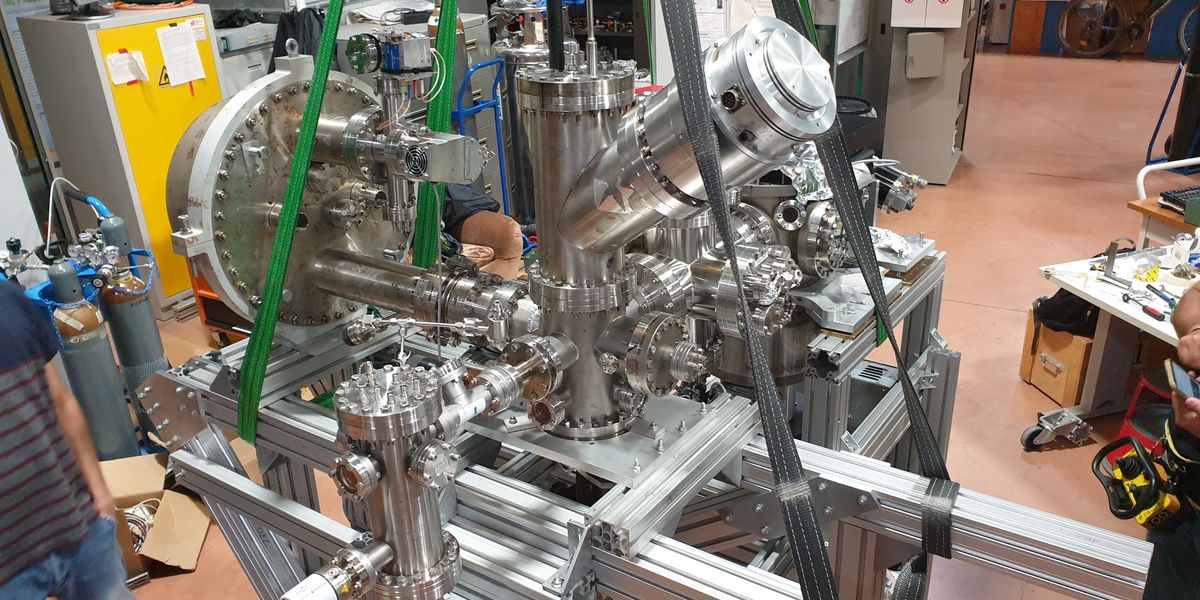
For their analyses, the researchers used a special method: they embedded the particles in tiny helium nanodroplets near absolute zero and examined the process using ultra-high-resolution electron spectroscopy. Complementary computer simulations visualized the resulting microstructures. This allowed the researchers to isolate how individual water molecules weaken the bond between sodium and chlorine until a complete hydrate shell eventually forms around both ions.
Water molecules envelop ions at different rates
The measurements reveal clear differences between the two partners: While a chloride ion is completely surrounded by as few as about 17 water molecules, a sodium ion requires up to 34 molecules. Only once a threshold of around 30 water molecules is reached do the ions remain permanently separated. “The water envelops the ions step by step, like a veil that gradually dissolves the salt,” says Mudrich. “Using a new measurement method, we were able to demonstrate for the first time when the ions become completely separated and are enveloped by water.”
Basic Knowledge Improves Models for Nature and Chemistry
Since this is purely basic research, the focus is not on immediate practical applications but on gaining a fundamental understanding of a key natural process. Many chemical and biological reactions take place in an aqueous environment. In a normal liquid, however, the individual intermediate steps are difficult to isolate.
“Our method makes it possible, in a sense, to selectively add individual water molecules and observe in real time how the electronic structure changes,” explains Mudrich. “In the long term, this knowledge will help us better understand chemical and biological processes—such as those in atmospheric or marine chemistry—at the molecular level and model them more realistically in computer simulations.”
Note: This article has been translated using a computer system without human intervention. LUMITOS offers these automatic translations to present a wider range of current news. Since this article has been translated with automatic translation, it is possible that it contains errors in vocabulary, syntax or grammar. The original article in German can be found here.
Original publication


Other news from the department science












Most read news









More news from our other portals























See the theme worlds for related content
Topic World Spectroscopy
Investigation with spectroscopy gives us unique insights into the composition and structure of materials. From UV-Vis spectroscopy to infrared and Raman spectroscopy to fluorescence and atomic absorption spectroscopy, spectroscopy offers us a wide range of analytical techniques to precisely characterize substances. Immerse yourself in the fascinating world of spectroscopy!

Topic World Spectroscopy
Investigation with spectroscopy gives us unique insights into the composition and structure of materials. From UV-Vis spectroscopy to infrared and Raman spectroscopy to fluorescence and atomic absorption spectroscopy, spectroscopy offers us a wide range of analytical techniques to precisely characterize substances. Immerse yourself in the fascinating world of spectroscopy!