Two for the price of one
Kyoto University simultaneously synthesizes dicarboxylic acids and hydrogen from diols
Advertisement


Every year, the chemical industry makes trillions of dollars synthesizing the countless chemical compounds we use every day.
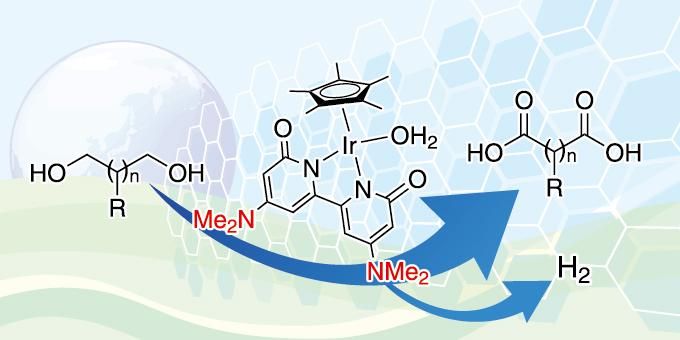
Using an iridium catalyst bound to a bipyridonate ligand, researchers were able to synthesize dicarboxylic acids from aqueous diols, with the added benefit of generating hydrogen as a byproduct
Kyoto University
From pharmaceuticals for keeping you healthy to polyester woven into your shirt, industrial processes turn simple chemicals into complex, valuable compounds. Researchers in turn work constantly to develop new substances as well as safer and more efficient methods of production.
In a paper published in ChemSusChem, researchers from Kyoto University's Graduate School of Human and Environmental Studies describe how they have significantly improved the process that leads to polymers and plasticizers. And as an added bonus, their method generates hydrogen as a byproduct.

"We use renewable chemical compounds collectively known as diols to dramatically change the synthesis of dicarboxylic acids," explains corresponding author Ken-ichi Fujita, "These are needed to produce polymers, plasticizers, and lubricants."
Existing production methods, based on the oxidation of hydrocarbons using toxic oxidants, generate harmful waste products. Knowledge of this motivated the team to work on a new method of synthesis, changing the initial compound along with the catalyst.
"We began by looking at liquid solutions of diols, which are more renewable than starting materials previously used," continues Fujita.
"Then we needed to find a catalyst, and we settled on using iridium bound to a bipyridonate ligand."
The team were pleased to find that combining the diols with the new catalyst generated dicarboxylic acids with greater efficiency and significantly more yield, as well as four equivalents of hydrogen for every unit of diols.
Developing more efficient and safer methods of compound production is vital for industrial organic chemistry, and for the global environment.
"It is a pleasant surprise to see how efficient our new process is," concludes Fujita. "We hope to continue to improve safety and efficiency as we discover alternative chemical processes that are valuable to all humanity."
Original publication


Other news from the department science



















These products might interest you


Most read news












More news from our other portals


























See the theme worlds for related content
Topic world Synthesis
Chemical synthesis is at the heart of modern chemistry and enables the targeted production of molecules with specific properties. By combining starting materials in defined reaction conditions, chemists can create a wide range of compounds, from simple molecules to complex active ingredients.
Topic world Synthesis
Chemical synthesis is at the heart of modern chemistry and enables the targeted production of molecules with specific properties. By combining starting materials in defined reaction conditions, chemists can create a wide range of compounds, from simple molecules to complex active ingredients.
Last viewed contents
LLC SIBUR selects INEOS Technologies as a licensor for 1.5 million tonnes of polyethylene capacity.
Neutrons for the quantum technologies of the future: breakthrough results on layered perovskites
Nuclear detector: New materials hold promise for better detection of nuclear weapons
Artificial intelligence evaluates chemical spectra in minutes - Researchers from the University of Jena, Helmholtz-Zentrum Berlin, and Zakodium develop AI system for chemical structure analysis

Claus Rettig to serve as interim CEO of Evonik - Christian Kullmann on the road to recovery
Scientists discover molecular ‘reshuffle’ and crack an 80-year-old conundrum - “Our findings open the door to new asymmetric transformations based on mechanistic pathways that chemists previously dismissed as inaccessible”

Rigaku opens Rigaku Technology Center Taiwan - Advancing regional growth through engineering and collaboration in Taiwan and beyond
Surface analysis of catalyst particles in aqueous solutions - The results are relevant for the development of efficient photoelectrodes for the production of green hydrogen

Linking superconductivity and structure