Clean biogas - universally measurable
Advertisement


Researchers at the Paul Scherrer Institute PSI have developed a new analysis method that detects even the smallest amounts of critical impurities in biogas. Even small biogas plants can use the method without major investment - this promotes the energy transition.
The market for biogas is growing: according to the Swiss Federal Office of Energy, Switzerland fed 471 gigawatt hours of this energy source into the natural gas grid last year - roughly twice as much as ten years ago. This also increases the need to be able to quickly and reliably measure impurities in biogas, as the green gas is subject to strict quality criteria.
Researchers at the Center for Energy and Environmental Sciences at PSI now have a solution to this problem. For the first time, they have developed an analytical method that simultaneously detects the two most critical impurities in biogas: Sulphur compounds and siloxanes. They present their method in the journal Progress in Energy.
Nationwide production
Over 160 biogas plants in Switzerland produce the valuable gas mixture from waste, slurry and manure; in addition, there are hundreds of wastewater treatment plants that ferment sewage sludge in digestion towers to produce sewage gas with a similar composition, a subspecies of biogas.
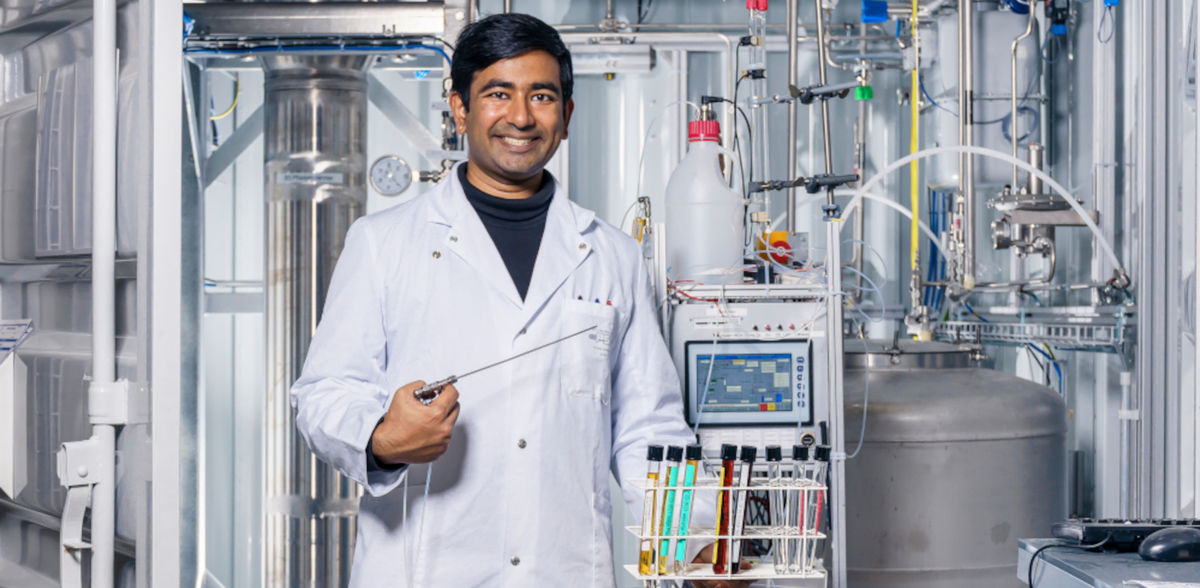
The green gas consists of 50 to 75 percent methane and at least a quarter carbon dioxide. Separating the carbon dioxide produces biomethane, which can be fed into the natural gas grid. However, biogas - and therefore also biomethane - can contain many impurities in just millionths of a percent. "Despite their tiny concentration, these cause huge problems," says Ayush Agarwal, who devoted his doctoral thesis at PSI to analyzing biogas and is the first author of the study.
Organic sulphur compounds, for example, are dreaded interfering substances: They are formed when bacteria break down proteins that contain sulphur atoms. Siloxanes, on the other hand, are silicon-containing compounds that make shower gels, for example, feel pleasant on the skin. The siloxanes are also flushed down the drain with the shower gel and end up in the sewage treatment plant - and ultimately in biogas.
Pure poison for fuel cells
If biomethane is burned to generate energy, for example in gas boilers, the siloxanes react in an extremely undesirable way: They form silicon dioxide - a component of sand and one of the most stable compounds on earth. "It clogs up the combustion systems, for example, the systems then require more energy to heat the same amount of water," explains Agarwal. Similar to a kettle that has become clogged with limescale.
Both siloxanes and organic sulphur compounds have also so far prevented biomethane from being used in a fuel cell. Fuel cells produce electricity from energy-rich gases, but sulphur compounds are pure poison for them. It is therefore currently not possible to operate fuel cells with biomethane. The impurities also interfere with the processing of biogas into biomethane that can be fed into the grid. In short: "Even in traces, siloxanes and organic sulphur compounds are harmful."
Measure to improve
In Switzerland, as in the rest of Europe, strict limits apply to sulphur compounds and siloxanes in biogas - a prerequisite for feeding biomethane into the public gas grid and for operating biogas plants as a fuel supplier.
Larger biogas plants have purification systems to remove undesirable substances from the gas. Operators use analytical equipment to measure the composition of their biogas and can thus check how well their purification systems are working. Good analytics are therefore a prerequisite for the entire biogas system to work: "You can only improve something if you can measure it well," summarizes Agarwal.
As part of his doctoral thesis at PSI's Center for Energy and Environmental Sciences, the scientist developed a robust analytical method that simultaneously detects siloxanes and organic sulphur compounds - down to traces of fifteen billionths, which means that there are exactly fifteen molecules of the impurity for every billion molecules - a truly tiny amount.
Boost for the energy transition
The PSI researchers have also developed a practical solution for small biogas plants that do not have analytical equipment on site. Biogas samples can be taken using a mobile device that dissolves the gases in a liquid. Even small amounts of impurities are proven to remain in the liquid for at least 28 days - sufficient time to send the samples to an analysis laboratory for measurement.
The universal applicability of the analysis method makes it possible to use it widely throughout the country and thus promote the use of biogas. "This is a good example of how we conduct applied research at PSI that provides concrete solutions to current challenges," says Christian Ludwig, also a researcher at the Center for Energy and Environmental Sciences and co-author of the study.
How the method works
A gas chromatography device first separates the components in the biogas. They are then recorded one by one using a method called "mass spectrometry with inductively coupled plasma". In this process, the sample components are vaporized, broken down into their atomic components and converted into charged particles. The mass spectrometer then records the isotopes of the individual elements and quantifies them.
The trick here is that the device only detects very specific, previously selected elements and ignores all others. This makes it possible to detect sulphur and silicon, even in very small quantities, alongside a host of other compounds in biogas. "To our knowledge, this is the first method of its kind that can determine sulphur and silicon compounds simultaneously," says Agarwal.
Note: This article has been translated using a computer system without human intervention. LUMITOS offers these automatic translations to present a wider range of current news. Since this article has been translated with automatic translation, it is possible that it contains errors in vocabulary, syntax or grammar. The original article in German can be found here.
Original publication


Other news from the department science












Most read news





More news from our other portals














See the theme worlds for related content
Topic World Mass Spectrometry
Mass spectrometry enables us to detect and identify molecules and reveal their structure. Whether in chemistry, biochemistry or forensics - mass spectrometry opens up unexpected insights into the composition of our world. Immerse yourself in the fascinating world of mass spectrometry!
Topic World Mass Spectrometry
Mass spectrometry enables us to detect and identify molecules and reveal their structure. Whether in chemistry, biochemistry or forensics - mass spectrometry opens up unexpected insights into the composition of our world. Immerse yourself in the fascinating world of mass spectrometry!