Siemens and CAPHENIA accelerate scale-up of Sustainable Aviation Fuel
Siemens supports CAPHENIA from pilot plant to commercial scale-up
Advertisement


Siemens and the cleantech company CAPHENIA have entered a partnership to scale the production of Sustainable Aviation Fuel (SAF). SAF is a synthetic kerosene made from renewable feedstocks that can reduce CO₂ emissions by up to 80 percent compared to fossil kerosene. As preferred automation and digitalization partner, Siemens will provide digitalization and automation solutions for CAPHENIA's plasma technology, which converts bio-methane into synthesis gas. The goal is a standardized concept that enables the global rollout of commercial production facilities.
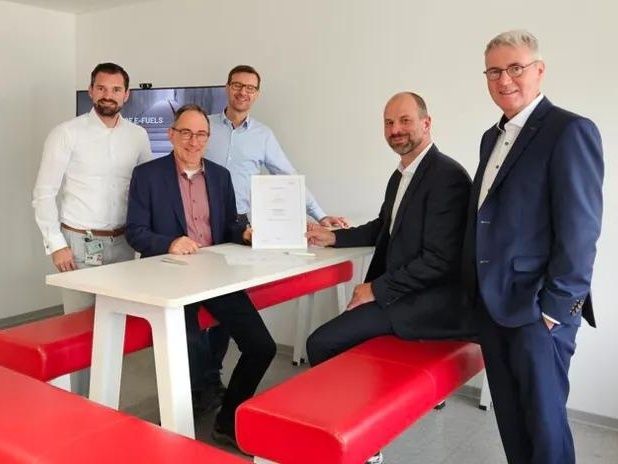
Siemens and CAPHENIA sign the partnership agreement. From left to right: Nicky Ahnert, Jürgen Giegerich, Frank Knauf (all Siemens), Dr. Mark Misselhorn, Dr. Andreas Waibel (both CAPHENIA)
Siemens
CAPHENIA's technology uses a plasma process to split bio-methane into synthesis gas at temperatures of around 1,500 degrees Celsius. CAPHENIA's Plasma Boudouard Reactor (PBR) is a globally unique 3-in-1 zone reactor that integrates three established chemical reactions in one system. The resulting synthesis gas can then be further processed into SAF, renewable diesel, or chemical products—without by-products and with minimal energy losses.
A key advantage: the heat released when cooling the synthesis gas is used to preheat the incoming bio-methane. This results in a process efficiency of more than 86 percent, representing significantly higher energy efficiency than is possible with conventional methods.
"Decarbonizing aviation cannot be achieved without synthetic fuels. Demand for SAF is growing exponentially, yet production capacity urgently needs to be ramped up," said Christian Gückel, Head of Vertical Chemicals at Siemens Digital Industries. "This is exactly where Siemens comes in: with our digitalization and automation solutions, we are making CAPHENIA's technology industrially scalable and thus accelerating its global market ramp-up."
"This partnership shows how technology leaders are working together to drive forward the energy transition. Siemens brings the portfolio and expertise to standardize and digitalize our plants. But the real point is this: the market for sustainable aviation fuels will not grow evenly—it will fragment. Those who scale quickly, those who are industrial-ready, those who have the right partners will lead. Together, we are not only laying the foundation for the international ramp-up of our PBR technology – we want to lead it," said Dr. Mark Misselhorn, founder and CEO of CAPHENIA.
Digitalization as key to scaling
Under the agreement, Siemens becomes CAPHENIA's preferred supplier and technology partner, offering comprehensive solutions from its Siemens Xcelerator portfolio, including process control systems, drive technology, measurement technology, and process simulation software. Digital twins will make it possible to optimize operating parameters before physical commissioning and to manage processes consistently across different sites.
Siemens is supporting CAPHENIA from its pilot plant at industrial park Höchst (Frankfurt, Germany) through to commercial scale-up. The goal is to develop a standardized automation and digitalization template for CAPHENIA's Plasma Boudouard Reactor (PBR) that is modularly scalable and can be adapted to different locations. This is intended to accelerate the rapid rollout of new plants in the coming years and significantly reduce commissioning time.
Growing demand for synthetic jet fuels
Demand for SAF is rising rapidly, driven by regulatory requirements. The EU Renewable Energy Directive (RED) mandates binding blending quotas, with penalties for non-compliance. The scale of the challenge is enormous: by 2050, the global aviation industry will need around 500 million tons of SAF annually. Currently, SAF covers less than one percent of global kerosene demand. Efficient and scalable production technologies are essential to close this gap.


Other news from the department business & finance











Most read news




More news from our other portals






















Something is happening in the chemical industry ...
This is what true pioneering spirit looks like: Plenty of innovative start-ups are bringing fresh ideas, lifeblood and entrepreneurial spirit to change tomorrow's world for the better. Immerse yourself in the world of these young companies and take the opportunity to get in touch with the founders.