Wearable patch vibrates when it detects environmental hazards
Advertisement


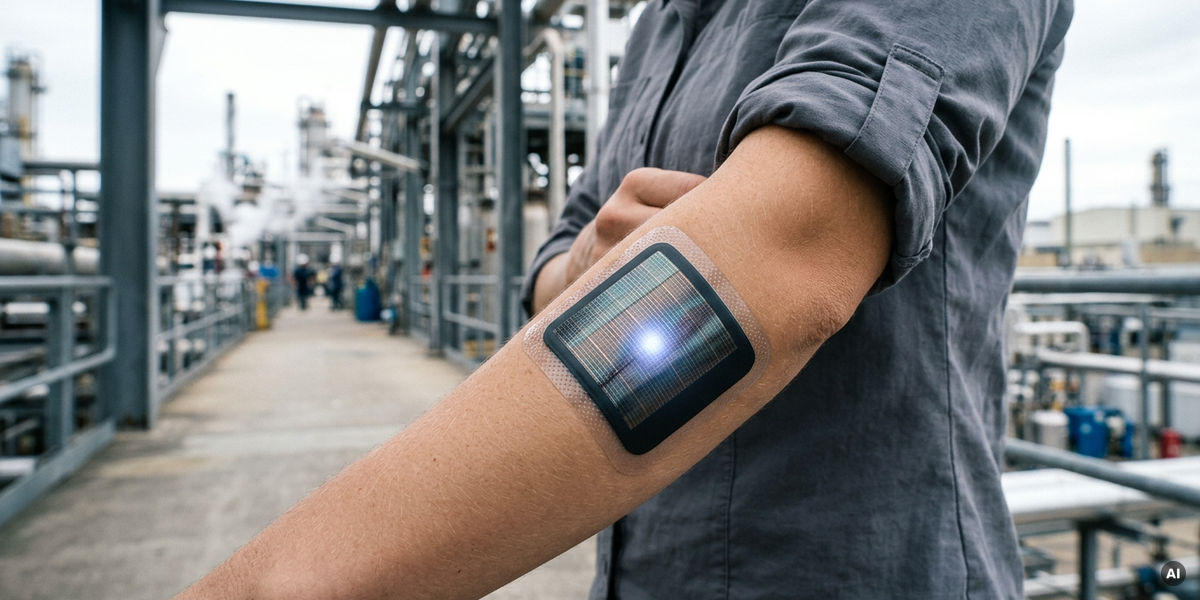
Researchers have created a wearable patch that can detect hazards in the environment – such as dangerous gases or heavy metals in water – and then notify wearers by vibrating against their skin. The researchers have also extended the work to create an "e-skin" for robotic devices, allowing robots to detect and avoid hazards in their environment.
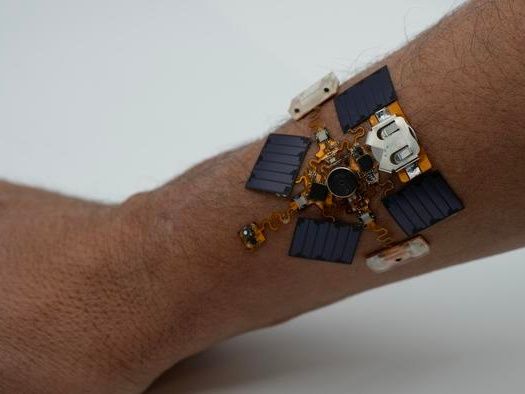
Wearable, multimodal sensor that detects gaseous, aerosolized, and aqueous environmental toxins and alerts the wearer via unique haptic feedback codes.
Baha Erim Uzunoğlu
"There are already sensors that can detect environmental hazards and send notifications to your phone – we wanted to improve on that," says Erim Uzunoğlu, first author of a paper on the work and a Ph.D. student at North Carolina State University. "We had two goals for this work. First, we wanted to miniaturize the sensors and incorporate them into a wearable patch to identify any potential risks to the wearer.
"Second, if you're coming into contact with a hazardous substance, you need to know as quickly as possible. And if the notification is being sent to your phone, you may not check it right away. So we wanted to incorporate haptic technology into the patch so that it would vibrate as soon as the hazard was detected, allowing people to respond quickly to the potential threat."

For this work, the researchers created a square patch slightly smaller than a driver's license. The patch contains a microcontroller that serves as the patch's brain; a very small battery; sensors to monitor for six environmental hazards; and a tiny actuator, which serves as the haptic motor that vibrates against the skin. The exterior of the patch also incorporates an array of thin-film photovoltaic cells, which allows the device to harvest solar power while being worn.
"Just having a buzzing motor isn't enough; you need to actually feel it," says Oluwatobi Ojuade, co-author of the paper and a Ph.D. student at NC State. "So, we designed tiny textured surfaces that sit at the interface between the motor and your skin, almost like a miniature pattern of bumps. By changing the size and spacing of those bumps, we could control how the vibration is perceived against your skin. That let us fine-tune the sensation so it actually grabs your attention, instead of feeling like a faint buzz you might miss."
The device also triggers a different "haptic sequence," or vibration pattern, for each hazard it detects. This allows wearers to determine which environmental hazard they need to be aware of.
"In proof-of-concept testing, we found that the device did a good job of detecting the hazardous substances and immediately triggering the haptic response," says Uzunoğlu. "We also found the energy harvesting technology did a good job of extending the life of the battery. Coupled with the low power demand of the sensors, this allows the device to function for around 24 hours."
As the researchers were developing the patch, they wondered whether it would be possible to extend the concept for use in robotic devices, allowing robots to detect and respond to hazards in their environment. That led to the development of what they call the e-skin.
The e-skin essentially layers the sensor patch over a layer of piezoelectric material. When the sensor detects a hazard and triggers the haptic response, the resulting vibration against the piezoelectric layer creates an electrical signal that can be detected by the robot.
In proof-of-concept testing, the e-skin allowed quadrupedal robots to detect hazards and alter their routes to avoid those hazards.
"The patch and e-skin are largely made using off-the-shelf components, with very few custom-engineered elements," says Amay Bandodkar, co-corresponding author of the paper and an assistant professor of electrical and computer engineering at NC State. "That should make it easier to scale up the technology moving forward. And the concept is extremely flexible – the sensor array is modular, so you can add or remove sensors that monitor for whichever hazards are most relevant to the application.
"It's quite amazing to see that we can encode tactile signals into materials of different properties, something that has been very challenging to do in the past – especially in real-world situations where people would want to wear the device," says Lilian Hsiao, co-corresponding author and an associate professor of chemical and biomolecular engineering at NC State. "To combine something that people would wear, along with sophisticated sensing capabilities and the ability to alert the user, is something we've been working on for a long time."
Original publication


Other news from the department science















These products might interest you

Most read news









More news from our other portals





















See the theme worlds for related content
Topic world Sensor technology
Sensor technology has revolutionized the chemical industry by providing accurate, timely and reliable data across a wide range of processes. From monitoring critical parameters in production lines to early detection of potential malfunctions or hazards, sensors are the silent sentinels that ensure quality, efficiency and safety.

Topic world Sensor technology
Sensor technology has revolutionized the chemical industry by providing accurate, timely and reliable data across a wide range of processes. From monitoring critical parameters in production lines to early detection of potential malfunctions or hazards, sensors are the silent sentinels that ensure quality, efficiency and safety.