Randomly Mixed Atoms Arranged in Rows and Columns for Sustainable Catalysis
Advertisement


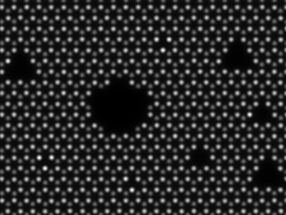
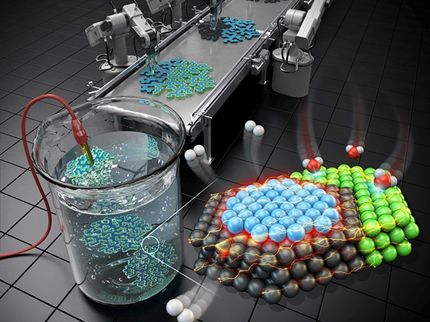
The energy system of the future will require sustainable catalysts that, for example, enable the efficient production of green hydrogen. Materials consisting of mixtures of five chemical elements show great promise for enabling ideal catalysts in the future. Researchers at the DFG Collaborative Research Center 1625 “Atomic-Scale Understanding and Design of Multifunctional Mixed-Crystal Surfaces with Complex Chemical Composition” have succeeded in growing such so-called complex mixed-crystal structures in a nearly single-crystalline state on a sapphire wafer and examining them in great detail using four different microscopy methods.

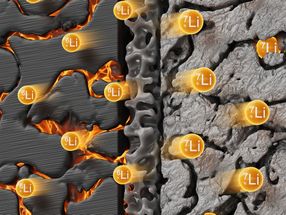
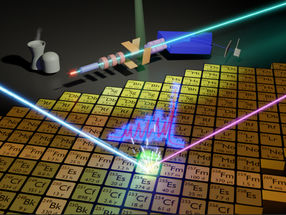
Illustrative image
AI-generated image
Atoms from Five Directions
To produce complex mixed crystals, the researchers use a combinatorial coating system (co-sputtering) that fires atoms of the five selected source elements onto a wafer from five directions. “There, they deposit randomly and form chemically disordered nanocrystals with countless interfaces,” explains Prof. Dr. Alfred Ludwig of Ruhr University Bochum, spokesperson for the Collaborative Research Center. “While this is excellent for applications, it also poses a challenge when it comes to investigating these new materials in basic research at atomic resolution. However, this is crucial for their future targeted design.”
To maintain the mixture of the five atomic components while introducing more structural order into the materials, Dr. Satyakam Kar from the Bochum research group chose a sapphire single-crystal wafer as a substrate, which was coated with an extremely thin layer of platinum as a mediator. “This causes the incident atoms to deposit themselves in such a way that they continue the crystal structure of the substrate over micrometer-scale areas,” Ludwig explains, referring to the process known as epitaxial layer growth. The result is a very well-defined crystalline surface that is extremely smooth, enabling high-resolution analyses.
“For this to work, the sputtering process must take place at high temperatures of 400 to 600 degrees Celsius; the rate of incoming atoms must be neither too high nor too low; and the correct buffer layer must be selected between the single-crystal substrate and the actual layer,” explains Satyam Kar, who now works as an assistant professor at the Indian Institute of Technology Gandhinagar.
Experimental Platform Under Microscopes
The research team tested the process using a mixture of iridium, palladium, platinum, rhodium, and ruthenium. They used the layers produced in this way as an experimental platform: During microscopic examinations, they observed that the five starting elements had deposited in a highly chemically mixed state despite the good structural order. “What we can also see is that two different orientations form during layer growth, between which there are interfaces, but far fewer and better defined than in the case of nanocrystals,” explains Alfred Ludwig. Using a tiny diamond tip, the researchers applied markings to the wafer so that they could use them as reference points during further microscopic examinations to locate the different areas and compare them with one another. Nanoelectrochemical analyses conducted by the group led by Prof. Dr. Corina Andronescu (University of Duisburg-Essen) showed that one of the two orientations was electrochemically advantageous.
Further investigations in the group led by Prof. Dr. Christina Scheu at the Max Planck Institute for Sustainable Materials revealed that the epitaxial layers exhibit an interesting defect structure. In some areas, the crystals continue to grow perfectly in accordance with the sapphire substrate. In other areas, however, stacking structures form that are microscopically recognizable as transverse stripes. “Future work will show what significance these defects have for the desired properties of catalysts,” says Alfred Ludwig.
Note: This article has been translated using a computer system without human intervention. LUMITOS offers these automatic translations to present a wider range of current news. Since this article has been translated with automatic translation, it is possible that it contains errors in vocabulary, syntax or grammar. The original article in German can be found here.
Original publication


Other news from the department science