A Swiss Army knife for the cell
Researchers are combining chemistry and cell biology to create a novel tool for biomedical research

Advertisement


A key that only fits into the lock when exposed to light—and brings along additional tools: Researchers at Friedrich-Alexander University Erlangen-Nuremberg (FAU) have developed a versatile inhibitor in an interdisciplinary chemical-biological study. This molecular Swiss Army knife can be selectively activated with light, tracked within living cells, and expanded to perform additional functions. It thus opens up new possibilities for biomedical research—and, in the long term, for more precise medications. The study, “A Multifunctional and Secure Photoresponsive proteasome Inhibitor to Control Cell Fate,” has been published in the Journal of the American Chemical Society.
How can a drug be controlled from the outside?
Ideally, a drug should act only where it is needed. In reality, this is difficult to achieve. Active ingredients spread throughout the body and, in addition to their intended target, can also affect healthy tissue and cause unwanted side effects. Prof. Dr. Henry Dube and Prof. Dr. Esther Zanin from FAU are therefore pursuing a different approach: They want to control the effect of a substance from the outside—using light.
What happens when the cell’s recycling machinery comes to a standstill?
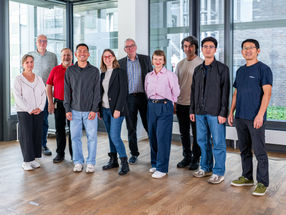
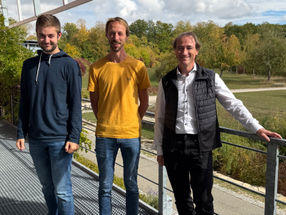
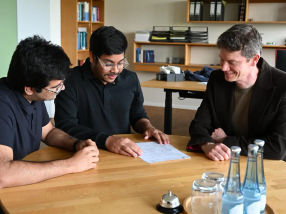
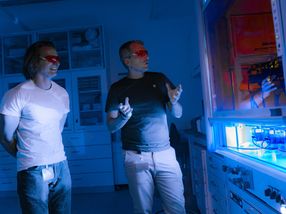
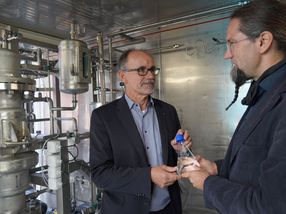
Dube is a chemist who develops molecules whose behavior can be controlled by light. Zanin is a cell biologist who studies how cells divide and the molecular processes behind this. For their current work, the two have combined their expertise—together with Manuel Valentin (a doctoral student in the Dube group) and David Féval (a master’s student in the Zanin group). The result is a kind of Swiss Army knife at the molecular level.
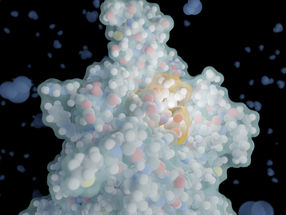
The starting point is an inhibitor called MG132. Its target is the proteasome, a kind of recycling machine found in every cell. It breaks down proteins that are no longer needed into their constituent parts, which can then be reused. This recycling is vital and also plays a crucial role in cell division. If the proteasome is blocked, key processes are thrown off balance—which ultimately leads to the cell’s death.
How does a molecule get a light switch?
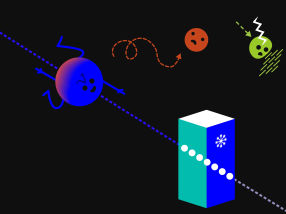
MG132 functions like a key that fits into a specific lock. The researchers have modified precisely this key. “We’ve essentially put a cap on it,” explains Prof. Dr. Henry Dube, holder of the Chair of Organic Chemistry I in the Department of Chemistry at FAU. “With this cap, the key no longer fits into the lock, and the inhibitor remains inactive. Only when we expose it to light does the cap come off. The key fits again and can block the proteasome.”
This principle is part of a new field of research called photopharmacology. The idea is that active ingredients should not be constantly active everywhere, but rather be activated as precisely as possible exactly where and when their effect is needed. In the long term, this could help, for example, in cancer therapies to spare healthy tissue. This is still a long way off: The Erlangen researchers have not developed a drug, but have instead investigated the underlying principle in cells.
How reliably does the molecular “cap” fit?
In doing so, they were able to show that their “cap” fits unusually securely. Without light, the inhibitor remains inactive even over extended periods. After irradiation with light, however, it is released, blocks the proteasome, and prevents the degradation of certain proteins. Ultimately, the treated cells die.
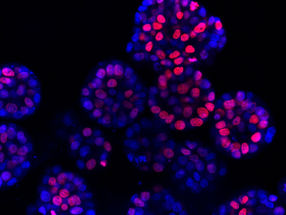
But the light switch is just one tool in this molecular Swiss Army knife. Dube and Zanin have also incorporated a docking site where additional molecular building blocks can be attached. In the study, they used a fluorescent dye. This allowed them to track the location of their inhibitor within the living cell under a microscope.
Light as a Remote Control for a Cellular Process
For Prof. Dr. Esther Zanin, holder of the Chair of Experimental Molecular Cell Dynamics in the Department of Biology at FAU, this is precisely what matters: “We can not only determine when our inhibitor becomes active. We can simultaneously observe where it is located in the cell and what happens after activation. This gives us a precision tool with which biological processes can be studied in a highly targeted manner, both temporally and spatially.”
This is particularly interesting, for example, for research into cell division. Cell division consists of many precisely coordinated steps in which proteins are synthesized and then degraded. With a light-controlled inhibitor, this process can be selectively interrupted at specific points. Light thus becomes, in a sense, a remote control for a biological process.
What else can be attached to this molecular Swiss Army knife?
The fluorescent dye is just a first example. In the future, other components could also be attached to the additional docking site—such as molecules that guide the inhibitor specifically to certain areas of a cell, or possibly a second active ingredient. “If we attach something to our key, we obviously can’t change it in such a way that it no longer fits in the lock,” says Dube. “That’s exactly where the challenge lies—but also the great potential of this modular system.”
A research tool today, a drug of tomorrow
The research is still a long way from being used on patients. But as a tool for basic research, the molecule is already opening up numerous possibilities. And in the long term, the work points to a bigger idea: one day, active ingredients could not only recognize a target in the body but also be controllable from the outside, provide information about their location, and take on additional tasks.
What happens when chemistry and biology come together?
This is made possible by the convergence of two research fields. “We come from very different backgrounds,” says Zanin. “On one hand, there’s chemistry, which can build and control such molecules in the first place. On the other hand, there’s biology, which can investigate the various functions of this ‘Swiss Army knife’ in living cells. Only when the two come together do such new possibilities arise.”
Note: This article has been translated using a computer system without human intervention. LUMITOS offers these automatic translations to present a wider range of current news. Since this article has been translated with automatic translation, it is possible that it contains errors in vocabulary, syntax or grammar. The original article in German can be found here.
Original publication


Other news from the department science