Light Paves the Way for Sustainable Active Ingredient Production
A low-energy synthesis method for cyclopropanes using light and renewable raw materials
Advertisement


The pharmaceutical industry is constantly searching for novel molecules as well as more efficient ways to synthesize established active ingredient building blocks. Highly strained ring structures pose a particular challenge, especially three-membered rings composed of carbon atoms, known as cyclopropanes.
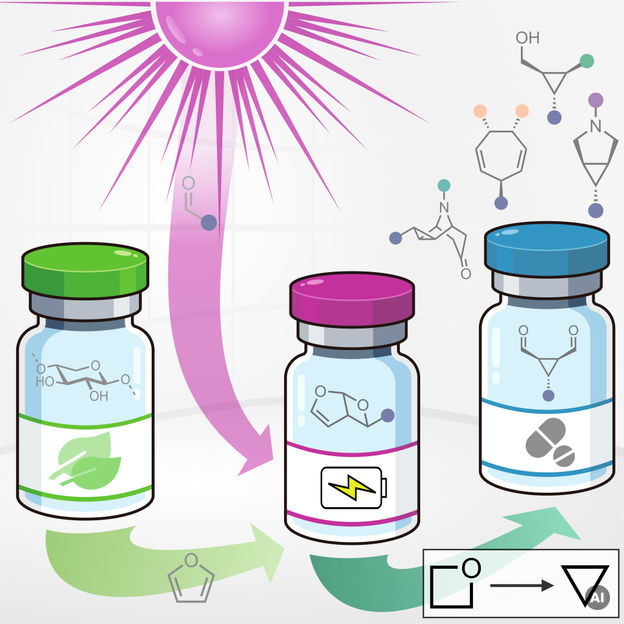
All it takes is light and a catalyst: the waste-free conversion of a renewable raw material—one that does not compete with food production—into valuable starting materials for the synthesis of active ingredients.
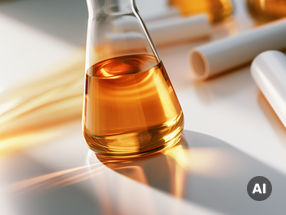
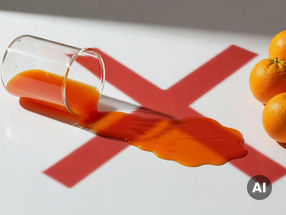
AI-generated imageThomas J. Tiefel
Traditional synthetic methods have significant drawbacks: To introduce the necessary energy into the system, one must rely either on explosive chemicals, such as diazo compounds, or on strongly reducing reagents. This not only poses safety risks but also generates significant amounts of waste. A team led by Professor Oliver Reiser from the University of Regensburg is now presenting a milder, resource-conserving alternative: Instead of dangerous reagents, the Regensburg group uses light. It serves as a “trace-free reagent” that can precisely deliver the required energy to molecules.
Because three-membered rings, unlike four-membered rings, cannot be formed exclusively using light energy, the researchers employed a clever strategy: an intermediate compound serves as an energy reservoir. In the first step, incident light is absorbed directly by one of the reactants, such as anisaldehyde (a component of essential oils), which can then react with furan. Furan is a renewable raw material derived from byproducts of agricultural food production. The resulting oxetane intermediate (a four-membered ring) stores the light energy as ring strain.
In a subsequent step, this tension is specifically utilized for a novel rearrangement reaction. The result is a functionalized cyclopropane ring that is highly sought after in pharmaceutical chemistry. The entire sequence proceeds with perfect atomic economy: in other words, no atoms are split off as waste. The method thus combines the use of sustainable raw materials with the green synthesis of complex active ingredient building blocks. The research team was able to significantly improve industrial active ingredient syntheses in key parameters such as the number of synthesis steps, the overall yield, and the amount of waste.
Note: This article has been translated using a computer system without human intervention. LUMITOS offers these automatic translations to present a wider range of current news. Since this article has been translated with automatic translation, it is possible that it contains errors in vocabulary, syntax or grammar. The original article in German can be found here.
Original publication


Other news from the department science













Most read news










More news from our other portals





















See the theme worlds for related content
Topic world Synthesis
Chemical synthesis is at the heart of modern chemistry and enables the targeted production of molecules with specific properties. By combining starting materials in defined reaction conditions, chemists can create a wide range of compounds, from simple molecules to complex active ingredients.
Topic world Synthesis
Chemical synthesis is at the heart of modern chemistry and enables the targeted production of molecules with specific properties. By combining starting materials in defined reaction conditions, chemists can create a wide range of compounds, from simple molecules to complex active ingredients.