Tritium in the quantum sieve
HZDR Team Separates Hydrogen Isotope Mixture for the First Time Using Quantum Effects
Advertisement


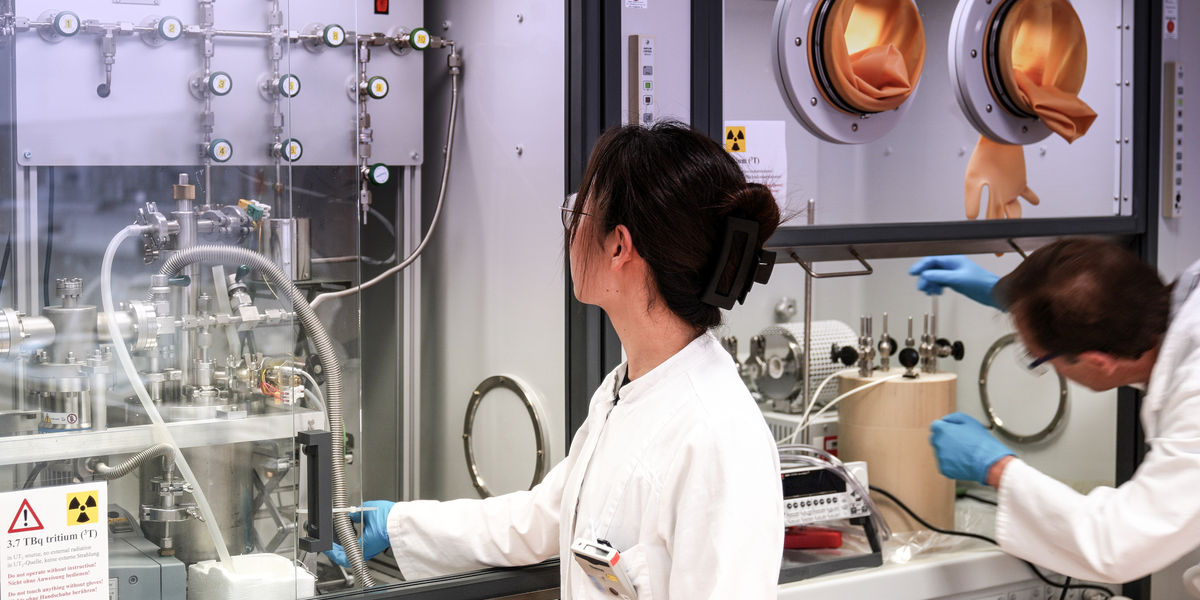
Fusion power plants of the future will not only require extremely hot plasmas and strong magnetic fields but also a fuel cycle in which the hydrogen isotopes deuterium and tritium can be recovered, separated, and reused. Together with partners, a team from HZDR has now demonstrated a highly efficient method for separating hydrogen isotopes using a silver-containing zeolite. The experiments with radioactive tritium were conducted in the radiochemical laboratory at HZDR’s Research Site Leipzig. The results represent an important advance in isotope separation and lay the foundation for the efficient recovery and processing of tritium in future fusion fuel cycles.
In fusion reactors, deuterium and tritium are fused to release large amounts of energy. But the fuel is not completely consumed. A significant fraction remains, together with ordinary hydrogen, also known as protium, which can be the product of side reactions with reactor materials or released by outgassing. The result is a mixture of the three hydrogen isotopes that have to be separated so that the fuel can be reused in the correct composition.
This separation poses a major challenge. Although the hydrogen isotopes, protium, deuterium and tritium, contain differing numbers of neutrons in their atomic nuclei, chemically, they behave almost identically. “This is where conventional separation methods reach the limits of their efficiency,” explains Prof. Cornelius Fischer, jointly appointed professor at HZDR and Leipzig University and head of the Department of Reactive Transport at HZDR’s Institute of Resource Ecology in Leipzig. “We are therefore exploring a fundamentally different separation approach.” To achieve this, he and his team employed a quantum mechanical effect that is particularly prominent in porous materials containing embedded metal ions.
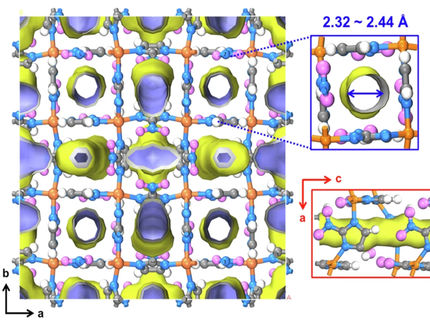
Silver sites in the pore structure
The team used a zeolite for their experiments. Zeolites occur naturally but can also be produced synthetically. They are composed of a regular framework of aluminum, silicon and oxygen atoms containing a network of microscopic pores. Positively charged ions, which can be exchanged and thus alter the properties of the material, sit at the walls of these cavities. This is precisely the property that the Leipzig group members Dr. Alexandra Becker, Dr. Holger Lippold, and Jing Liu made use of. Becker and Liu conducted the research as a part of the DFG Research Training Group “Hydrogen Isotopes 1,2,3H” at Leipzig University, while senior postdoctoral researcher Lippold oversees work in the tritium lab.
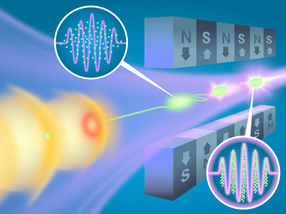
The team used a zeolite in which the original sodium ions had been replaced with silver ions. “The key effect arises from the interaction between hydrogen molecules and the electronic structure of the silver ions. This creates an adsorption potential,” Fischer explains. Due to their differing mass, the three isotopes have different zero-point energies, the minimum energy that a quantum-mechanical system possesses even at absolute zero. Since deuterium and tritium have lower zero-point energies than protium, they are more strongly stabilized in the adsorption potential, causing them to bind more strongly to the material. As a result, the isotopes are released at different temperatures when the zeolite is heated: protium desorbs first, followed by deuterium and finally tritium.
Dr. Michael Hirscher of the Max Planck Institute for Solid State Research in Stuttgart contributed his many years of expertise in hydrogen adsorption and thermal desorption spectroscopy to the study. This technique makes it possible to track the temperatures at which the previously adsorbed molecules are released from the material. And this, in turn, reveals how strongly the individual isotopes bind to the silver sites.
Tritium binds longer
The decisive step was the experiment using tritium. “It’s the first time anyone has managed to separate a hydrogen isotope mixture of protium, deuterium and tritium using a porous solid material,” says Fischer. After contact with the silver-containing zeolite, the mixture that initially contained equal amounts of the three isotopes emerged with an H₂:D₂:T₂ ratio of 1:41:175 . So, tritium was retained much more strongly than deuterium, while protium was hardly retained at all.
The material also exhibited high selectivity in experiments with mixtures of two isotopes. The greatest difference was observed between tritium and protium. “These are not just marginal differences,” Fischer explains. “The separation process is highly efficient even in a single step.” The results also represent an important milestone for fundamental research, as they provide the first experimental validation of theoretical predictions involving tritium.
Another aspect is the stability of the material. Tritium undergoes radioactive decay, emitting beta radiation that could potentially damage the silver sites in the zeolite. However, even after several hours of exposure to tritium, the experiments revealed no measurable decline in separation performance. “This is not yet proof for long-term technical operation but an important indication that this class of material is well worth investigating further,” explains Fischer. But before technical applications become feasible, additional steps are necessary. The current experiments were conducted with a small amount of material. For larger facilities, process design, long-term stability and scalability would still need to be explored. “We are clearly on fundamental research territory here,” says Fischer. “Our task is to understand the underlying mechanisms quantitatively and compare different materials systematically.”
Thus, the silver-containing zeolite is not the end of the Leipzig team’s search. The researchers now plan to apply their methods to other porous materials, exploring the fundamental question: how can isotopes that are chemically almost indistinguishable be separated as efficiently as possible?
Original publication


Other news from the department science












These products might interest you





Most read news









More news from our other portals

























See the theme worlds for related content
Topic World Spectroscopy
Investigation with spectroscopy gives us unique insights into the composition and structure of materials. From UV-Vis spectroscopy to infrared and Raman spectroscopy to fluorescence and atomic absorption spectroscopy, spectroscopy offers us a wide range of analytical techniques to precisely characterize substances. Immerse yourself in the fascinating world of spectroscopy!

Topic World Spectroscopy
Investigation with spectroscopy gives us unique insights into the composition and structure of materials. From UV-Vis spectroscopy to infrared and Raman spectroscopy to fluorescence and atomic absorption spectroscopy, spectroscopy offers us a wide range of analytical techniques to precisely characterize substances. Immerse yourself in the fascinating world of spectroscopy!