Oxygen vacancies turn a poor ion conductor into a good battery material
Enhanced ion transport demonstrated by combining conductivity and nuclear magnetic resonance (NMR) spectroscopy
Advertisement


lithium titanate (LTO, Li4Ti5O12) is a well-established battery material that, in its pristine state, is a poor conductor of lithium ions. It develops high ionic conductivity only during charging, when additional lithium ions and electrons are incorporated into the material. Bernhard Gadermaier and Martin Wilkening from the Institute of Chemistry and Technology of Materials at TU Graz have now taken an entirely different approach: they transformed pure, non-lithiated LTO in its original composition, Li4Ti5O12, into a significantly better ion conductor by deliberately introducing defects into the crystal lattice. Specifically, they removed individual oxygen atoms, thereby creating oxygen vacancies that activate a previously blocked migration pathway for lithium ions. “This diffusion pathway is already pre-formed in the LTO structure, but is only activated by the defect structure,” explains Wilkening. The results of the experimental study have been published in the journal Science Advances.
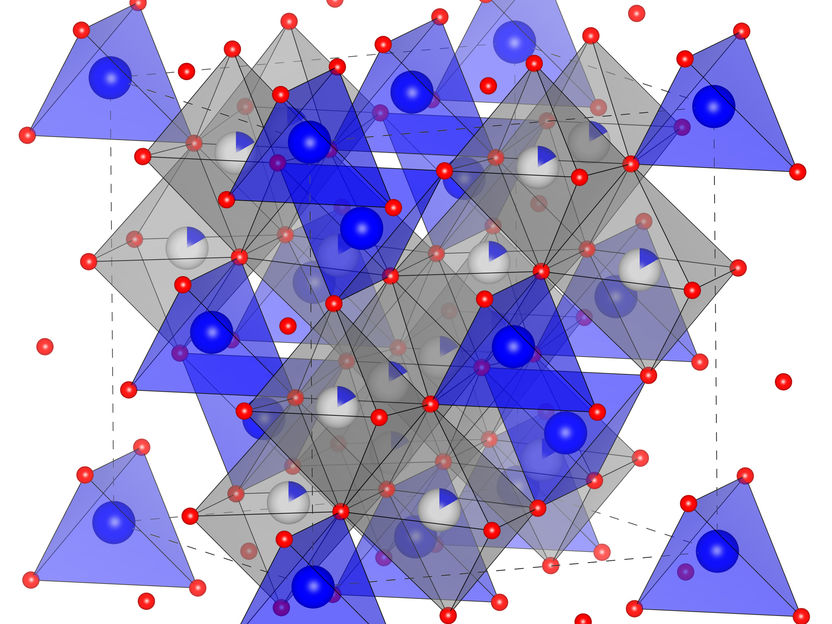
Oxygen (red), lithium (blue) and titanium (grey) together make up the crystal structure of battery material lithium titanate.
ICTM - TU Graz
Heating in an oxygen-poor atmosphere
To create the defects in LTO, Gadermaier and Wilkening heated the lithium titanate to 300 degrees Celsius in an oxygen-poor atmosphere. “This gentle heating process removes individual oxygen atoms from the crystal lattice,” explains Martin Wilkening. “The resulting oxygen vacancies have a direct influence on the mobility of the lithium cations and transform what was originally a poor ionic conductor into a significantly better one. The example of LTO clearly illustrates the enormous influence that atomic-scale defect structures can have on the macroscopic properties of a material.”
Extensive experimental verification
The researchers demonstrated the enhanced ion transport experimentally by combining conductivity spectroscopy with nuclear magnetic resonance (NMR) spectroscopy. The NMR measurements, in particular, provided direct experimental evidence of the newly activated atomic-scale diffusion pathway.
“Our experimental study demonstrates that the properties of a solid are not determined solely by its chemical composition, but are also to a significant extent by its local defect structure and thermal history,” says Martin Wilkening. “We show how the mobility of small lithium cations can be precisely controlled using the classical concepts of anionic defect chemistry.”
Basic research as a driving force behind new material functions
“This work is also a prime example of how fundamental research driven by scientific curiosity, without an immediate application in mind, can lead to entirely new material functions,” says Wilkening. “The targeted control of ionic conductivity through defect chemistry opens up future prospects for iontronic, memristive and neuromorphic devices in micro- and nanoelectronics.”
Original publication


Other news from the department science












Most read news









More news from our other portals

























See the theme worlds for related content
Topic World Spectroscopy
Investigation with spectroscopy gives us unique insights into the composition and structure of materials. From UV-Vis spectroscopy to infrared and Raman spectroscopy to fluorescence and atomic absorption spectroscopy, spectroscopy offers us a wide range of analytical techniques to precisely characterize substances. Immerse yourself in the fascinating world of spectroscopy!

Topic World Spectroscopy
Investigation with spectroscopy gives us unique insights into the composition and structure of materials. From UV-Vis spectroscopy to infrared and Raman spectroscopy to fluorescence and atomic absorption spectroscopy, spectroscopy offers us a wide range of analytical techniques to precisely characterize substances. Immerse yourself in the fascinating world of spectroscopy!
Topic World Battery Technology
The topic world Battery Technology combines relevant knowledge in a unique way. Here you will find everything about suppliers and their products, webinars, white papers, catalogs and brochures.

Topic World Battery Technology
The topic world Battery Technology combines relevant knowledge in a unique way. Here you will find everything about suppliers and their products, webinars, white papers, catalogs and brochures.