Ti-V alloys' superconductivity: Inherent, not accidental
Advertisement


Physicists from India have shed new light on a long-unanswered question related to superconductivity in so-called transition metal binary alloys. The team revealed that the local magnetic fluctuations, or spin fluctuations, an intrinsic property of Titanium-vanadium (Ti-V) alloys, influence superconductivity in a way that is more widespread than previously thought. They found that it is the competition between these local magnetic fluctuations and the interaction between electrons and collective excitations, referred to as phonons, which determine the superconductivity. Dr. Matin, from the Raja Ramanna Center for Advanced Technology, Indore, India, and colleagues published their findings in a study in EPJ B.
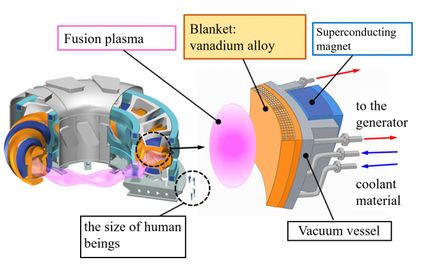
The authors investigated the underlying mechanisms responsible for the variation of superconducting temperature threshold TC in Ti-V alloys, which can be used in thermonuclear reactors. They measured the temperature and magnetic field dependency of several physical characteristics including resistivity, heat capacity and magnetisation. They also used a microscopic theoretical techniquecalled density functional theoryto study the density of states at each energy level available for electrons to occupy.
Theoretical predictions provided by the Bardeen Cooper Schrieffer (BCS) theory suggest a high TC on the order of 20 Kelvin (K) for these alloys. By comparison, the authors' experimental value of TC was less than 10 K. They attribute the difference to spin fluctuations in these alloys, which, the authors found, are inherent to the Ti-V alloys.
The authors deduced that these spin fluctuations are reflected in the properties of the normal state of electrons. They therefore influence the superconductivity of the alloys in a similar way to that observed in high-temperature oxide and iron-based superconductors; as such, the influence of spin fluctuations on superconductivity is not necessarily confined to certain classes of exotic compounds, as previously thought
Original publication
Other news from the department science