Ru-based catalyst drives electrified lignin upgrading into high-value fuels
A Bi-Ru interfacial structure suppresses competing hydrogen gas formation and steers active hydrogen toward lignin bond cleavage
Advertisement


lignin is one of the most abundant renewable aromatic resources on Earth. As a major component of plant biomass, it contains rich benzene-ring structures that could be transformed into high-value chemicals and fuel molecules. However, lignin is also highly complex and difficult to break down efficiently because its structural units are connected by strong C-O and C-C bonds.
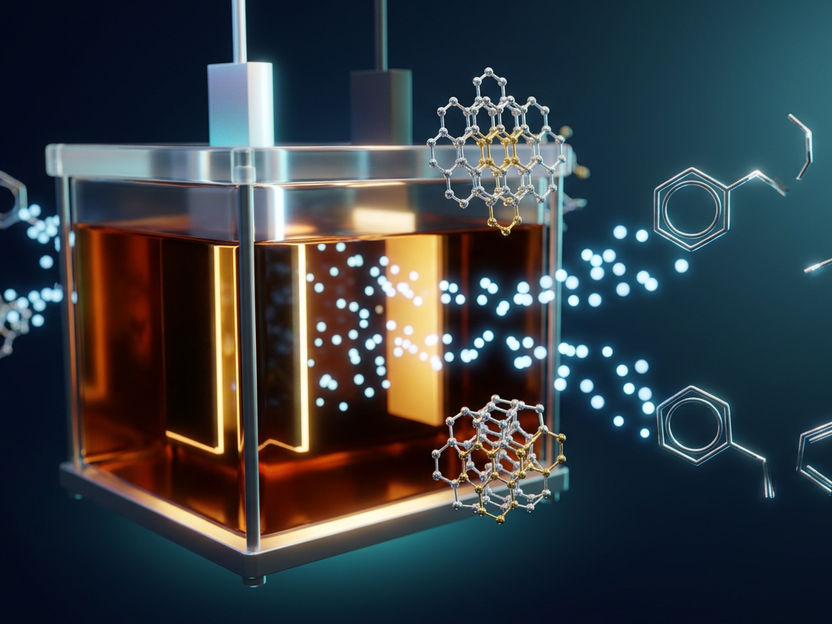
Symbolic image
AI-generated image
Electrocatalytic hydrogenation offers a promising way to upgrade lignin under mild conditions using electricity instead of high-pressure hydrogen gas. This approach is attractive because it can be coupled with renewable electricity and provides precise control over the reaction process. However, a major challenge remains: during electrochemical reactions, active hydrogen species are often consumed by the competing hydrogen evolution reaction, producing H2 gas rather than participating in lignin conversion. This lowers energy efficiency and limits product formation.
Recently, a research team led by Prof. Junming Xu from the Institute of Chemical Industry of Forest Products, Chinese Academy of Forestry, China developed an interface-engineered Ru@Bi/N-C catalyst coupled with a multifunctional HPW-HFIP electrolyte system for efficient electrocatalytic hydrogenation upgrading of lignin. The study reveals that the Bi-Ru interfacial structure and neighboring N-defect sites can precisely regulate active hydrogen migration, suppress the competing hydrogen evolution reaction, and promote selective cleavage of lignin linkages. This catalyst-electrolyte synergistic strategy enables highly efficient conversion of lignin model compounds into valuable aromatic monomers and fuel-related chemicals, providing a promising route for sustainable biomass valorization.
In this system, the Bi-Ru interface suppresses excessive hydrogen gas formation on Ru sites, while promoting the migration of active hydrogen toward nearby nitrogen-defect sites. These neighboring sites provide suitable adsorption strength for lignin model compounds, allowing them to undergo efficient bond cleavage and rapid product desorption. In simple terms, the catalyst helps active hydrogen choose the "right pathway": reacting with lignin molecules rather than forming hydrogen gas.
The electrolyte also plays a crucial role. Phosphotungstic acid, abbreviated as HPW, acts as an electron and proton mediator. It can reversibly accept and release electrons, helping generate active hydrogen species on the suspended catalyst surface. Meanwhile, HFIP, a highly polar additive, promotes the activation of hydroxyl groups in lignin-derived molecules and lowers the energy barrier for C-O bond cleavage. Together, the HPW-HFIP electrolyte creates a favorable reaction microenvironment for efficient biomass upgrading.
Using 2-phenoxy-1-phenylethanol as a representative lignin model compound, the Ru@Bi/N-C catalyst achieved a conversion of 93.64% and a Faradaic efficiency of 91.92%. The reaction produced several valuable aromatic monomers, including phenol and phenylethanol derivatives. Further mechanistic studies using electrochemical measurements, in-situ Raman spectroscopy, hydrogen temperature-programmed desorption, and theoretical calculations confirmed that the high performance originates from the synergistic regulation of hydrogen migration, substrate adsorption, and electrolyte-assisted activation.
Original publication


Other news from the department research and development










Most read news








More news from our other portals
























See the theme worlds for related content
Topic World Battery Technology
The topic world Battery Technology combines relevant knowledge in a unique way. Here you will find everything about suppliers and their products, webinars, white papers, catalogs and brochures.

Topic World Battery Technology
The topic world Battery Technology combines relevant knowledge in a unique way. Here you will find everything about suppliers and their products, webinars, white papers, catalogs and brochures.