New building block combines proteins with other molecules
Artificial molecular building block links proteins and synthetic molecules to form complex nanostructures

Advertisement


proteins form complex three-dimensional shapes and can join together to create larger structures. Researchers want to utilize these properties to make artificial materials. However, arranging proteins and synthetic molecules together with a high level of structural precision is no easy task. This is partly because of the lack of large, clearly defined contact surfaces between the two components.
Researchers led by Professor Ivan Huc from the Department of Chemistry and Pharmacy at LMU have teamed up with colleagues from Berlin, Bordeaux and Nantes to develop an artificial protein-foldamer pair that meets this requirement. “A specifically selected protein recognizes a synthetic molecule and binds to it with high affinity,” summarizes Huc. “The sizeable contact surface, which has a clearly defined structure, makes it possible to use the complex as a modular building block for larger molecular architectures.” The team has now presented the results in the journal Nature Chemistry.
The search for the right counterpart
This new paper focuses on what is known as a foldamer, which is an artificial molecule that, in a similar way to a protein, folds into a stable shape, in this case a helix.
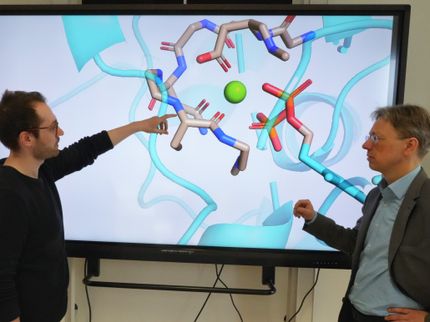
The researchers were looking for a protein that would be just the right counterpart for this foldamer. In their research, they used ribosome display, a biochemical method for identifying protein-protein interactions out of hundreds of billions of different protein variants and that proved to work for foldamer-protein interactions as well. After four rounds of selection, the team identified variant C10 of a protein scaffold known as Nanofitin.
The right-handed P-helix of the foldamer binds C10 with great strength, whereas no binding was detected for the left-handed M-helix. The protein and foldamer are in contact with each other over a large, clearly defined area. Previous protein-foldamer complexes were less stable or required flexible connectors.
From a molecule to a network
The team investigated how the protein and foldamer structurally fit together using nuclear magnetic resonance (NMR) spectroscopy and X-ray crystallography, among other techniques. The researchers also analyzed larger complexes using mass spectrometry.
They then used these binding pairs to create more complex structures. A foldamer constructed in this way was able to bind two proteins physically separately from one another. Conversely, it was possible to configure protein dimers in such a way that they were able to bind two foldamers.
In addition, ring-shaped architectures and a one-dimensional, zigzag-shaped network were created in crystals. The arrangement can be influenced via the geometry of the building blocks. The length of the foldamer determines, for example, the spacing and the spatial orientation of the bound proteins.
Computer-aided analyses of the crystal lattice show a high porosity. The largest cavities could theoretically accommodate spherical objects, for examples nanoparticles or large molecules, with a diameter of around five nanometers.
Prospects of producing artificial materials
“Our results show that artificial foldamers can be used as precise connecting elements for protein architectures,” says Huc. “As it’s possible to change their length and chemical composition, they could in future play a role in helping to construct porous three-dimensional materials and introduce additional functional groups into such structures in the process.”
The specific arrangement of naturally occurring proteins presents another potential topic for new studies. If these proteins are equipped with foldamer binding domains, foldamers could bring them together or maintain a defined spacing between them, possibly influencing their biological function as a result.
Original publication


Other news from the department science








Most read news









More news from our other portals


















See the theme worlds for related content
Topic World Mass Spectrometry
Mass spectrometry enables us to detect and identify molecules and reveal their structure. Whether in chemistry, biochemistry or forensics - mass spectrometry opens up unexpected insights into the composition of our world. Immerse yourself in the fascinating world of mass spectrometry!

Topic World Mass Spectrometry
Mass spectrometry enables us to detect and identify molecules and reveal their structure. Whether in chemistry, biochemistry or forensics - mass spectrometry opens up unexpected insights into the composition of our world. Immerse yourself in the fascinating world of mass spectrometry!
Topic World Spectroscopy
Investigation with spectroscopy gives us unique insights into the composition and structure of materials. From UV-Vis spectroscopy to infrared and Raman spectroscopy to fluorescence and atomic absorption spectroscopy, spectroscopy offers us a wide range of analytical techniques to precisely characterize substances. Immerse yourself in the fascinating world of spectroscopy!

Topic World Spectroscopy
Investigation with spectroscopy gives us unique insights into the composition and structure of materials. From UV-Vis spectroscopy to infrared and Raman spectroscopy to fluorescence and atomic absorption spectroscopy, spectroscopy offers us a wide range of analytical techniques to precisely characterize substances. Immerse yourself in the fascinating world of spectroscopy!