‘White graphene’ halts rust in high temps
Nano-thin films of hexagonal boron nitride protect materials from oxidizing
Advertisement


Atomically thin sheets of hexagonal boron nitride (h-BN) have the handy benefit of protecting what’s underneath from oxidizing even at very high temperatures, Rice University researchers have discovered.
One or several layers of the material sometimes called “white graphene” keep materials from oxidizing – or rusting — up to 1,100 degrees Celsius (2,012 degrees Fahrenheit), and can be made large enough for industrial applications, they said.
The Rice study led by materials scientists Pulickel Ajayan and Jun Lou appears in the online journal Nature Communications.
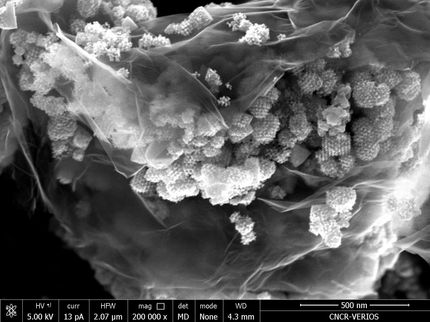
Oxidation prevention is already big business, but no products available now work on the scale of what the Rice lab is proposing. The researchers see potential for very large sheets of h-BN only a few atoms thick made by scalable vapor deposition methods.
“We think this opens up new opportunities for two-dimensional material,” said Lou, an associate professor of mechanical engineering and materials science. “Everybody has been talking about these materials for electronic or photonic devices, but if this can be realized on a large scale, it’s going to cover a broad spectrum of applications.”
Lou said ultrathin h-BN protection might find a place in turbines, jet engines, oil exploration or underwater or other harsh environments where minimal size and weight would be an advantage, though wear and abrasion could become an issue and optimum thicknesses need to be worked out for specific applications.
It’s effectively invisible as well, which may make it useful for protecting solar cells from the elements, he said. “Essentially, this can be a very useful structural material coating,” Lou said.
The researchers made small sheets of h-BN via chemical vapor deposition (CVD), a process they said should be scalable for industrial production. They first grew the thin material on nickel foil and found it withstood high temperature in an oxygen-rich environment. They also grew h-BN on graphene and found they could transfer sheets of h-BN to copper and steel with similar results.
“What’s amazing is that these layers are ultrathin and they stand up to such ultrahigh temperatures,” Ajayan said. “At a few nanometers wide, they’re a totally non-invasive coating. They take almost no space at all.”


Other news from the department science