New simulation tool tracks down unknown catalyst reactions
Method recognizes reaction mechanisms without prior knowledge of chemistry
Advertisement


nitrogen oxides, which are produced as unwanted by-products of combustion, can be converted back into molecular nitrogen using porous catalyst materials. A team of chemists at Heinrich Heine University Düsseldorf (HHU) led by Junior Professor Dr. Jan Meisner has investigated the reactions involved and developed a new simulation tool. In the journal Angewandte Chemie, they present its application potential for new catalysts.
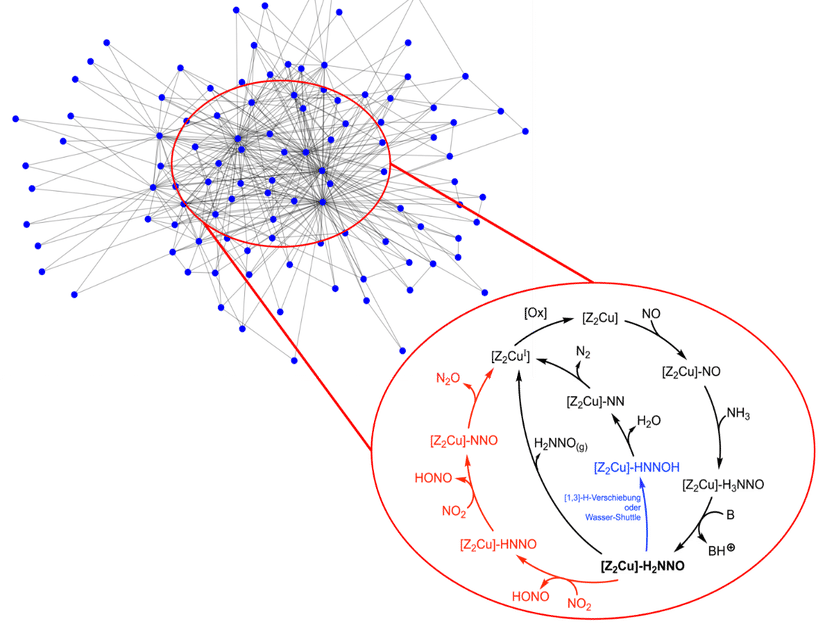
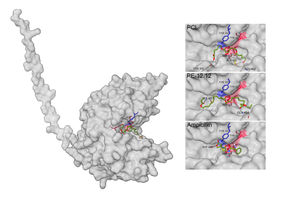
Reaction network of the SCR. Molecular species are represented by dots connected by reactions (lines). The catalysis cycle for the SCR, which is also shown, was extracted from this reaction network.
Adapted from Fig. 3 from DOI: 10.1002/ange.202514074
Many thousands of deaths each year are attributed to nitrogen oxides (NOx), which can be produced in car combustion engines at high temperatures, for example. They are mainly associated with cardiovascular diseases. Today, motor vehicles must be equipped with special catalytic converters in which a large proportion of the nitrogen oxides are reacted back into harmless nitrogen (N2) using a process known as selective catalytic reduction (SCR).
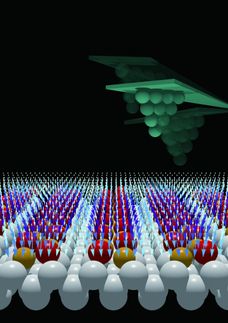
Porous catalysts such as zeolites are used in exhaust gas purification. They have extremely large (inner) surfaces and complex active centers where numerous different reaction pathways can be catalyzed. Such zeolites have pores in the nanometer range (i.e. a billionth of a meter in size) that act like molecular cages: they enclose the reacting molecules so that they react directly at the active centers.
"There are a large number of chemical reactions that take place in these pores, all of which are linked and compete with each other. They form reaction networks with thousands of intermediate stages. We are familiar with many reactions, but there are often completely new, unexpected mechanisms that we often don't have in mind," says Jun.-Prof. Dr. Jan Meisner from the HHU Institute of Physical Chemistry. "In my working group, we have developed a method using 'periodic nanoreactor molecular dynamics' to recognize reaction mechanisms even without prior chemical knowledge, so that the reaction network can be explored autonomously and automatically."
Quantum mechanical calculations are essential for the precise determination of reaction rates. However, these are very computationally intensive, meaning that the dynamics of the reacting atoms and molecules can only be simulated for a very short period of time. With the help of "nanoreactor molecular dynamics" (NMD), molecules are given an additional energy boost, with which more chemical reactions can be observed in the simulations. The HHU chemists have extended this technique to detect very rare reactions in porous materials and to directly observe previously unknown mechanisms.
The method opens up a new perspective on catalytic networks: instead of looking at individual steps in isolation, the entire reaction network becomes visible. This means that side reactions, intermediates and complex reaction mechanisms can also be discovered.
Daniel Deißenbeck, first author of the article now published in the journal Angewandte Chemie: "A special feature of our NMD approach is its predictive power: it explores the chemical space independently and without additional assumptions, i.e. it also 'finds' reactions that we hadn't even thought of." By subsequently evaluating the results energetically using established methods, the researchers obtain meaningful thermodynamic data for the mechanisms found.
The Düsseldorf chemists have applied this method to the SCR of nitrogen oxides and their side reactions. Of particular importance here is the formation of nitrous oxide (N2O), which is not yet fully understood. This potent greenhouse gas is produced as an undesirable by-product and should be avoided wherever possible. "We found a radical-driven route by which nitrous oxide is produced that did not occur in previous models. Our results could potentially contribute to the development of lower-emission and more efficient exhaust gas catalysts," explains Deißenbeck.
In addition to the new method for researching reaction networks, the work in Düsseldorf opens up a wide range of applications in catalysis research, for example for sustainable chemistry, low-emission processes and the design of new catalysts. Above all, reactions in other porous materials, such as organometallic framework compounds and on surfaces, can also be investigated. Meisner: "In the long term, our method can help to significantly shorten development cycles in catalyst research, as potentially relevant reaction pathways can be systematically identified at an early stage, enabling targeted catalyst design."
Note: This article has been translated using a computer system without human intervention. LUMITOS offers these automatic translations to present a wider range of current news. Since this article has been translated with automatic translation, it is possible that it contains errors in vocabulary, syntax or grammar. The original article in German can be found here.
Original publication
Daniel Deißenbeck, Patrick Meier, Wassja A. Kopp, Anthony D. Debellis, Jan Meisner; "Reaction Discovery in Porous Materials Using Periodic Nanoreactor Molecular Dynamics"; Angewandte Chemie International Edition, Volume 65, 2025-12-15
Daniel Deißenbeck, Patrick Meier, Wassja A. Kopp, Anthony D. Debellis, Jan Meisner; "Entdeckung von Reaktionsmechanismen in porösen Materialien mittels periodischer Nanoreaktor‐Molekulardynamik"; Angewandte Chemie, Volume 138, 2026-1-1


Other news from the department science