No patch of the world's oceans without human chemicals
Human chemical signals even in marine areas of the Pacific that are considered pristine
Advertisement


Man-made chemicals are permeating the coastal oceans to an unprecedented extent. This is the result of an international study led by biochemists Jarmo-Charles Kalinski and Daniel Petras at the University of California, Riverside, who also heads a junior research group at the University of Tübingen. The research team analyzed more than 2,300 seawater samples from more than 20 field studies collected over more than a decade in the Pacific, Atlantic and Indian Oceans. The results were published in Nature Geoscience.
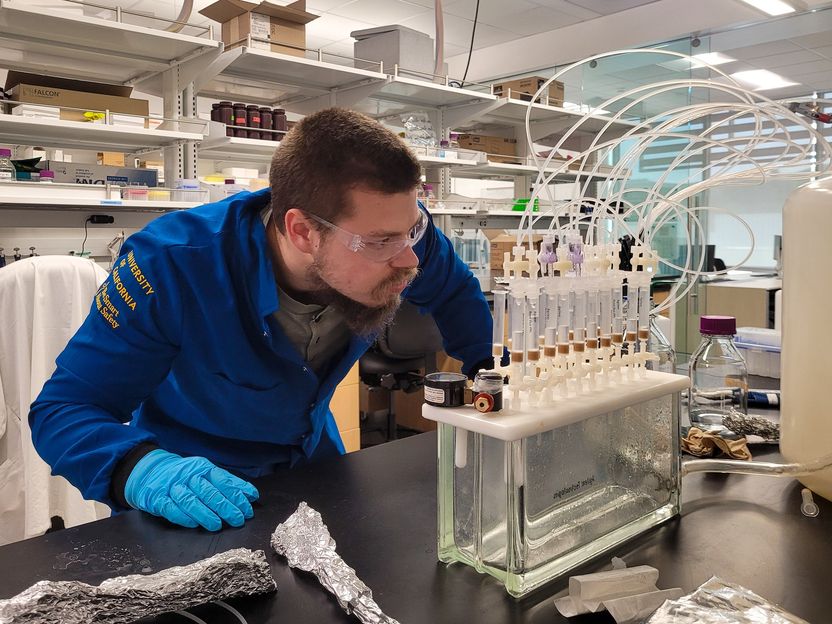
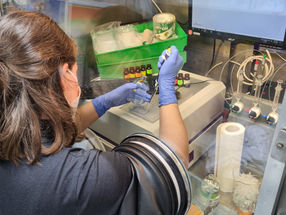
Tilman Schramm, PhD student in the group of Daniel Petras and former Master's student at the University of Tübingen, extracts dissolved organic molecules from seawater samples for mass spectrometry analysis.
Daniel Petras
"Even in places we think are untouched, we found clear chemical fingerprints of human activity. Although chemical pollution of the oceans has been known for a long time, the extent surprised us," says Daniel Petras, assistant professor at the University of California and junior research group leader in the Cluster of Excellence "Control of Microorganisms to Fight Infections" (CMFI) at the University of Tübingen. According to Petras, even remote coral reef systems, often considered particularly pristine marine environments, bear clear chemical signatures of human activity - from agriculture and coastal development to tourism. "There was virtually no place we sampled that showed no chemical impact from humans," says Jarmo-Charles Kalinski, a former postdoctoral researcher in Petras' group at UC Riverside and lead author of the study.
An enormous amount on a global scale
The researchers found that anthropogenic chemicals are detectable far beyond the coastline. Even more than 20 kilometers offshore, human-derived compounds accounted for about 1 percent of the organic matter detected. "On a global scale, that's an enormous amount of material," says Petras.
In coastal waters, the signal values of man-made organic molecules reached a median value of up to 20 percent, compared to the lowest values of around 0.5 percent in the open ocean. Extreme values at estuaries with untreated or poorly treated wastewater even exceeded values of 50 percent in some cases. In total, the team identified 248 human-derived compounds, accounting for a median of around 2 percent of the total signal across all samples. The team expected to find pesticides and pharmaceutical compounds primarily near the coast, but industrial chemicals such as plasticizers from plastics, lubricants and other chemicals from personal care and consumer products dominate the human chemical footprint in the oceans. Some of these compounds straddle the boundary between organic molecules and nanoplastics, blurring the line between chemical and plastic pollution, explains Daniel Petras. "These chemicals are an essential part of the ocean's organic matter community. This means that they may play a previously unknown role in the carbon cycle and in the functioning of the marine ecosystem."
Thousands of samples from various studies analyzed
The study represents one of the most comprehensive chemical meta-analyses of the marine coastal zones to date. It is based on samples collected for many different research purposes, including the study of coral reef health, algal blooms and the carbon cycle. A key innovation of the research team was the combination of uniform, high-resolution mass spectrometry methods across multiple labs and the use of scalable computational methods developed in the group of Mingxun Wang, assistant professor of computer science at UC Riverside. These technological advances allowed the group to combine and analyze thousands of samples from unrelated studies as a unified, consolidated data set.
"This work was only possible through the efforts of our collaborators around the globe and their publicly available datasets," says Petras. "By making our data publicly available, we hope to accelerate research and provide a more comprehensive understanding of human chemical impacts on the world's oceans." Despite the scale of the dataset, the researchers point out that large parts of the world are still under-researched. The data was heavily focused on North America and Europe, with limited coverage of the southern hemisphere and little data from regions such as Southeast Asia, India and Australia. "The lack of data doesn't mean the problem isn't there," says Kalinski. "It means that we haven't looked closely enough."
Long-term ecological consequences largely unknown
The authors of the study emphasize that these analyses only provide an initial overview and that further detailed analyses are required to determine the concentrations precisely. In addition, the effects of cumulative chemical concentrations and their long-term ecological consequences are largely unknown. The study clearly shows that humans are changing marine chemistry. What this means for marine life, food chains or ecosystem resilience will have to be shown in follow-up studies.
The results highlight a broader, often overlooked fact: everyday activities such as driving, cleaning and personal hygiene contribute to the spread of chemicals. The same applies to food packaging. These chemicals are washed down the drain or carried by rainwater and eventually end up in the sea via rivers and sewage systems.
"What we use on land doesn't just disappear," says Kalinski. "It often ends up in the sea, the final sink." The results have also influenced Petras' own habits. "I reduce my plastic consumption, avoid unnecessary packaging and consume less highly processed food," he says. "Not only to protect the environment, but also because I want to avoid unnecessary direct chemical exposure for myself and my family."
"The results of this study are an impressive demonstration of the new findings that modern research can produce when we cooperate and work together at an international level. They show us once again how much responsibility we have as humanity to act responsibly and, in particular, sustainably," says Professor Dr. Karla Pollmann, Rector of the University of Tübingen.
Note: This article has been translated using a computer system without human intervention. LUMITOS offers these automatic translations to present a wider range of current news. Since this article has been translated with automatic translation, it is possible that it contains errors in vocabulary, syntax or grammar. The original article in German can be found here.
Original publication
Jarmo-Charles J. Kalinski, Abzer K. Pakkir Mohamed Shah, Bruno Ruiz Brandão da Costa, Shane P. Farrell, Lisa Schellenberg, Lana G. Graves, ... Silvio Pantoja-Gutiérrez, J. Michael Beman, Aaron Hartmann, Allegra Aron, Xavier Siwe Noundou, Rosemary A. Dorrington, Deniz Tasdemir, Andreas F. Haas, Pieter C. Dorrestein, Craig E. Nelson, Lihini I. Aluwihare, Mingxun Wang, Daniel Petras; "Widespread presence of anthropogenic compounds in marine dissolved organic matter"; Nature Geoscience, 2026-3-16


Other news from the department science








These products might interest you


Most read news






More news from our other portals





















See the theme worlds for related content
Topic World Mass Spectrometry
Mass spectrometry enables us to detect and identify molecules and reveal their structure. Whether in chemistry, biochemistry or forensics - mass spectrometry opens up unexpected insights into the composition of our world. Immerse yourself in the fascinating world of mass spectrometry!
Topic World Mass Spectrometry
Mass spectrometry enables us to detect and identify molecules and reveal their structure. Whether in chemistry, biochemistry or forensics - mass spectrometry opens up unexpected insights into the composition of our world. Immerse yourself in the fascinating world of mass spectrometry!