One Molecule, Many Signals: How Researchers Distinguish Between Stimuli
Which excitation process corresponds to which measurement signal?
Advertisement


molecules can be placed in a wide variety of quantum states. How can these states be distinguished in measurements when theoretical models are unreliable? Which excitation process underlies which measurement signal?
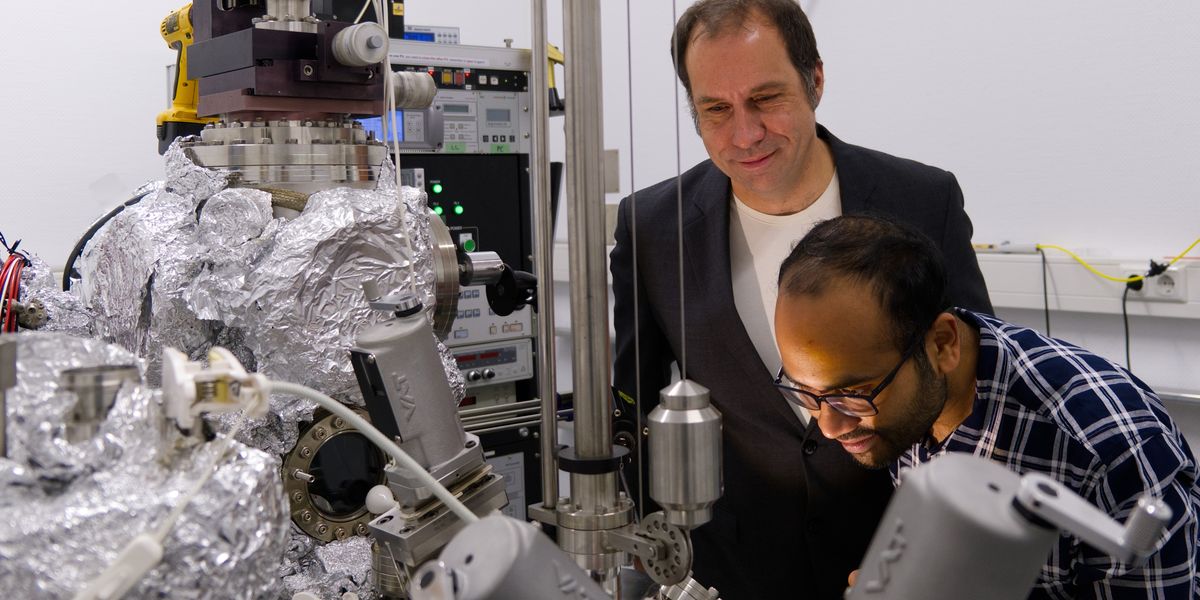
These were precisely the questions Dr. Arnab Banerjee faced when he investigated individual cobaltocene molecules using tunneling spectroscopy. The measured spectra revealed a bewildering variety of excitations. Together with four colleagues in Kiel and San Sebastián (Spain), he succeeded in deciphering the data in a new way. The results were recently published in the journal *Physical Review Letters* and highlighted by the editors as an “Editors’ Suggestion.”
What Lies Behind the Peaks
The researchers studied the cobaltocene molecule on a lead surface that becomes superconducting at very low temperatures—that is, it conducts electricity without resistance. To do this, the team used a scanning tunneling microscope. They brought the microscope’s metallic tip close enough to the molecule so that electrons could bridge the tiny gap to the molecule. By varying the energy of the electrons and recording the resulting current, the researchers obtained a spectrum: A sudden jump in current indicates that a process is triggered in the molecule at that specific energy level. However, a jump alone does not reveal exactly which process is involved, and things become particularly confusing when many different excitations occur within the same spectrum.
To distinguish between the signals, the team injected electrons into and out of the molecule and also investigated the effect of a strong magnetic field. Together, these two factors reveal the nature of the excitation, whether it is a molecular vibration, a flip in an electron’s spin, or an electron hopping between different orbitals.
A Look Inside the Molecule
The measurements reveal not only the energies at which excitations occur. The spatial distribution of the excitation probability was also determined with submolecular resolution. A comparison with the results of complex calculations (density functional theory, time-dependent density functional theory—TDDFT) further confirmed the assignment of the measurement signals to the molecular states involved.
“Molecules are quantum systems. To control their states and potentially use them as building blocks for quantum computers, low temperatures are essential,” says Dr. Alexander Weismann, co-author of the study. “Currently, the physics department at Kiel is conducting cutting-edge research into quantum phenomena as part of KiNSIS—Kiel Nano, Surface, and Interface Science. I hope that CAU will not abandon this promising field.”
Note: This article has been translated using a computer system without human intervention. LUMITOS offers these automatic translations to present a wider range of current news. Since this article has been translated with automatic translation, it is possible that it contains errors in vocabulary, syntax or grammar. The original article in German can be found here.
Original publication


Other news from the department science















Most read news










More news from our other portals




























See the theme worlds for related content
Topic World Spectroscopy
Investigation with spectroscopy gives us unique insights into the composition and structure of materials. From UV-Vis spectroscopy to infrared and Raman spectroscopy to fluorescence and atomic absorption spectroscopy, spectroscopy offers us a wide range of analytical techniques to precisely characterize substances. Immerse yourself in the fascinating world of spectroscopy!

Topic World Spectroscopy
Investigation with spectroscopy gives us unique insights into the composition and structure of materials. From UV-Vis spectroscopy to infrared and Raman spectroscopy to fluorescence and atomic absorption spectroscopy, spectroscopy offers us a wide range of analytical techniques to precisely characterize substances. Immerse yourself in the fascinating world of spectroscopy!